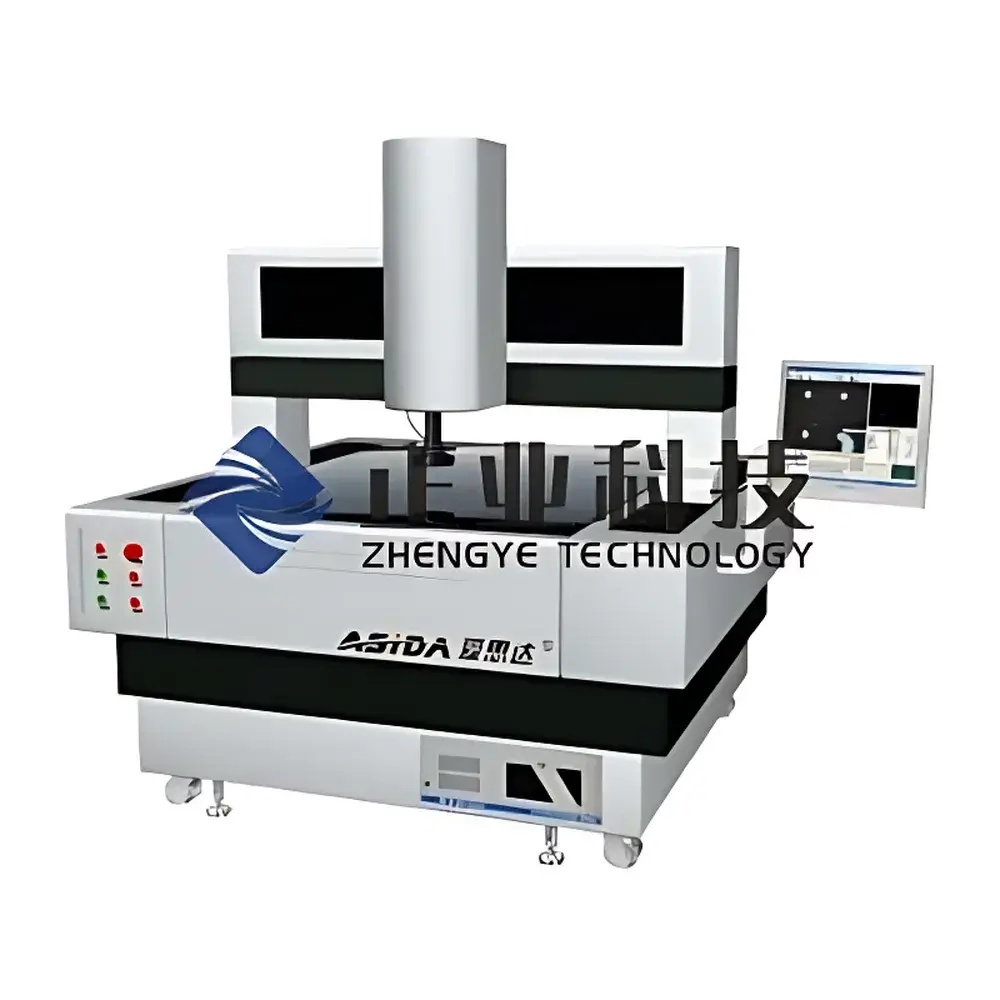
ASIDA Manual 2D Vision Measuring System
| Brand | ASIDA |
|---|---|
| Model | Manual Vision Measuring Machine (2010/3020/4030/5040 Series) |
| Measurement Principle | Optical Coordinate Metrology with CCD Imaging |
| Base Material | Natural Granite |
| Motion System | Precision Linear Rolling Guides + Friction-Driven Stage |
| Illumination | Adjustable Ring LED Cold Light Source |
| Optics | Manual Zoom Objective (0.7×–4.5× or 0.7×–5.0×) + Interchangeable Eyepieces (0.5×, 1×, 2×) |
| Encoder Resolution | 1 µm |
| XY Axis Accuracy | (3 + L/200) µm (L in mm) |
| Repeatability | ≤ ±3 µm |
| Z-Axis Travel | 150–200 mm |
| XY Travel Range | 200×100 mm to 500×400 mm |
| Stage Load Capacity | 25 kg |
| Working Distance | 90 mm |
| Software | ASIDA VMM3.0D (Multilingual: English, Simplified Chinese, Traditional Chinese) |
| Compliance | Designed for ISO 10360-7 and GB/T 16857.7 alignment with geometric dimensioning and tolerancing (GD&T) workflows |
Overview
The ASIDA Manual 2D Vision Measuring System is a precision optical coordinate measuring instrument engineered for high-accuracy two-dimensional metrology of mechanical parts, stamped components, PCBs, molds, and precision machined features. Operating on the principle of optical coordinate metrology, the system captures high-fidelity digital images via a stabilized CCD camera mounted on a manually controlled XYZ stage. Measurements are derived from pixel-to-real-world calibration using certified reference artifacts and linear encoders with 1 µm resolution. Unlike automated systems, this manual platform emphasizes operator control, tactile feedback, and adaptability for low-volume inspection, R&D prototyping, and first-article verification—where flexibility and intuitive operation outweigh throughput demands. Its granite base and column provide thermal stability and vibration damping essential for sub-10 µm measurement integrity under ambient lab conditions.
Key Features
- Natural granite structural frame ensures long-term dimensional stability, high rigidity, and minimal thermal drift—critical for maintaining XY linearity accuracy of (3 + L/200) µm across extended operational periods.
- Precision rolling linear guides on X- and Y-axes deliver smooth, backlash-free motion while preserving positional fidelity; Z-axis employs a robust lead-screw mechanism optimized for vertical repeatability ≤ ±3 µm.
- Friction-driven stage with non-threaded optical shafts eliminates mechanical play and wear-induced hysteresis, supporting consistent manual positioning over thousands of measurement cycles.
- Adjustable ring-type LED cold illumination provides uniform, shadow-free surface lighting without thermal load—preventing heat-induced expansion in temperature-sensitive samples such as thin plastics or thin-film substrates.
- High-transmission manual zoom objective (0.7×–4.5× standard; 0.7×–5.0× optional) enables rapid magnification adjustment without refocusing; interchangeable eyepieces (0.5×, 1×, 2×) extend effective field-of-view and depth-of-field options.
- Japanese Panasonic servo motors drive all three axes with precise torque control, ensuring repeatable manual jog inputs and stable holding during fine adjustments.
Sample Compatibility & Compliance
This vision system accommodates flat, rigid, and semi-rigid specimens up to 25 kg and within defined travel envelopes (e.g., 500 × 400 × 200 mm for the 5040 model). It supports direct imaging of metallic, ceramic, polymer, and composite surfaces—provided adequate edge contrast exists for sub-pixel centroid detection. Optional tactile probe integration allows limited 3D point acquisition (e.g., hole depth, step height), though full 3D profiling requires dedicated profilometry hardware. The system is designed to support compliance with ISO 10360-7 (acceptance and reverification testing of CMMs), ISO 1101 (geometrical tolerancing), and GB/T 16857.7 (Chinese national standard for coordinate measuring machines). While not FDA 21 CFR Part 11–certified out-of-the-box, audit trails and user-access logs in ASIDA VMM3.0D can be configured per GLP/GMP documentation requirements when deployed in regulated manufacturing environments.
Software & Data Management
ASIDA VMM3.0D is a Windows-based metrology software suite supporting English, Simplified Chinese, and Traditional Chinese interfaces. It provides standardized GD&T evaluation (position, concentricity, parallelism, perpendicularity), auto-edge detection with adjustable sensitivity thresholds, and batch reporting in CSV, PDF, and DXF formats. All measurement sessions include timestamped operator ID logging, parameter configuration snapshots, and raw image archiving—enabling traceability for internal quality audits. Exported reports embed measurement uncertainty estimates based on calibrated encoder error models and optical distortion correction matrices. The software supports import of CAD overlays (DXF/DWG) for nominal-actual deviation mapping and includes scripting capability (via embedded VBScript engine) for custom report templates and repetitive task automation.
Applications
- Dimensional verification of injection-molded plastic housings, including wall thickness, gate location, and draft angle assessment.
- PCB component placement validation: pad center distance, solder mask opening conformity, fiducial alignment, and BGA ball array geometry.
- Mechanical part inspection: slot width and position tolerance, circularity of bearing bores, angularity of milled faces, and contour deviation of stamped brackets.
- Tooling and die inspection: electrode profile matching, cavity symmetry analysis, and EDM finish evaluation via edge sharpness quantification.
- Educational and research use: metrology training platforms where students learn fundamental concepts of coordinate measurement, uncertainty propagation, and GD&T interpretation.
FAQ
Is this system compliant with ISO 10360-7 for CMM verification?
Yes—the mechanical design, granite base stability, encoder resolution, and documented accuracy formula (3 + L/200 µm) align with the performance criteria outlined in ISO 10360-7 for 2D optical measuring systems used in acceptance testing.
Can the software generate ISO-compliant GD&T reports?
Yes—VMM3.0D computes and reports GD&T characteristics per ISO 1101, including tolerance zone evaluation, datum establishment, and result visualization overlaid on measured contours.
What is the maximum sample thickness supported at full Z-travel?
The Z-axis stroke ranges from 150 mm (2010/3020 models) to 200 mm (4030/5040 models); combined with a 90 mm objective working distance, total usable vertical clearance is approximately 290 mm for low-profile fixtures.
Does the system support calibration with NIST-traceable artifacts?
Yes—calibration routines accept certified step gauges, ball bars, and grid plates with documented uncertainties; VMM3.0D stores calibration certificates and applies correction maps automatically.
Is remote support or firmware update capability available?
Yes—ASIDA provides secure remote desktop assistance and signed firmware/software patches via encrypted download portal, with version-controlled release notes and change logs.