
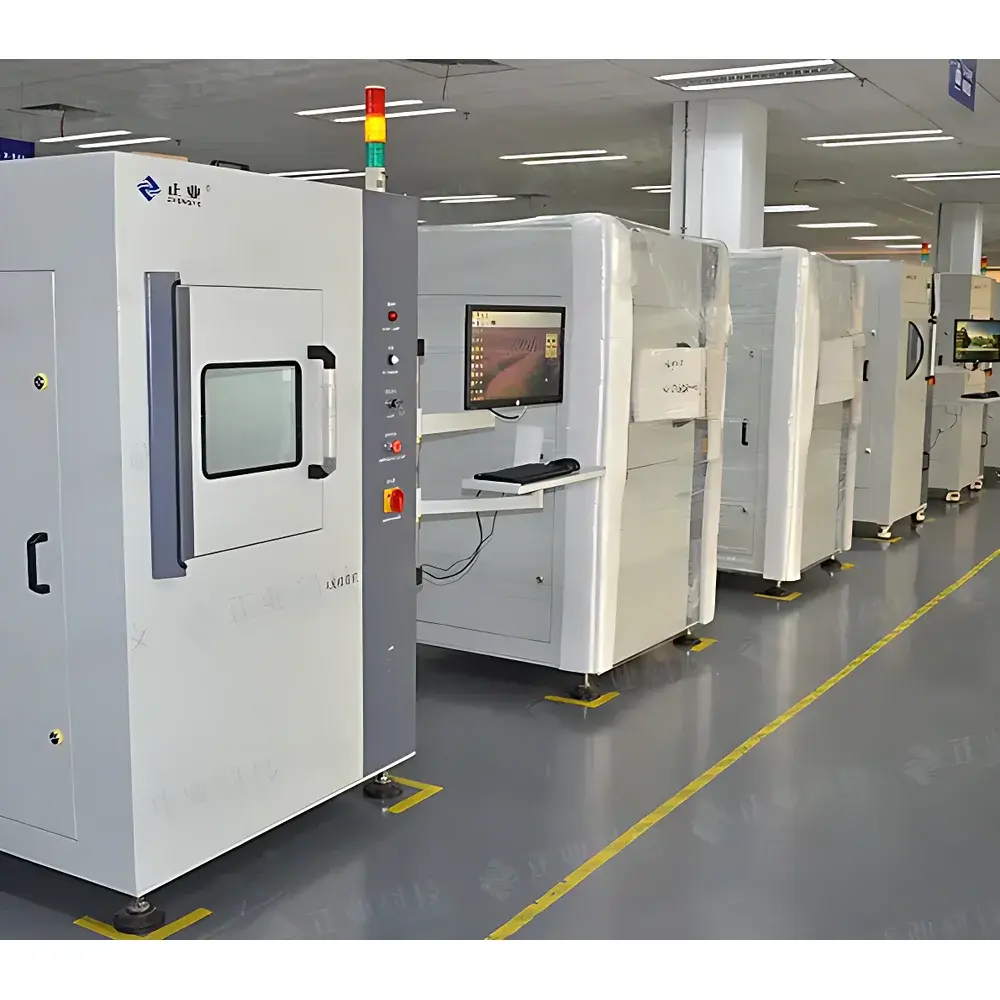
ASIDA X-ray Non-destructive Inspection System for Lithium-ion Battery Cells
| Brand | ASIDA |
|---|---|
| Model | ASIDA-XNDI-BAT |
| Origin | Guangdong, China |
| Type | Benchtop X-ray Transmission Imaging System for In-line Cell QA/QC |
| Detection Principle | X-ray Radiography (2.5D Digital Radiography) |
| Motion Architecture | Motorized XYZ Manipulation of X-ray Source and Image Intensifier |
| Software | Proprietary Automated Defect Recognition (ADR) Suite with CNC Path Memory & Real-time Image Processing |
| Compliance | Designed to Support ISO 9001 Quality Audits, ASTM E2737-21 (Standard Practice for Digital Radiographic Testing), and GLP/GMP-aligned QA workflows |
Overview
The ASIDA X-ray Non-destructive Inspection System for Lithium-ion Battery Cells is an industrial-grade digital radiography platform engineered specifically for in-process quality assurance and failure analysis in lithium battery manufacturing. Based on the fundamental principle of X-ray transmission imaging—where differential attenuation of X-ray photons through materials of varying density and atomic number generates high-contrast projection images—the system enables non-invasive, real-time visualization of internal structural features within prismatic, pouch, and cylindrical cells. It delivers sub-millimeter spatial resolution suitable for detecting critical defects including electrode misalignment, tab weld voids, separator wrinkles, foreign metallic particles, anode/cathode delamination, and jelly-roll deformation. Unlike conventional film-based or low-resolution radiographic setups, this system integrates a motorized source-detector geometry with synchronized motion control and calibrated image acquisition, supporting both static inspection and programmed scan sequences for consistent repeatability across production lots.
Key Features
- 2.5D Geometric Metrology Engine: Supports precise measurement of linear distances, circle diameters, concentricity between multiple circular features (e.g., electrode cutouts and casing apertures), and radial offsets from user-defined centroids—enabling quantitative dimensional verification beyond binary pass/fail classification.
- CNC Path Programming & Recall: Users can record, store, and replay multi-point inspection trajectories via intuitive graphical interface; ideal for small-batch or mixed-product lines where rapid reconfiguration without manual repositioning is required.
- Intuitive Navigation Interface: A large-scale real-time navigation window displays the full-field-of-view radiograph; clicking any region triggers automatic, closed-loop motion control to center the X-ray focal spot precisely over the selected coordinate—reducing operator dependency and minimizing setup time.
- Real-time Image Enhancement Pipeline: On-the-fly contrast stretching, noise suppression (non-local means filtering), edge sharpening, and dynamic range optimization ensure optimal feature visibility under variable exposure conditions; processed frames are saved in DICOM, TIFF, and PNG formats with embedded metadata (timestamp, position, kV/mA settings).
- Stable Mechanical Architecture: Fixed sample stage eliminates vibration-induced blur; X-ray tube and image intensifier move independently along three orthogonal axes (X/Y/Z) via precision-ground ball screws and synchronous belt-driven stepper motors—ensuring smooth, repeatable positioning with ≤ ±5 µm positional accuracy per axis.
Sample Compatibility & Compliance
The system accommodates standard lithium-ion cell formats up to 600 mm × 400 mm × 120 mm (L×W×H), with optional custom fixtures available for specialized geometries. It operates within regulated safety parameters compliant with IEC 61331-1:2014 (Protective devices against diagnostic medical X-ray equipment) and meets electromagnetic compatibility requirements per EN 61326-1:2013. While not certified as a medical device, its radiographic output adheres to ALARA (As Low As Reasonably Achievable) exposure principles and supports traceable calibration protocols aligned with ISO/IEC 17025 laboratory accreditation frameworks. Documentation packages include IQ/OQ templates for GMP-regulated environments and audit-ready logs for FDA 21 CFR Part 11–compatible electronic records when integrated with validated network storage solutions.
Software & Data Management
The proprietary ASIDA ADR (Automated Defect Recognition) software provides a unified interface for acquisition, analysis, reporting, and data archival. Measurement results, pass/fail flags, and annotated radiographs are timestamped and stored in structured SQLite databases with configurable export options (CSV, XML, PDF reports). The system supports role-based access control (RBAC), audit trail logging of all user actions (including parameter changes and result overrides), and integration with MES/SCADA platforms via OPC UA or RESTful API endpoints. All image processing algorithms are deterministic and version-controlled, enabling full reproducibility during root cause investigations or regulatory submissions.
Applications
- Pre-formation cell screening for internal short-circuit precursors
- Post-welding inspection of tab-to-current-collector joints
- Separator integrity assessment after calendering and slitting
- Foreign particle detection in dry-room assembled modules
- Failure analysis of field-return cells (e.g., swelling, dendrite formation)
- Process validation for new electrode coating or stacking configurations
FAQ
What radiation safety measures are implemented in this system?
The unit incorporates interlocked lead shielding (≥2.5 mm Pb equivalent), beam collimation to minimize scatter, and real-time dose monitoring with automatic shutdown if threshold limits are exceeded.
Can the system be integrated into an automated production line?
Yes—it supports hardware-triggered acquisition via TTL/RS-485 signals and offers PLC-compatible I/O ports for seamless synchronization with conveyor systems and robotic handlers.
Is remote diagnostics or software update capability available?
Firmware and application updates are delivered via secure HTTPS channels; remote desktop-assisted troubleshooting is supported under signed service agreements with encrypted session protocols.
Does the software support multi-language UI and report generation?
English and Simplified Chinese interfaces are included by default; report templates are fully customizable and support localized units, terminology, and regulatory disclaimers.
What is the typical throughput for inline inspection?
Average cycle time per cell ranges from 8–25 seconds depending on resolution mode, part size, and measurement complexity—scalable to >1,200 units/hour with dual-station configurations and parallel processing pipelines.






