
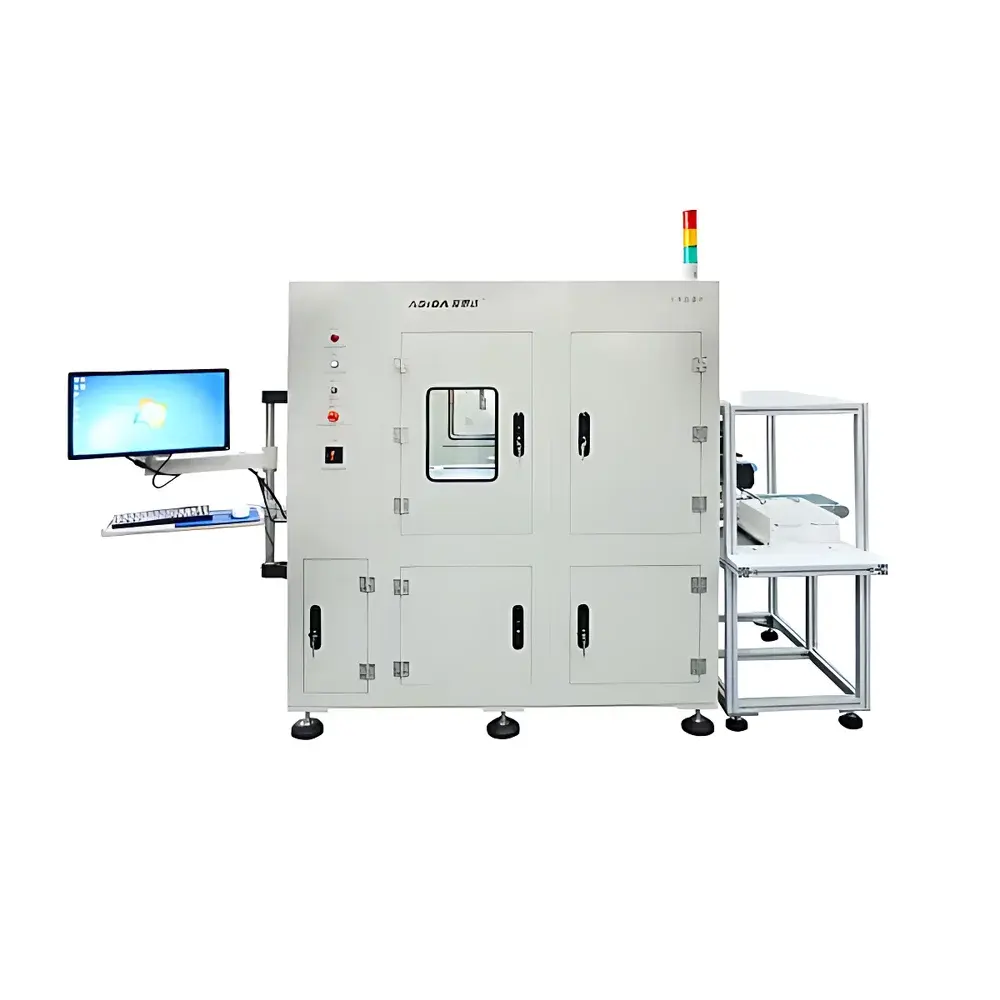
Asida XG5130A Online Fully Automated X-ray Inspection System for Prismatic Pouch Lithium-ion Cells
| Brand | Asida |
|---|---|
| Model | XG5130A |
| Origin | Guangdong, China |
| Type | Online, Fully Automated X-ray Inspection System |
| Application | In-line Quality Control of Prismatic Pouch Lithium-ion Battery Cells |
| X-ray Source | Microfocus Tube (90 kV, 89 µA, 5 µm focal spot) |
| Imaging System | Dual-FOV Image Intensifier (2″/4″), 75–110 lp/cm resolution, X-CCD sensor (752 × 480 px) |
| Throughput | ≥30 ppm (≥30,000 units/day) |
| Measurement Repeatability | ±60 µm |
| False Positive Rate | ≤2% |
| Miss Detection Rate | 0.0% |
| Overall Yield Accuracy | ≥99.5% |
| Radiation Leakage | ≤1 µSv/hr (compliant with IEC 61000-6-4 and IEC 62471) |
Overview
The Asida XG5130A Online Fully Automated X-ray Inspection System is an industrial-grade, in-line non-destructive testing (NDT) platform engineered specifically for high-throughput quality assurance of prismatic pouch lithium-ion battery cells. Leveraging microfocus X-ray generation and real-time digital radiography, the system performs internal structural verification—including electrode alignment, tab positioning, foil wrinkling, foreign object detection, and separator integrity—without physical contact or cell disassembly. Its architecture integrates seamlessly into battery manufacturing lines via conveyor-coupled input/output interfaces, enabling 100% automated inspection at production speeds exceeding 30 parts per minute. The system operates on the principle of differential X-ray attenuation: variations in material density and thickness within the pouch cell modulate the transmitted beam intensity, which is captured by a high-sensitivity image intensifier and digitized for quantitative geometric analysis.
Key Features
- Fully automated in-line operation with dual robotic loading arms operating in alternating sequence to eliminate idle time and sustain continuous throughput.
- Integrated microfocus X-ray source (90 kV, 89 µA, 5 µm focal spot) with air-cooled thermal management—no consumables or scheduled tube replacement required during normal operation.
- Dual-field-of-view image intensifier (2″ and 4″ modes) supporting both high-resolution defect localization and wide-area coverage; optical resolution up to 110 line pairs per centimeter.
- Real-time image acquisition at full frame rate with lossless storage of raw DICOM-compliant radiographs for traceability and offline review.
- Programmable motion control via industrial motion controller board, supporting customizable inspection paths, dwell times, and multi-angle acquisition sequences.
- Triple-layer safety architecture: interlocked access doors, photoelectric curtain monitoring, and real-time radiation leakage monitoring with audible/visual (tricolor tower light) fault indication.
Sample Compatibility & Compliance
The XG5130A accommodates standard prismatic pouch cells ranging from 80 mm × 120 mm to 180 mm × 220 mm in footprint, with thickness up to 25 mm. It supports variable electrode stack configurations (e.g., stacked vs. folded) and common cathode/anode chemistries (LCO, NMC, LFP). All mechanical, electrical, and radiation safety designs conform to IEC 61000-6-4 (EMC immunity), IEC 62471 (photobiological safety), and national regulatory limits for occupational radiation exposure (≤1 µSv/hr at any external surface point). The system meets factory acceptance test (FAT) requirements for ISO 9001-certified battery production environments and supports audit readiness for IATF 16949 and UL 1642-aligned quality systems.
Software & Data Management
The proprietary inspection software provides calibrated pixel-to-metric conversion, enabling sub-60 µm geometric measurement repeatability. Core functions include automated electrode alignment quantification (anode/cathode edge offset, centroid deviation), statistical process control (SPC) charting of alignment metrics (min/max/mean/std dev), and binary pass/fail classification based on user-defined tolerance bands. Each inspected unit is linked to its unique serial code via integrated barcode/2D scanner; all results—including raw images, measurement logs, and classification decisions—are timestamped and stored in SQLite-backed local database with optional OPC UA or MQTT export for MES integration. Audit trail functionality complies with GLP/GMP data integrity principles, including electronic signature support and immutable record retention.
Applications
This system is deployed in Tier-1 battery cell manufacturing facilities for post-lamination, pre-forming, and final assembly verification. Typical use cases include: validation of anode/cathode foil alignment tolerance (±0.3 mm specification); detection of metallic contaminants (>80 µm Fe/Cu particles); identification of delamination or folding defects in separator layers; assessment of jelly-roll concentricity and tab weld integrity; and verification of electrolyte filling uniformity via density gradient mapping. It also supports R&D applications such as comparative analysis of electrode coating homogeneity across pilot batches and failure mode root cause analysis in 8D reports.
FAQ
What is the maximum throughput achievable under continuous operation?
The system sustains ≥30 ppm (1,800 units/hour) with stable thermal equilibrium and validated image quality across 8-hour shifts.
Does the system support changeover between different pouch cell formats?
Yes—mechanical fixture reconfiguration and imaging parameter presets enable format switching within 30–120 minutes, verified via built-in calibration phantom checks.
Is radiation shielding certification documentation provided?
Yes—each unit ships with third-party radiation survey report (per GBZ 126-2011 / IEC 62471), confirming compliance with ≤1 µSv/hr leakage limit at 5 cm from any surface.
Can inspection criteria be modified without software developer intervention?
Yes—operators can adjust measurement thresholds, region-of-interest (ROI) definitions, and pass/fail logic via password-protected engineering interface without source code access.
What data export formats are supported for SPC analysis?
CSV, XML, and OPC UA node mapping are natively supported; custom JSON schema export is available via API extension module.



