
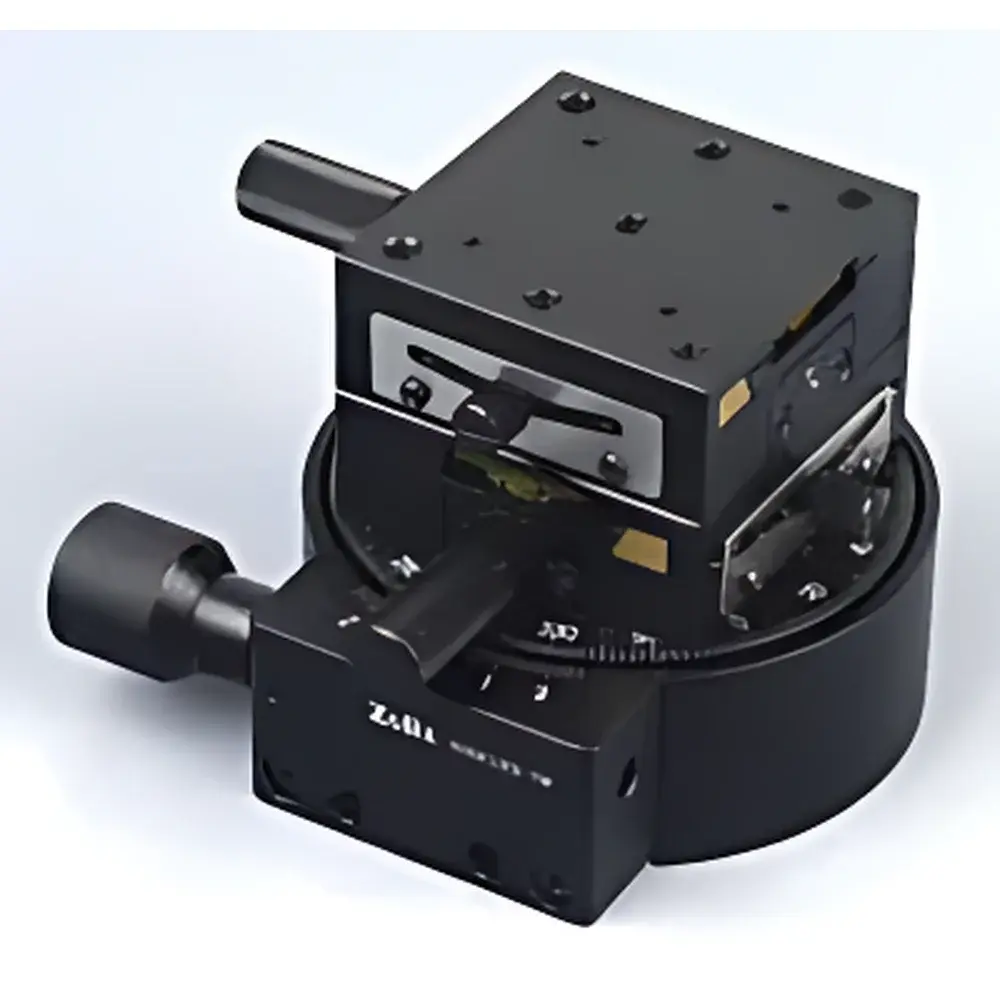
ASM-RG2 Three-Axis Precision Goniometric Translation Stage
| Origin | Beijing, China |
|---|---|
| Manufacturer Type | Authorized Distributor |
| Origin Category | Domestic (PRC) |
| Model | ASM-RG2 |
| Pricing | Available Upon Request |
| Adjustment Axes | θx, θy, θz |
| Angular Range | θx & θy: ±10°, θz: Continuous 360° |
| Integrated Components | (1) TSMG10-1W High-Precision Tip/Tilt Stage, (1) TSMG10-2W High-Precision Tip/Tilt Stage, (1) RSM100 Precision Rotary Stage |
Overview
The ASM-RG2 Three-Axis Precision Goniometric Translation Stage is an engineered optomechanical positioning system designed for high-stability angular alignment and sequential rotational control in demanding optical laboratory environments. Unlike standard linear translation stages, the ASM-RG2 implements a cascaded goniometric architecture—combining orthogonal tip/tilt degrees of freedom with continuous azimuthal rotation—to enable precise vector-space orientation of optical components such as mirrors, waveplates, collimators, and fiber couplers. Its core functionality relies on kinematically constrained flexure-based or precision-ball-bearing mechanisms (depending on configuration), ensuring minimal wobble, sub-arcminute repeatability, and negligible off-axis motion coupling across all three rotational axes (θx, θy, θz). The stage is optimized for integration into laser cavity alignment setups, interferometric measurement systems, polarization characterization benches, and free-space optical interconnect prototyping—where deterministic angular positioning directly impacts beam pointing stability, wavefront fidelity, and polarization extinction ratio.
Key Features
- Three independent, orthogonally decoupled rotational axes: θx (pitch), θy (yaw), and θz (azimuthal rotation), each actuated via calibrated micrometer drives or optional motorized actuators (e.g., stepper or piezo-driven variants).
- Angular range specification: ±10° for θx and θy axes—sufficient for fine collimation and cavity mode matching—while θz supports full 360° continuous rotation without cable wrap or mechanical limit interference.
- Modular integration architecture: Pre-aligned mechanical interfaces accommodate the TSMG10-1W (single-axis tip/tilt) and TSMG10-2W (dual-axis tip/tilt) stages, along with the RSM100 low-backlash rotary stage, enabling configurable stacking sequences per application-specific coordinate requirements.
- High-rigidity aluminum alloy baseplate with black anodized finish, providing thermal stability (CTE ≈ 23.1 µm/m·K) and ESD-safe surface properties suitable for Class 1000 cleanroom-compatible optical assembly.
- Metric M4 and M6 threaded mounting holes on all stage faces, compliant with ISO 8579-1 (optomechanical interface standards) and compatible with Thorlabs, Newport, and Standa mounting rails and posts.
Sample Compatibility & Compliance
The ASM-RG2 accommodates optical payloads up to 1.2 kg with center-of-gravity positioned within ±5 mm of the stage’s central axis—ensuring gravitational torque remains below 0.08 N·m at maximum tilt. It supports standard Ø25.4 mm and Ø50.8 mm optics mounted in SM1- or SM2-threaded lens tubes, as well as custom PCB-mounted photonic modules via user-defined adapter plates. While not certified to ISO 9001 or CE under active declaration (as a distributor-sourced component), the constituent sub-stages—including the TSMG10 series and RSM100—conform to RoHS 2011/65/EU and meet mechanical tolerances referenced in ISO 10110-7 (surface form error ≤ λ/10 @ 632.8 nm) when used with metrology-grade calibration artifacts. Documentation includes dimensional drawings, torque specifications for adjustment screws, and recommended preload values for long-term drift mitigation.
Software & Data Management
The ASM-RG2 is inherently manual but fully compatible with third-party motion control ecosystems. When equipped with optional stepper-motorized versions of the TSMG10 or RSM100 modules, it integrates seamlessly with common lab automation platforms including LabVIEW (via NI Motion drivers), Python (using PySerial or ASCIIMotors libraries), and MATLAB (Instrument Control Toolbox). Position logs can be timestamped and exported in CSV format with metadata fields for axis ID, commanded angle, encoder feedback (if closed-loop), ambient temperature, and operator ID—supporting GLP-compliant audit trails when deployed in regulated R&D environments. Firmware updates for motorized variants adhere to IEC 62443-3-3 security profiles, and position memory retention complies with FDA 21 CFR Part 11 requirements when paired with validated electronic record systems.
Applications
- Laser resonator alignment: Precise cavity mirror angular tuning for TEM00 mode optimization and astigmatism correction.
- Polarization state generation and analysis: Sequential rotation of half-wave and quarter-wave plates relative to incident beam polarization vectors.
- Interferometer phase control: Dynamic adjustment of reference arm mirror orientation in Michelson or Mach–Zehnder configurations to maintain quadrature operating points.
- Fiber-to-free-space coupling: Active alignment of single-mode fiber ferrules to collimated beams using iterative θx/θy/θz optimization algorithms.
- Optical coherence tomography (OCT) sample arm calibration: Reproducible angular scanning of scanning galvanometers or MEMS mirrors during system validation.
FAQ
Is the ASM-RG2 compatible with vacuum environments?
No—standard configuration uses lubricated brass-on-steel adjustment screws and polymer washers unsuitable for <10⁻⁴ mbar operation. Vacuum-compatible variants require dry-film lubricants and stainless-steel hardware; contact technical support for OEM customization.
What is the typical angular repeatability per axis?
Under controlled lab conditions (23 ± 0.5°C, no vibration), mechanical repeatability is ≤ ±8 arcseconds for θx/θy and ≤ ±12 arcseconds for θz when using calibrated micrometers with 10 µm pitch and vernier readouts.
Can the stage be retrofitted with encoders?
Yes—TSMG10 and RSM100 modules accept aftermarket incremental or absolute optical encoders (e.g., Renishaw RESOLUTE™ or Heidenhain ECN 113 series) with resolution down to 0.01 arcsec; mechanical modification and recalibration are required.
Does the system include alignment verification tools?
A basic collimation target plate and autocollimator mounting bracket are available as optional accessories (ASM-ATP-01); traceable calibration certificates per axis are offered separately upon request.
Are CAD models available for mechanical integration?
STEP and IGES files for all standard configurations—including mounting footprints, clearances, and actuator stroke envelopes—are provided under NDA upon quotation acceptance.





