
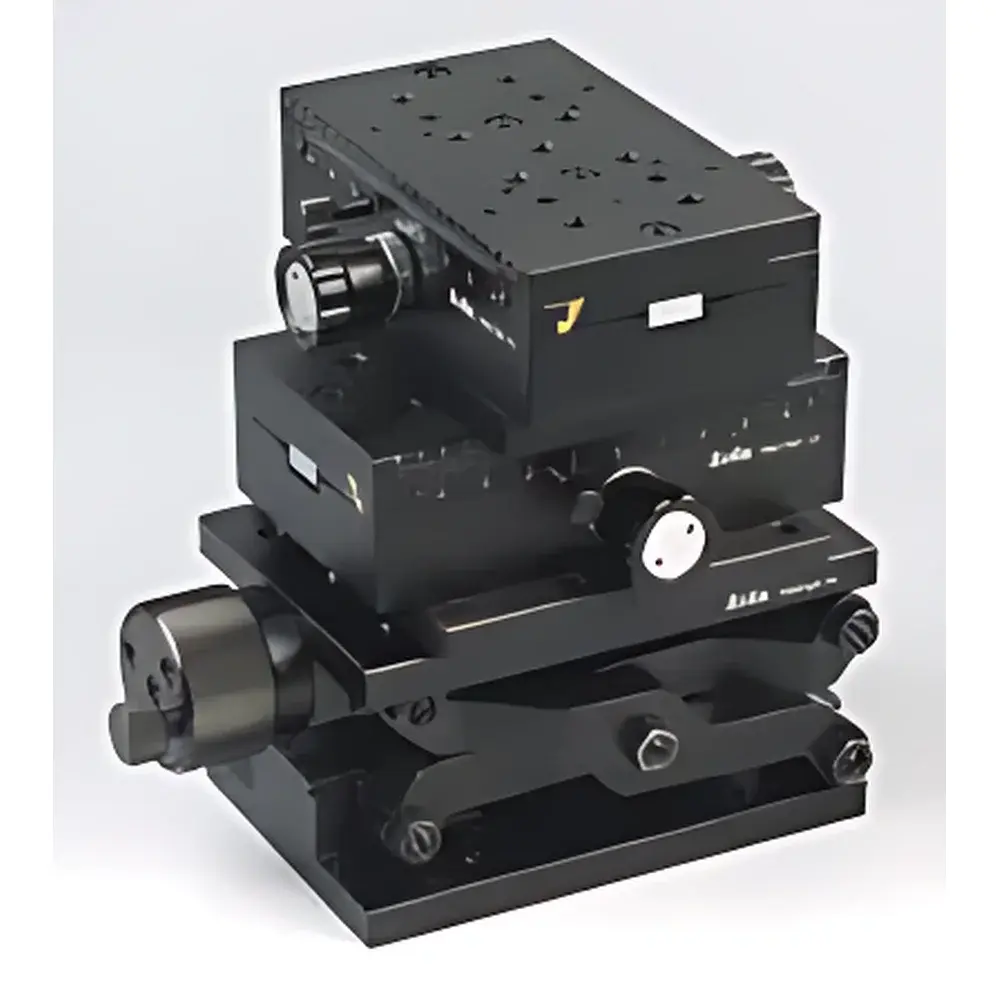
ASM75XY-V60 Three-Axis Stacked Translation Stage (ZOLIX)
| Brand | ZOLIX |
|---|---|
| Origin | Beijing, China |
| Manufacturer Type | Direct Manufacturer |
| Origin Category | Domestic (China) |
| Model | ASM75XY-V60 |
| Pricing | Available Upon Request |
| Motion Axes | X, Y, Z (orthogonal stacked configuration) |
| Travel Range | X: 75 mm, Y: 75 mm, Z: 60 mm |
| Core Subassemblies | Two TSM75D-1C Linear Translation Stages, One TSMV60-1S Vertical Lift Stage, Two BP-28 Adapter Plates |
| Load Capacity | Standard optical payload (≤5 kg, typical for manual precision stages) |
| Repeatability | ≤±2 µm (per axis, under controlled lab conditions) |
| Resolution | Manual micrometer drive with 10 µm graduation scale |
| Mounting Interface | Standard M6 threaded holes on top and base plates (ISO metric thread pattern) |
Overview
The ASM75XY-V60 Three-Axis Stacked Translation Stage is a manually operated, high-stability optomechanical positioning system engineered for precise spatial alignment in optical laboratories, interferometry setups, laser beam steering configurations, and photonics R&D environments. Designed and manufactured by ZOLIX (Beijing Zolix Instruments Co., Ltd.), this stage implements a modular stacked architecture—comprising two orthogonal TSM75D-1C horizontal translation stages and one TSMV60-1S vertical lift stage—interconnected via BP-28 precision-machined adapter plates. Its kinematic layout ensures orthogonal decoupling of motion axes, minimizing parasitic pitch/yaw during X/Y/Z adjustments. The stage operates on precision-ground stainless-steel dovetail guides with brass-on-steel sliding interfaces and calibrated micrometer drives, delivering deterministic, backlash-minimized displacement without reliance on motorized or electronic components. It conforms to standard ISO 9001 manufacturing protocols and is routinely deployed in applications requiring sub-10 µm positional control under static loading conditions up to 5 kg.
Key Features
- Orthogonal three-axis architecture (X–Y–Z) with independent manual actuation per axis
- 75 mm travel range in both X and Y directions; 60 mm vertical (Z-axis) lift capability
- Modular construction using ZOLIX’s TSM75D-1C linear stages (dovetail-guided, micrometer-driven) and TSMV60-1S vertical lift stage
- BP-28 aluminum adapter plates ensure rigid, repeatable stacking with ±5 µm parallelism tolerance between adjacent stage planes
- M6-threaded mounting patterns (standard ISO metric grid) on top platform and base plate for seamless integration with optical posts, lens mounts, and cage systems
- Manual micrometer drives with 10 µm scale resolution and locking thumbscrews for position retention
- No electrical power or controller required—ideal for EMI-sensitive, vacuum-compatible (with optional anodization), or ultra-low-noise experimental environments
Sample Compatibility & Compliance
The ASM75XY-V60 accommodates optical components including mirrors (up to Ø50 mm), kinematic mirror mounts, fiber collimators, photodetectors, and small laser diode packages. Its load distribution design supports center-of-gravity offsets ≤25 mm from the central Z-axis without significant tilt-induced error. While not certified to specific international standards such as ISO 10110 or ANSI Z80.1, the stage is fabricated using aerospace-grade 6061-T6 aluminum alloy (anodized black) and passivated stainless steel hardware compliant with RoHS Directive 2011/65/EU. Surface flatness of the top platform is maintained within 15 µm over 75 × 75 mm per ASME B46.1, and all moving surfaces undergo dry-film lubrication per MIL-PRF-81322G Class II specifications.
Software & Data Management
As a fully manual mechanical stage, the ASM75XY-V60 does not incorporate embedded electronics, sensors, or firmware. Consequently, it requires no driver installation, firmware updates, or software licensing. Positional data logging must be performed externally using calibrated dial indicators, capacitive displacement sensors, or laser interferometers interfaced via third-party DAQ systems. For GLP/GMP-aligned labs, users may document stage settings manually in lab notebooks or integrate readings into LIMS platforms using standardized CSV or Excel templates. No FDA 21 CFR Part 11 compliance is applicable due to absence of electronic records or digital signatures.
Applications
- Alignment of multi-element optical trains in Fourier-transform spectrometers and tunable laser cavities
- Coarse and fine positioning of sample holders in confocal microscopy and near-field scanning optical microscopy (NSOM)
- Adjustment of retroreflector arrays in Michelson and Mach–Zehnder interferometers
- Integration into custom-built vacuum chambers (with optional vacuum-rated grease and non-outgassing materials)
- Education and training platforms for undergraduate optics laboratories emphasizing mechanical metrology fundamentals
- Stabilized mounting of photonic integrated circuit (PIC) test fixtures during probe station characterization
FAQ
Is the ASM75XY-V60 compatible with motorized controllers or stepper motor retrofits?
No—this model is strictly manual. ZOLIX offers motorized variants (e.g., ASM75XY-V60-M) with integrated stepper motors and RS-485/USB interfaces, but they are structurally distinct and not field-upgradable.
What is the maximum allowable moment load on the Z-axis stage?
When loaded at maximum Z-travel (60 mm extension), the TSMV60-1S stage maintains angular stability within ±0.02° under a 2 kg eccentric load located 20 mm off-center; full specification sheets define moment limits per ISO 10100 Annex C.
Can the BP-28 adapter plates be replaced with custom-machined alternatives?
Yes—BP-28 follows ZOLIX’s open mechanical interface standard (drawing ZL-BP28-REV3). CAD models and GD&T tolerances are available under NDA for OEM integration projects.
Does ZOLIX provide calibration certificates for individual units?
Traceable calibration reports (per ISO/IEC 17025) are available as a paid option, covering travel linearity, orthogonality, and repeatability measurements using Renishaw XL-80 laser interferometry.
Is thermal drift compensated in this stage design?
No active compensation is implemented. Users operating across >±5 °C ambient variations should apply empirical thermal expansion corrections (α ≈ 23.6 × 10⁻⁶ /°C for 6061-Al) to positional targets.




