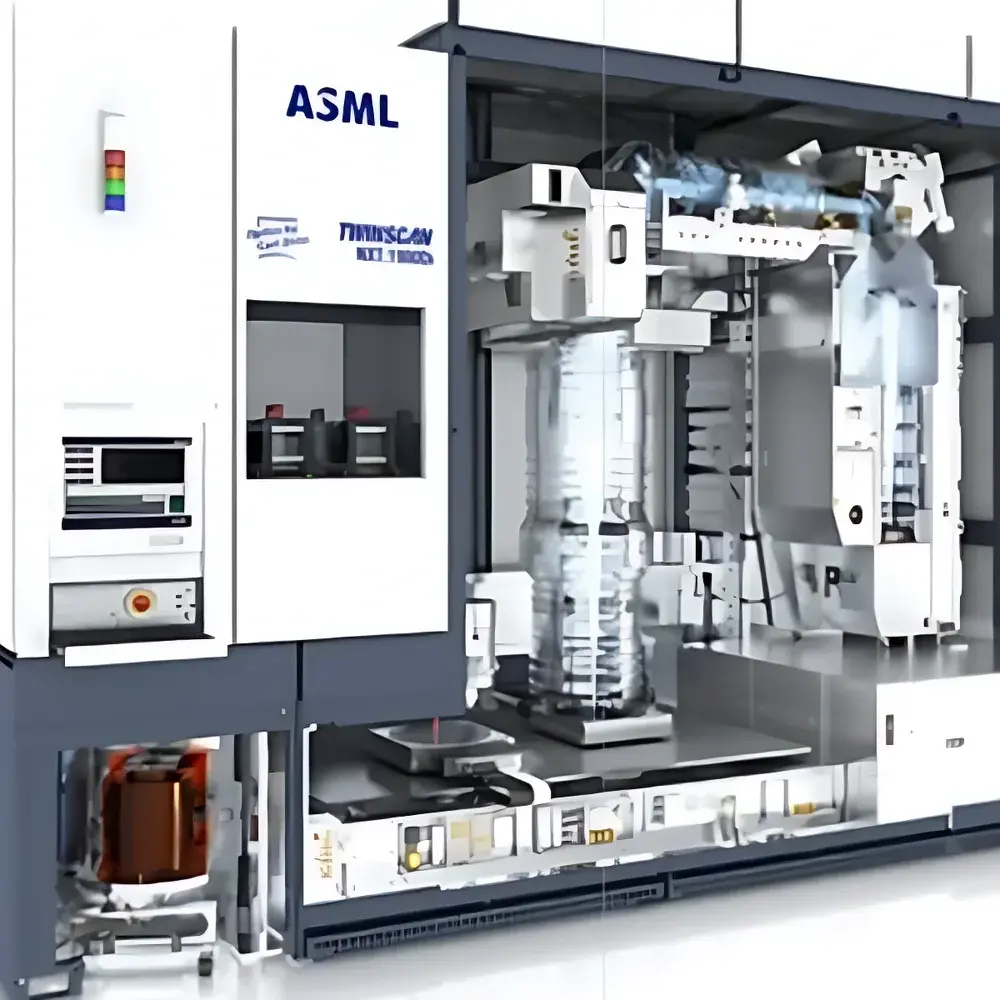
ASML TWINSCAN NXT:1980Di Immersion Lithography Scanner (Refurbished)
| Brand | ASML |
|---|---|
| Origin | Netherlands |
| Model | TWINSCAN NXT:1980Di |
| Numerical Aperture (NA) | 1.35 |
| Minimum Achievable Resolution | ≤38 nm |
| Throughput | 275 wafers/hour (300 mm) |
| Process Node Support | 14 nm to 45 nm (with multi-patterning extending capability to ~7 nm) |
| Age | 3 years operational use |
| Condition | Fully refurbished and factory-recertified |
Overview
The ASML TWINSCAN NXT:1980Di is a high-precision immersion lithography scanner engineered for advanced semiconductor manufacturing at the 14 nm technology node and above. Based on ArF excimer laser light (193 nm wavelength) coupled with water-immersion optics, this system leverages a numerical aperture of 1.35 NA to achieve a theoretical resolution limit of ≤38 nm—enabling patterning fidelity required for logic, memory, and foundry applications. Unlike dry lithography tools, the NXT:1980Di utilizes a dynamic liquid interface between the final lens element and the photoresist-coated wafer, increasing effective resolution through refractive index enhancement. Its modular architecture supports seamless integration into existing cleanroom environments compliant with SEMI S2/S8 safety standards and ISO Class 1–3 particle control requirements. As a refurbished unit, each system undergoes ASML-certified remanufacturing—including optical alignment verification, stage calibration, reticle handling subsystem validation, and full tool qualification per ASML’s Field Service Protocol (FSP) Rev. 4.2.
Key Features
- Immersion-based ArF lithography platform optimized for 300 mm wafer processing
- High-NA (1.35) projection optics with thermally stabilized lens housing and real-time aberration correction
- Advanced wafer and reticle stages featuring sub-nanometer positioning repeatability and active vibration damping
- Integrated illumination system with programmable off-axis illumination (OAI) modes including dipole, quadrupole, and C-quad for enhanced process window control
- Real-time focus and dose control via integrated aerial image sensor (AIS) and dose metrology system (DMS)
- Full compatibility with ASML’s TWINSCAN platform software stack, including LithoCym™ for overlay modeling and YieldStar™-linked process monitoring interfaces
Sample Compatibility & Compliance
The NXT:1980Di processes standard 300 mm silicon wafers with front-side alignment marks and accommodates standard 6-inch reticles (152 × 152 mm) with pellicle support. It operates under strict environmental controls: temperature stability ±0.1 °C, humidity 45 ±5% RH, and vibration isolation meeting VC-E criteria. The system complies with EU Machinery Directive 2006/42/EC, IEC 60204-1 for electrical safety, and SEMI E10-0719 for equipment reliability metrics. All refurbished units include documented traceability of critical components (lens modules, stage encoders, illumination optics), full FAT/SAT reports, and GLP-aligned maintenance logs covering the prior 36 months of operation.
Software & Data Management
Controlled by ASML’s proprietary TWINSCAN Control System (TCS) v5.8+, the NXT:1980Di provides audit-trail-enabled operation in accordance with FDA 21 CFR Part 11 requirements when deployed in regulated environments. Software features include recipe management with version-controlled parameter sets, automated calibration sequencing, and secure remote diagnostics via ASML Remote Service Portal (RSP). Data export supports SECS/GEM protocol for factory automation integration and outputs metrology-ready files in GDSII, OASIS, and ASCII log formats. Optional upgrade paths include integration with ASML’s HMI (High-Mix Integration) suite for multi-product lot scheduling and predictive maintenance analytics using historical tool sensor data.
Applications
This system is routinely deployed in R&D pilot lines and volume manufacturing facilities for patterning critical layers in DRAM, NAND flash, and logic ICs—including gate, contact, and metal interconnect levels. Its proven performance in double- and quadruple-patterning schemes makes it suitable for extending design rules down to the 7 nm node without EUV infrastructure. Academic and national lab users leverage its high-resolution capability for maskless lithography research, nanoimprint template fabrication, and advanced packaging applications such as fan-out wafer-level packaging (FO-WLP) redistribution layer (RDL) definition. The platform also serves as a reference standard in metrology labs performing CD-SEM correlation studies and OPC model validation.
FAQ
Is this unit fully refurbished and certified by ASML or an ASML-authorized service provider?
Yes—each unit undergoes ASML Field Service Center recertification, including optical wavefront measurement, stage encoder recalibration, and full lithographic performance validation against PDM-004 specification.
What documentation is provided with the system?
Buyers receive complete technical documentation: FAT/SAT reports, component traceability records, calibration certificates, software license transfer confirmation, and 12-month limited warranty covering mechanical and optical subsystems.
Can the system be upgraded to support newer illumination modes or overlay enhancements?
Hardware-compatible upgrades—including new illumination pupil filters and enhanced metrology modules—are available subject to ASML’s End-of-Life (EOL) policy and component availability.
Does the system include reticle handling automation and contamination control systems?
Yes—it retains full ASML-standard reticle transport (RTM), vacuum chucking, and Class 1 reticle storage cabinet with HEPA/ULPA filtration and moisture control.
What are the facility requirements for installation?
Required infrastructure includes 400 VAC ±10%, 3-phase power with dedicated grounding; chilled water supply (12–15 °C, 12 L/min); compressed dry nitrogen (≥99.999% purity); and cleanroom classification ISO 3 (Class 1) at tool interface.