ASP YKF Series Platinum Resistance Thermometers
| Brand | ASP / Advanced Sensing Products |
|---|---|
| Origin | USA |
| Manufacturer Type | Authorized Distributor |
| Product Category | Imported Instrumentation |
| Model | YKF Series |
| Instrument Class | Temperature Verification and Calibration System |
| Temperature Range | –260 °C to +850 °C |
| Nominal Resistance at 0.01 °C | 25.5 Ω or 100 Ω (per model) |
| TCR (Temperature Coefficient of Resistance) | 0.003850 Ω/Ω/°C or 0.003925 Ω/Ω/°C |
| Long-Term Stability | <0.0025 °C/year @ 0 °C |
| High-Temperature Drift (500 h) | <0.006 °C @ 500 °C |
| Repeatability | <0.0005 °C (–260 °C to 260 °C, 20 cycles) |
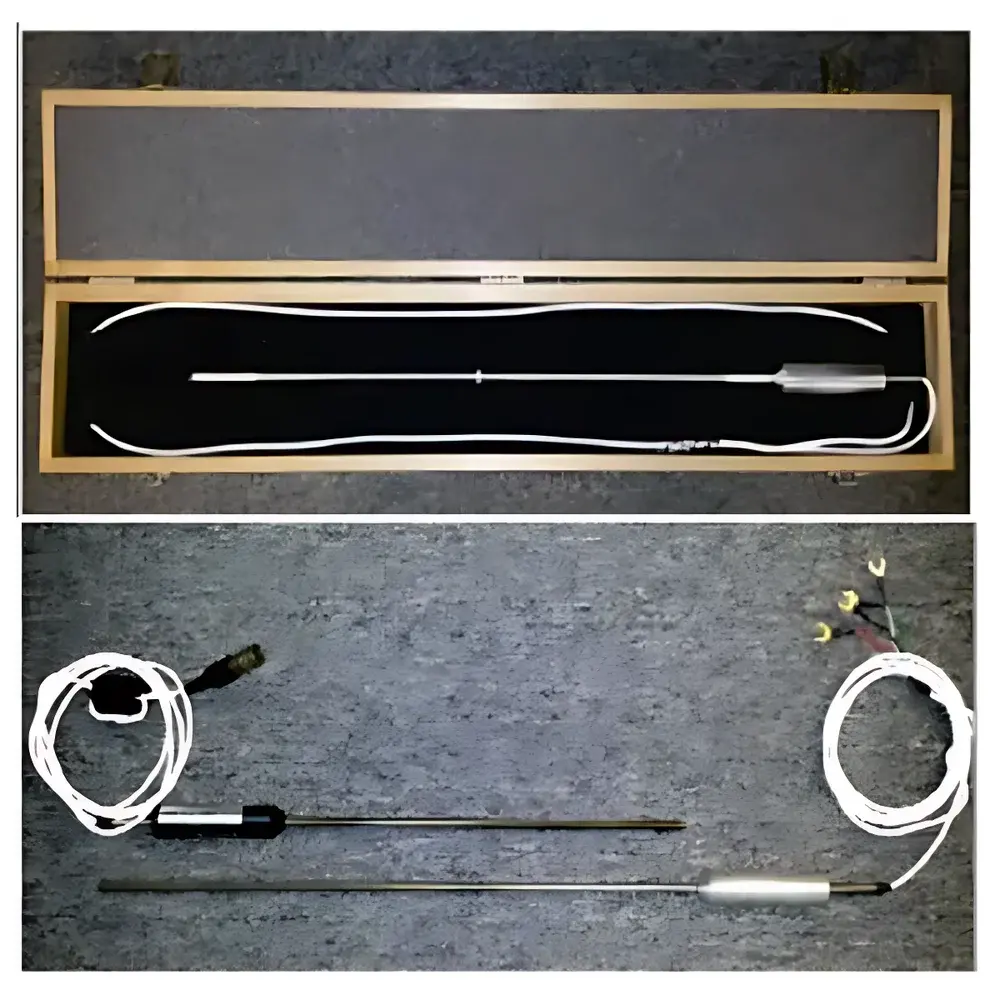
| Probe Diameter | 3.2 mm (standard sensing tip) |
| Standard Sheath Diameters | 4.78 mm or 6.35 mm |
| Standard Length | 305 mm |
| Vibration Resistance | 20 G, 10–2000 Hz |
| Standard Connector | 6-pin |
| Optional Connectors | Spade terminals, 5-pin DIN, 2-pin DIN, 4-pin DIN |
Overview
The ASP YKF Series Platinum Resistance Thermometers (PRTs) are high-precision, industrial-grade temperature sensors engineered for metrological traceability in calibration laboratories, national standards institutes, and critical process environments. Based on the fundamental principle of resistance thermometry—where platinum’s highly predictable and monotonic resistivity change with temperature is measured per IEC 60751 and ASTM E1137—the YKF Series delivers exceptional long-term stability and reproducibility across an ultra-wide operating range from –260 °C (liquid helium point) to +850 °C. Each sensor employs a strain-free, wire-wound or thin-film platinum element housed within a hermetically sealed, mechanically robust sheath of stainless steel or Inconel® alloy—materials selected for low thermal expansion, oxidation resistance, and immunity to thermal shock during rapid cycling. The design eliminates hysteresis and minimizes self-heating error through optimized excitation current management and low-power dissipation architecture.
Key Features
- Four calibrated sub-series (YKF200, YKF500, YKF670, YKF850) optimized for distinct upper-range limits while maintaining identical base accuracy and stability performance below 0 °C
- Choice of nominal resistance values: 25.5 Ω (optimized for low-temperature applications requiring high sensitivity) or 100 Ω (standard for general-purpose calibration and industrial systems)
- Configurable TCR options: 0.003850 Ω/Ω/°C (IEC 60751 standard) or 0.003925 Ω/Ω/°C (DIN 43760 legacy), enabling direct compatibility with legacy bridges and modern digital readouts
- Proven drift performance validated under accelerated aging: <0.006 °C R₀ shift after 500 hours at 500 °C; <0.015 °C at 850 °C—supporting extended recalibration intervals per ISO/IEC 17025 requirements
- Hermetic metal-sheath construction with optional Inconel® 600 or 316 stainless steel—resistant to thermal cycling, mechanical vibration (20 G, 10–2000 Hz), and corrosive atmospheres
- Standard 6-pin connector with full pinout documentation for four-wire (Kelvin) measurement; field-replaceable termination options including spade lugs and multiple DIN configurations
Sample Compatibility & Compliance
The YKF Series is designed for use with fixed-point cells (e.g., ITS-90-defined triple points of mercury, water, gallium, indium, tin, zinc, aluminum), liquid-in-glass thermometers, radiation thermometers, and other PRT-based reference standards. Its compact tip geometry (3.2 mm diameter × 9.7 mm active length) ensures minimal stem conduction error and fast thermal response in air, oil, and stirred baths. All models comply with the essential metrological requirements of ISO/IEC 17025:2017 for calibration laboratories, support uncertainty budgets aligned with EURAMET cg-18 guidelines, and meet the physical robustness criteria specified in ASTM E74 for force calibration instrumentation. While not intrinsically certified for hazardous locations, the stainless steel/Inconel® housing permits operation in cleanroom, vacuum, and inert-gas environments compliant with USP , FDA 21 CFR Part 11 (when integrated with compliant data acquisition software), and GLP/GMP validation protocols.
Software & Data Management
YKF sensors interface seamlessly with industry-standard calibration software platforms—including Fluke Metrology Software (Cal Desktop), Hart Scientific 1560 Super-thermometer firmware, and open-source Python-based DAQ systems via IEEE 488.2 (GPIB), RS-232, or USB-to-serial adapters. The 6-pin connector provides dedicated leads for current sourcing, voltage sensing, and shield grounding—enabling true 4-wire resistance measurement with rejection of lead-wire resistance and contact potential errors. When deployed in automated calibration systems, the YKF Series supports full audit-trail logging, certificate generation per ISO 17025 Annex C, and traceable metadata embedding (including serial number, calibration date, reference standard ID, and environmental conditions). Firmware updates and configuration parameters (e.g., TCR selection, linearization coefficients) are retained in non-volatile memory, ensuring continuity across instrument re-deployment.
Applications
- Primary and secondary temperature calibration laboratories performing accredited calibrations to ISO/IEC 17025
- Validation of environmental chambers, autoclaves, freeze dryers, and semiconductor process tools per IQ/OQ/PQ protocols
- Thermal characterization of aerospace materials under cryogenic and high-temperature exposure
- Reference-grade monitoring in nuclear reactor coolant loop simulators and fusion test stands
- Inter-laboratory comparison studies coordinated by BIPM, NIST, or regional metrology institutes (RMOs)
- Research applications requiring ultra-stable, low-hysteresis temperature references in quantum computing cryostats and superconducting magnet systems
FAQ
What is the recommended excitation current for optimal accuracy and self-heating mitigation?
For 100 Ω elements, 1 mA is standard; for 25.5 Ω elements, 2 mA is typical. Current must be limited to ≤1 mW power dissipation in the element to maintain <0.001 °C self-heating error.
Can YKF sensors be used in vacuum or reducing atmospheres?
Yes—Inconel®-sheathed models are qualified for continuous operation at pressures down to 10⁻⁶ Torr and in hydrogen or argon environments up to 850 °C without degradation.
Is NIST-traceable calibration documentation included with shipment?
Each unit ships with a manufacturer’s calibration report traceable to NIST SRMs. Full ISO/IEC 17025-accredited calibration certificates are available as an optional service.
How does the YKF series handle thermal shock during rapid transitions between cryogenic and ambient temperatures?
The strain-free platinum element mounting and matched-coefficient metal sheath minimize thermal stress-induced resistance drift, with verified repeatability <0.005 °C over 20 cycles spanning –196 °C to +850 °C.
Are custom probe geometries available for OEM integration?
Yes—ASP offers engineering support for bespoke diameters, lengths, bend radii, and connector configurations, including miniature versions for embedded sensor applications.