ASP YKF200 Ultra-Low-Temperature Platinum Resistance Thermometer
| Brand | ASP/Advanced Sensing Products |
|---|---|
| Origin | USA |
| Manufacturer Type | Authorized Distributor |
| Product Category | Imported Instrument |
| Model | YKF200 |
| Instrument Type | Temperature Verification and Calibration System |
| Temperature Range | −260 °C to +260 °C |
| Nominal Resistance | 25.5 Ω or 100 Ω at 0 °C |
| TCR (α) | 0.003850 Ω/Ω/°C or 0.003925 Ω/Ω/°C |
| Stability Drift | <0.0025 °C/year at 0 °C |
| Repeatability (R₀) | <0.0005 °C over 20 consecutive cycles across full range |
| Vibration Resistance | 20 G, 10–2000 Hz |
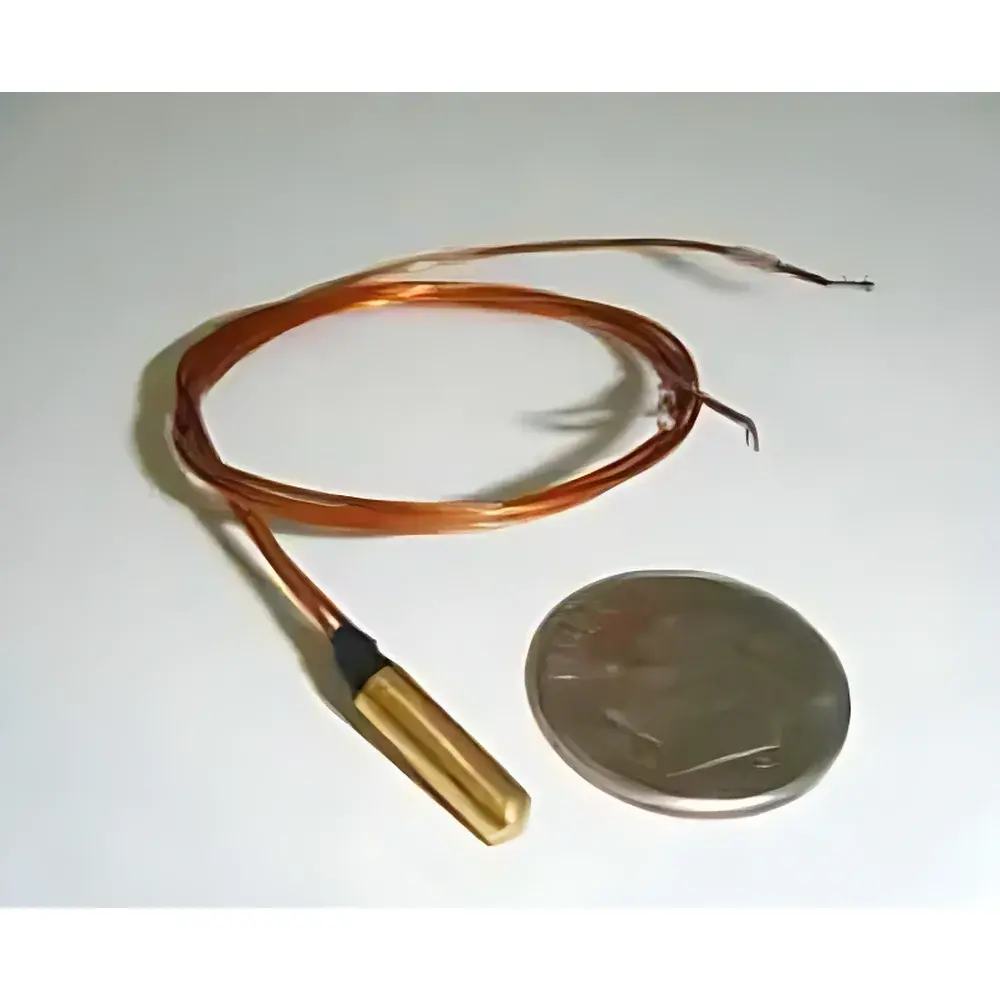
| Dimensions | Ø3.2 mm × 9.7 mm |
| Fill Gas | Dry Helium |
| Sheath Material | Gold-Plated Copper |
| Primary Application | NIST-Traceable Cryogenic Reference Standard |
Overview
The ASP YKF200 Ultra-Low-Temperature Platinum Resistance Thermometer is a primary-standard-grade cryogenic sensor engineered for metrological traceability and long-term stability in demanding low-temperature calibration environments. Based on the fundamental principle of platinum resistance thermometry—where temperature is derived from the highly predictable and reproducible resistive response of high-purity platinum wire—the YKF200 implements a rigorously controlled construction optimized for operation from 3.2 K (−269.95 °C) to 533.15 K (+260 °C). Its design conforms to the International Temperature Scale of 1990 (ITS-90) requirements for Standard Platinum Resistance Thermometers (SPRTs), enabling direct use as a reference standard in national metrology institutes, accredited calibration laboratories, and cryogenic R&D facilities. The sensor’s core element is a strain-free, four-wire wound platinum sensing element housed within a hermetically sealed, gold-plated copper sheath filled with ultra-dry helium gas—eliminating condensation, thermal lag, and oxidation-related drift. This architecture ensures minimal thermal mass, rapid thermal response, and immunity to thermal shock during repeated immersion into liquid helium or nitrogen baths.
Key Features
- Ultra-broad operational range: −260 °C to +260 °C, validated for continuous use down to liquid helium temperatures
- NIST-traceable calibration certificate supplied with each unit; recognized by the National Institute of Standards and Technology as a designated reference instrument for cryogenic thermometry
- Hermetic helium-fill with proprietary sealing technology prevents gas permeation and maintains internal dryness over decades of service
- Gold-plated copper sheath provides excellent thermal conductivity, electromagnetic shielding, and corrosion resistance in humid or cryogenic vapor environments
- Sub-millimeter dimensional stability: <0.0005 °C repeatability in R₀ (resistance at 0 °C) over 20 consecutive thermal cycles across full span
- Proven mechanical robustness: qualified to withstand 20 G sinusoidal vibration across 10–2000 Hz without resistance shift or structural compromise
- Configurable nominal resistance options (25.5 Ω or 100 Ω) and temperature coefficient variants (0.003850 or 0.003925 Ω/Ω/°C) to match legacy calibration infrastructure or ITS-90 interpolation requirements
Sample Compatibility & Compliance
The YKF200 is compatible with all standard cryostats, liquid nitrogen dewars, stirred oil baths, and fixed-point cells (e.g., triple-point-of-water, melting-point-of-gallium, freezing-point-of-indium). Its compact 3.2 mm diameter and 9.7 mm active length allow insertion into narrow bore tubes and micro-cryogenic probe assemblies without perturbing thermal gradients. The device complies with ISO/IEC 17025:2017 requirements for reference standards used in accredited calibration laboratories. It supports GLP/GMP audit readiness through documented calibration history, uncertainty budgets, and NIST-traceable certificates issued per ANSI/NCSL Z540-1 and ISO/IEC 17025 Annex A. While not intrinsically safety-rated for hazardous locations, its passive, non-powered construction renders it suitable for use inside vacuum chambers, magnetic resonance systems, and superconducting magnet cryostats where electromagnetic compatibility and outgassing are critical.
Software & Data Management
The YKF200 operates as a passive resistance standard and does not incorporate embedded electronics or firmware. It interfaces seamlessly with industry-standard resistance bridges (e.g., Hart Scientific 1560, Fluke 56xxA series) and digital multimeters meeting IEEE 1057 or IEC 61000-4-30 Class A accuracy requirements. Resistance measurements are processed using ITS-90 deviation function algorithms implemented in calibration software such as MET/CAL, Thermo-CAL, or custom Python/Matlab-based uncertainty engines compliant with GUM (JCGM 100:2008). All calibration reports include full uncertainty analysis per ISO/IEC Guide 98-3, covering self-heating effects, lead-wire correction, bridge linearity, and environmental thermal EMF contributions. Audit trails, calibration due dates, and certificate version control are supported via integration with LIMS platforms adhering to FDA 21 CFR Part 11 electronic record requirements.
Applications
- Cryogenic thermometer calibration in national metrology labs (e.g., NIST, NPL, PTB) and ISO/IEC 17025-accredited calibration service providers
- Reference standard for qualification and routine verification of cryocoolers, dilution refrigerators, and superconducting magnet temperature monitoring systems
- In-situ validation of temperature sensors in quantum computing hardware, fusion plasma diagnostics, and space simulation chambers
- Inter-laboratory comparison studies and key comparisons under the CIPM MRA framework
- Primary standard for establishing fixed-point realizations below 273.16 K, including argon triple point (83.8058 K) and oxygen freezing point (54.3584 K)
- Long-term drift monitoring in climate-controlled metrology vaults and time-stable thermal reference environments
FAQ
Is the YKF200 certified to ITS-90? Why is this important?
Yes—the YKF200 is supplied with a full ITS-90 calibration report referencing defined fixed points (e.g., triple-point-of-water, melting-point-of-gallium), enabling interpolation across its entire range with uncertainties below ±0.001 °C near 0 °C. ITS-90 compliance ensures international equivalence and legal metrological acceptance.
Can the YKF200 be used in vacuum or magnetic fields?
Yes—its all-metal, non-magnetic (copper/gold/platinum) construction and helium fill make it suitable for high-vacuum (<10⁻⁶ mbar) and static magnetic fields up to 12 T. No ferromagnetic components or organic binders are present.
What is the recommended measurement current to avoid self-heating error?
For 100 Ω configuration: ≤1 mA RMS; for 25.5 Ω: ≤2 mA RMS. Self-heating is typically <0.0001 °C at these levels in still air, and further reduced in liquid immersion.
How often should the YKF200 be recalibrated?
Annual recalibration is recommended for ISO/IEC 17025 compliance. However, stability data shows <0.0025 °C/year drift at 0 °C—enabling extended recalibration intervals (e.g., 2–3 years) under controlled usage conditions with documented verification checks.
Does ASP provide on-site calibration support or uncertainty budgeting services?
Yes—ASP partners with A2LA-accredited calibration providers to deliver on-site verification, uncertainty analysis per GUM, and ISO/IEC 17025-compliant reporting. Custom uncertainty budgets—including user-specific environmental and instrumentation contributions—are available upon request.