
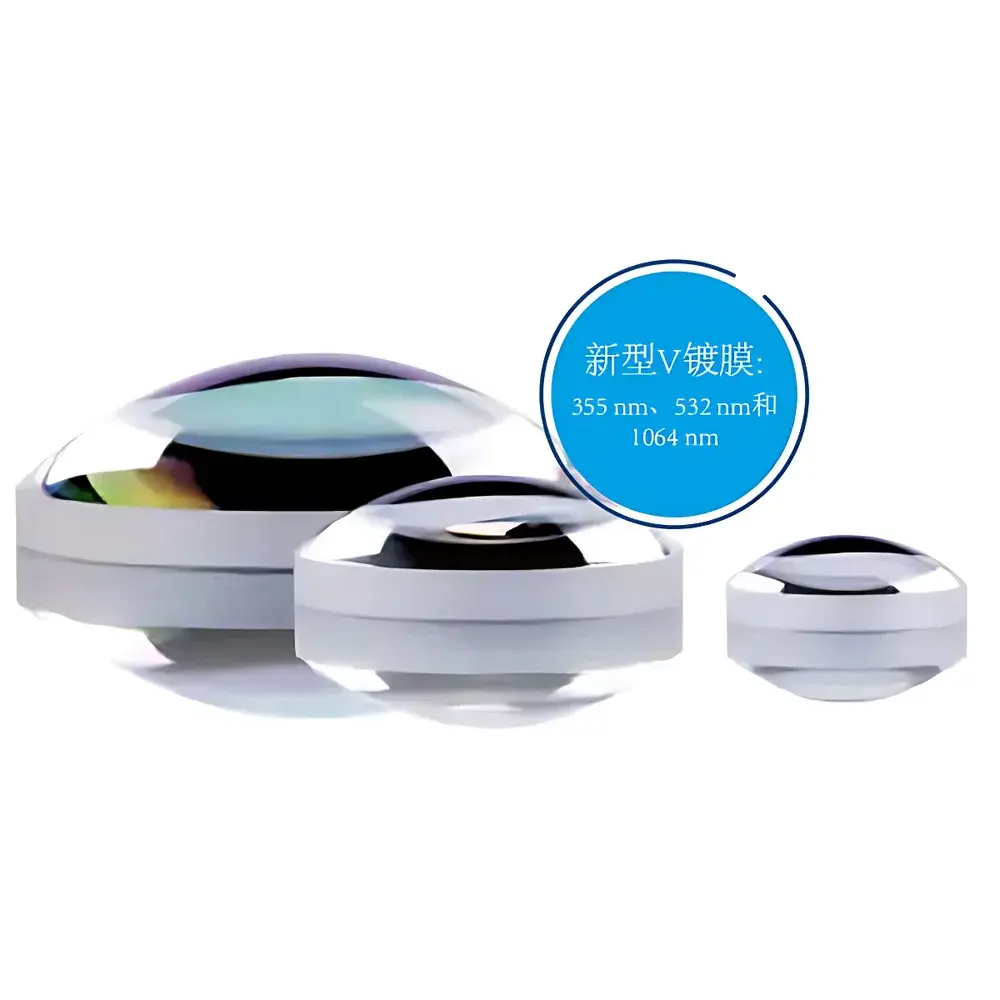
Asphericon AFL-D Series Fused Silica Aspheric Lenses
| Brand | Asphericon |
|---|---|
| Material | UV-grade Fused Silica |
| Surface Form Error (RMSi) | ≤0.02 µm |
| Surface Roughness (Rq) | ≤0.5 nm |
| Laser Damage Threshold | 12 J/cm² @ 100 Hz, 6 ns, 532 nm |
| Coating Options | 7 standard AR coatings (X, A, K, B, L, C, M) |
| EFL Tolerance | ≤0.1% |
| Diameter Tolerance | +0/−0.05 mm |
| Center Thickness Tolerance | ±0.05 mm |
| Clear Aperture | ≥90% |
| Compliance | RoHS-compliant |
| Design Wavelengths | 240–1600 nm (model-dependent) |
| Stock Availability | Yes |
Overview
The Asphericon AFL-D Series Fused Silica Aspheric Lenses are ultra-precision optical components engineered for demanding ultraviolet (UV), visible, and near-infrared (NIR) applications requiring diffraction-limited performance and minimal wavefront distortion. Manufactured from synthetic UV-grade fused silica (SiO₂), these lenses feature a non-spherical surface profile optimized to eliminate spherical aberration—enabling single-element correction of off-axis and axial ray errors that would otherwise require multi-lens assemblies. The aspheric geometry reduces system complexity, minimizes element count, and supports compact, lightweight optical designs without sacrificing imaging fidelity or beam quality. Each lens in the AFL-D series is diamond-turned and magnetorheological finished to achieve a surface form error (RMSi) of ≤0.02 µm per ISO 10110-5 and an ultra-low surface roughness (Rq) of ≤0.5 nm—critical for low-scatter performance in high-resolution microscopy, ultrafast laser focusing, and UV lithography systems.
Key Features
- Ultra-high surface accuracy: RMSi ≤ 0.02 µm (ISO 10110-5), enabling sub-wavelength wavefront control
- Exceptional surface smoothness: Rq ≤ 0.5 nm — optimized for minimal scatter in UV and high-power laser applications
- UV-grade fused silica substrate: Low OH⁻ content, high transmission from 185 nm to 2.1 µm, excellent thermal stability (CTE ≈ 0.55 × 10⁻⁶/K), and high laser-induced damage threshold (12 J/cm² @ 532 nm, 6 ns, 100 Hz)
- Seven standardized anti-reflection (AR) coating options: X (240–380 nm), A (400–600 nm), K (355 nm), B (600–1050 nm), L (532 nm), C (1000–1600 nm), M (1064 nm); all specified at 0° angle of incidence with RAVG ≤ 0.4% or RMAX < 1.0%
- Precision mechanical tolerances: EFL tolerance ≤ ±0.1%, diameter tolerance +0/−0.05 mm, center thickness tolerance ±0.05 mm, clear aperture ≥90%
- Stock availability across standard diameters (12.5 mm, 25 mm, 50 mm) and focal lengths (e.g., AFL25-50-D, AFL25-75-D, AFL25-100-D), supporting rapid prototyping and integration into OEM systems
- RoHS-compliant manufacturing and documentation traceability aligned with ISO 9001 quality management systems
Sample Compatibility & Compliance
These aspheres are compatible with high-irradiance UV excimer lasers (e.g., ArF 193 nm, KrF 248 nm), frequency-tripled Nd:YAG (355 nm), and ultrafast Ti:sapphire systems (700–1000 nm). Their fused silica base ensures negligible solarization under prolonged UV exposure and maintains dimensional stability across thermal cycling (−40 °C to +80 °C). All AFL-D lenses meet RoHS Directive 2011/65/EU requirements and are supplied with full metrology reports—including interferometric surface form maps, surface roughness spectra (measured via AFM), and spectral reflectance/transmittance data. For regulated environments, optional documentation packages support GLP/GMP audit readiness, including calibration certificates traceable to PTB (Physikalisch-Technische Bundesanstalt) standards.
Software & Data Management
Asphericon provides comprehensive optical design support through native Zemax OpticStudio and CODE V compatibility files (including .ZAR and .SEQ formats), containing accurate surface sag tables, refractive index data (Schott N-SF11-equivalent dispersion model for fused silica), and coating spectral performance curves. Lens-specific metrology datasets—including full-aperture interferograms and power spectral density (PSD) plots—are delivered in ASCII and HDF5 formats for integration into automated alignment algorithms or statistical process control (SPC) workflows. No proprietary software is required; all data adhere to ISO 14971 risk management and ASTM E2915-19 archival standards.
Applications
- Diffraction-limited beam shaping: Gaussian-to-top-hat conversion, Bessel beam generation, and focus engineering in ultrafast laser micromachining
- UV fluorescence microscopy: High-NA, low-aberration collection optics for confocal and STED systems operating below 400 nm
- LIDAR and remote sensing: Compact, athermalized transmitter/receiver optics for airborne and spaceborne platforms
- Photolithography illumination: Homogenizing condenser elements and projection lens subcomponents in mask aligners
- High-energy laser systems: Final focusing optics in industrial cutting/welding stations (e.g., 1064 nm, 532 nm, 355 nm)
- Quantum optics setups: Mode-matching optics for cavity-enhanced spectroscopy and ion trap experiments
- OEM instrumentation: Embedded optics in portable spectrometers, gas analyzers, and medical endoscopic devices requiring long-term environmental stability
FAQ
What is the difference between the AFL-P, AFL-U, and AFL-D series?
The AFL-P series offers precision-grade performance (RMSi ≤ 0.5 µm), suitable for general-purpose beam collimation. The AFL-U series delivers ultra-precision (RMSi ≤ 0.3 µm, Rq ≤ 1 nm) for demanding visible/NIR applications. The AFL-D series represents Asphericon’s highest tier: diffraction-limited performance (RMSi ≤ 0.02 µm, Rq ≤ 0.5 nm), specifically qualified for UV and ultrafast laser use.
Can these lenses be mounted or integrated into kinematic mounts?
Yes—Asphericon offers pre-mounted versions (e.g., AFL-D-M) with SM1-threaded aluminum housings, kinematic adjustment capability (±2° tip/tilt), and vacuum-compatible anodization. Custom mounting interfaces (e.g., CF flanges, Ø1″ or Ø2″ barrels) are available upon request.
Are custom coatings supported beyond the seven standard AR options?
Yes—custom dielectric stacks (high-reflectivity mirrors, edge filters, broadband AR, or polarization-sensitive coatings) can be deposited using ion-beam sputtering (IBS) with in-situ monitoring. Lead times and minimum order quantities apply.
Do you provide test reports with each shipment?
Each lens ships with a Certificate of Conformance (CoC) and a digital metrology dossier including interferometric surface map (Zygo GPI format), AFM roughness analysis, spectral transmission/reflectance curves (PerkinElmer Lambda 1050+), and dimensional inspection report (Zeiss CONTURA G2 CMM data).
Is there a warranty or lifetime guarantee for laser damage performance?
Asphericon warrants all AFL-D lenses against manufacturing defects for 24 months. While laser damage threshold values are statistically derived (per ISO 21254-1), actual performance depends on beam profile, pulse duration, repetition rate, and cleanliness—users are advised to follow IEC 60825-1 safety protocols and perform qualification testing under application-relevant conditions.




