
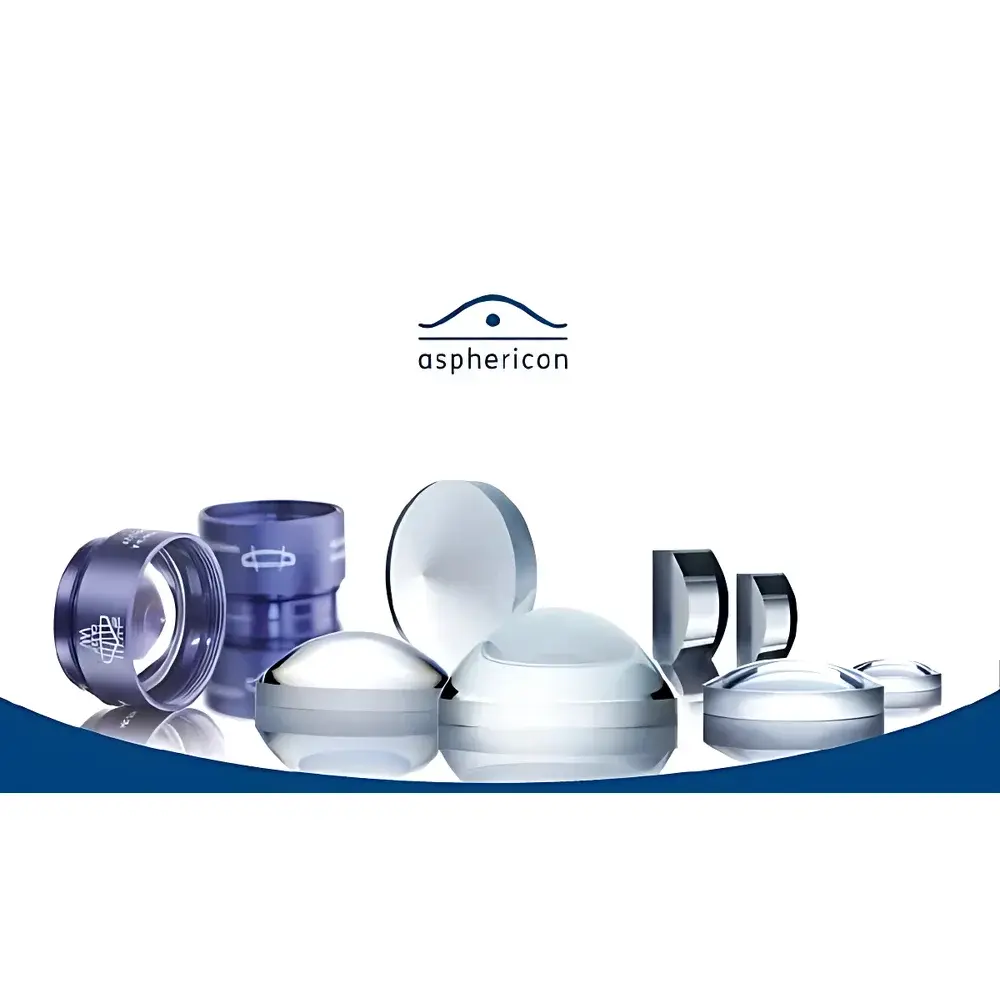
Asphericon S-LAH64 High-NA Aspheric Lens
| Brand | Asphericon |
|---|---|
| Model | S-LAH64 |
| Material | S-LAH64 optical glass |
| Surface Irregularity (RMSi) | ≤ 0.5 µm |
| EFL Tolerance | ≤ 0.1% |
| Diameter Tolerance | +0/−0.05 mm |
| Center Thickness Tolerance | ±0.05 mm |
| Clear Aperture | ≥90% |
| Standard AR Coatings | A (400–600 nm), B (600–1050 nm), C (1000–1600 nm) |
| Laser Damage Threshold | 12 J/cm² @ 100 Hz, 6 ns, 532 nm |
Overview
The Asphericon S-LAH64 High-NA Aspheric Lens is a precision-engineered optical component designed for demanding laser and imaging applications requiring diffraction-limited performance, minimal wavefront error, and high energy throughput. Manufactured from Schott’s S-LAH64 — a low-dispersion, high-refractive-index lanthanum crown glass — this asphere delivers exceptional chromatic correction and thermal stability across visible and near-infrared spectra. Its high numerical aperture (NA up to 0.61) enables tight focusing, efficient collimation, and reduced optical path length in compact systems. Unlike spherical lenses, the aspheric surface profile eliminates spherical aberration at the design wavelength (typically 780 nm for StockOptics variants), allowing single-element replacement of multi-lens assemblies without sacrificing resolution or Strehl ratio. This lens is part of Asphericon’s StockOptics program: pre-characterized, metrologically verified, and available from stock with full ISO-compliant test reports.
Key Features
- Precision surface form accuracy: RMS irregularity ≤ 0.5 µm (ISO 10110-5), ensuring sub-wavelength wavefront fidelity
- S-LAH64 substrate: refractive index nd = 1.802, Abbe number νd = 46.5 — optimized for low longitudinal chromatic aberration and high transmission in broadband laser systems
- Three standard anti-reflection coatings: A (400–600 nm), B (600–1050 nm), C (1000–1600 nm), each with RAVG ≤ 0.4% and RMAX < 1.0% at normal incidence
- Laser damage threshold certified at 12 J/cm² (100 Hz, 6 ns, 532 nm), validated per ISO 21254-1 for continuous integration into Class 4 laser platforms
- Tight mechanical tolerances: EFL ±0.1%, diameter +0/−0.05 mm, center thickness ±0.05 mm, clear aperture ≥90%
- RoHS-compliant manufacturing and packaging; traceable batch documentation with interferometric surface maps and MTF data
Sample Compatibility & Compliance
The S-LAH64 asphere is compatible with standard optomechanical mounts (e.g., SM1-threaded lens tubes, kinematic mounts with Ø25.4 mm or Ø50.8 mm bores) and integrates seamlessly into OEM laser delivery systems, confocal microscopes, fiber coupling stages, and ultrafast amplifier compressors. All StockOptics units undergo full compliance verification against ISO 10110-5 (surface form), ISO 10110-7 (surface imperfections), and ISO 14997 (laser damage testing). The material meets EU Directive 2011/65/EU (RoHS 2) for hazardous substance restrictions. For regulated environments (e.g., medical device optics or aerospace instrumentation), Asphericon provides optional GLP-aligned calibration certificates and audit-ready manufacturing records — including interferogram archives, coating spectral reflectance curves, and environmental stress screening logs (thermal cycling, humidity exposure).
Software & Data Management
Each shipped lens includes a digital metrology dossier containing ZYGO or QED interferometer-generated surface deviation maps (in .zmx or .dat format), measured MTF curves at multiple field points, and spectral transmittance data (200–2000 nm). These files are structured for direct import into optical design software (Zemax OpticStudio, CODE V, FRED) via standardized ASCII or binary formats. Asphericon’s online portal provides secure access to historical lot data, coating deposition logs, and revision-controlled test reports — supporting FDA 21 CFR Part 11 compliance when paired with customer-managed electronic signature workflows. No proprietary software is required; all datasets adhere to ISO 17025-accredited measurement protocols and include uncertainty budgets per GUM (Guide to the Expression of Uncertainty in Measurement).
Applications
- Laser beam shaping: Gaussian-to-flat-top conversion in UV–NIR regimes, especially in excimer, Ti:sapphire, and fiber laser systems
- High-resolution imaging: Objective elements in fluorescence microscopy, OCT sample arms, and EUV lithography illumination modules
- Fiber coupling: Efficient coupling into single-mode fibers (SMF-28, PM980) with minimized back-reflection and mode mismatch loss
- Industrial metrology: Reference optics in interferometric displacement sensors and structured-light 3D scanners
- Aerospace & defense: Ruggedized beam expanders and collimators for LIDAR transceivers operating under thermal shock (−40°C to +85°C)
- Quantum optics: Mode-matching optics for cavity-enhanced spectroscopy and cold atom trapping setups requiring λ/20 surface fidelity
FAQ
What is the typical lead time for StockOptics S-LAH64 lenses?
Standard StockOptics units ship within 3–5 business days from order confirmation, subject to real-time inventory availability. Lead times are published daily on Asphericon’s global distributor portal.
Can I request custom AR coating outside the A/B/C standard bands?
Yes. Asphericon offers bespoke dielectric stack designs — including ultra-low-GDD coatings for femtosecond pulses, dual-band AR for pump-probe configurations, and angle-tuned filters — with full spectral modeling and accelerated aging validation.
Is surface roughness data provided for each lens?
Yes. All S-LAH64 lenses include measured surface roughness (Rq) values, typically ≤3 nm RMS over 80×80 µm scan areas, acquired via white-light interferometry per ISO 25178-2.
How is thermal stability characterized for S-LAH64 in high-power CW applications?
Coefficient of thermal expansion (CTE) is 7.5 × 10⁻⁶ K⁻¹; dn/dT is −1.5 × 10⁻⁶ K⁻¹. Thermal lensing simulations are available upon request using measured thermo-optic coefficients and finite-element modeling.
Do you provide mounting solutions or optomechanical integration support?
Yes. Asphericon collaborates with precision mount manufacturers to supply pre-aligned, kinematically stabilized lens cells — including vacuum-compatible, athermalized, and radiation-hardened variants — with full alignment tolerance stack analysis.







