
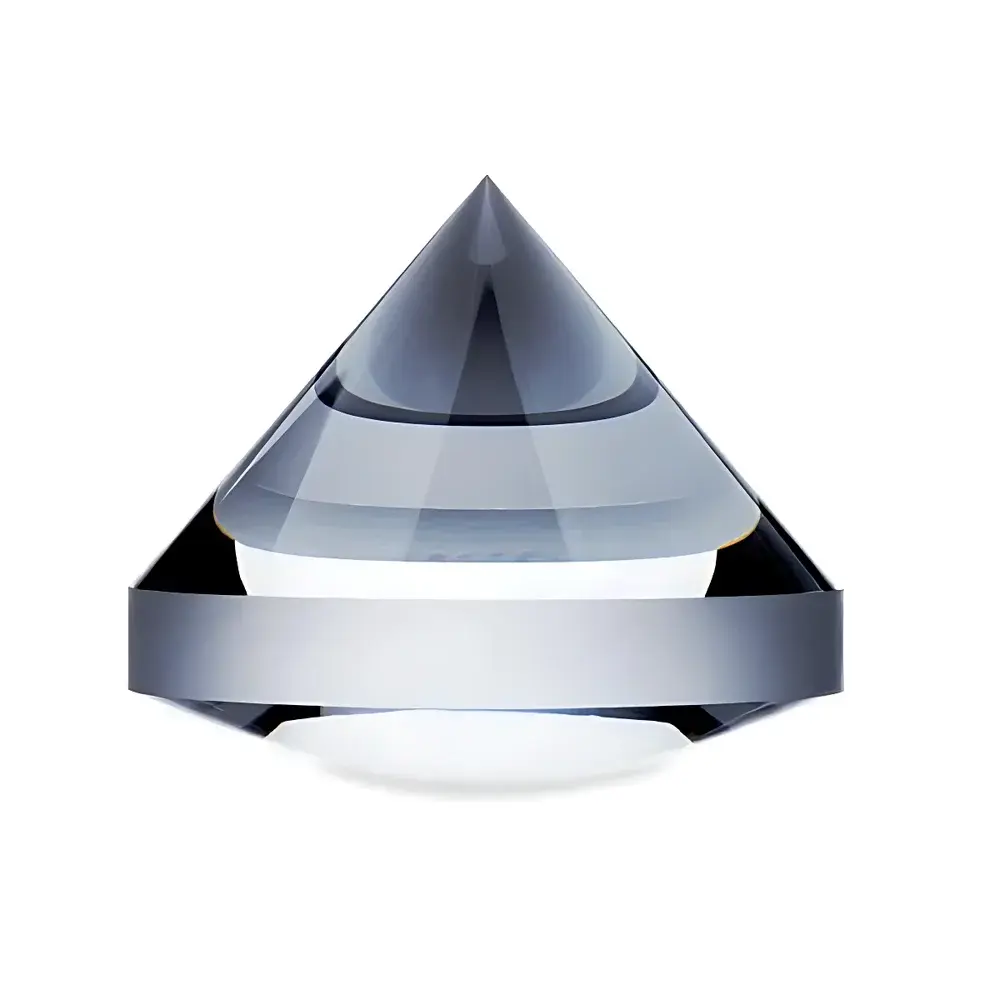
Asphericon StockOptics Axicon Lens
| Brand | Asphericon |
|---|---|
| Model | StockOptics Axicon |
| Type | Precision Fused Silica Axicon (Conical Lens) |
| Material | Fused Silica |
| Surface Figure (RMSi) | ≤ 0.07 µm |
| Surface Quality | 40–20 scratch-dig |
| Diameter Tolerance | +0/−0.1 mm |
| Center Thickness Tolerance | ±0.1 mm |
| Clear Aperture | ≥90% |
| Standard AR Coatings | A (400–600 nm), B (600–1050 nm), C (1000–1600 nm), X (240–380 nm) |
| Laser Damage Threshold | 12 J/cm² @ 100 Hz, 6 ns, 532 nm |
Overview
The Asphericon StockOptics Axicon Lens is a high-precision conical optical element engineered for deterministic beam shaping in demanding laser and metrology applications. Unlike conventional lenses, the axicon operates on the principle of controlled conical refraction: incident collimated light is transformed into a non-diffracting Bessel-like beam or a focused ring-shaped intensity distribution. This behavior arises from the continuous linear variation of optical path length across the conical surface—governed by the apex angle—and enables extended depth-of-focus profiles unattainable with spherical or aspheric optics. Fabricated from UV-grade fused silica, each StockOptics axicon undergoes deterministic single-point diamond turning followed by magnetorheological finishing to achieve sub-70 nm RMSi surface figure error (ISO 10110-5 compliant). The design supports both free-space and fiber-coupled integration, making it suitable for applications requiring long focal-depth illumination, annular focus generation, or structured light projection.
Key Features
- Precision-engineered conical surface with RMSi ≤ 0.07 µm—verified via full-aperture interferometry using ZYGO Verifire™ systems
- UV-grade fused silica substrate with low thermal expansion (α = 0.55 × 10⁻⁶ K⁻¹) and high transmission from 190 nm to 2.2 µm
- Four standard broadband anti-reflection coatings optimized for key laser wavelengths: A (400–600 nm), B (600–1050 nm), C (1000–1600 nm), and X (240–380 nm), all meeting RAVG ≤ 0.4% and RMAX < 1.0% at 0° AOI
- Laser damage threshold certified at 12 J/cm² (100 Hz, 6 ns, 532 nm), enabling compatibility with Q-switched Nd:YAG and frequency-doubled solid-state lasers
- Standard diameters: 25.4 mm and 50.8 mm; apex angles ranging from 0.5° to 20°; edge thickness options from 5 mm to 8 mm
- RoHS-compliant manufacturing and traceable metrology documentation per ISO 9001:2015 and ISO 10110-5 standards
Sample Compatibility & Compliance
Asphericon StockOptics axicons are designed for integration into Class 1 and Class 4 laser systems compliant with IEC 60825-1:2014 and ANSI Z136.1-2022 safety requirements. Their fused silica composition ensures chemical inertness against common solvents and resistance to UV-induced solarization. All standard coatings meet MIL-C-48497A specifications for environmental durability under humidity cycling (95% RH, 40 °C, 240 h) and adhesion testing (ASTM D3359). Each lens ships with a calibration certificate including interferometric surface map, spectral reflectance data, and surface defect inspection report aligned with ISO 10110-7. For regulated environments—including ISO 13485-certified medical device labs and FDA-regulated phototherapy development—the lenses support audit-ready documentation packages upon request.
Software & Data Management
While the axicon itself is a passive optical component, Asphericon provides downloadable Zemax OpticStudio-compatible .ZAR and .STEP files for precise system modeling. These files include accurate surface sag tables derived directly from measured interferograms—not idealized mathematical approximations—ensuring fidelity in ray-tracing simulations. For users implementing automated alignment or beam profiling workflows, the lenses integrate seamlessly with Thorlabs’ Kinesis® motion control platforms and DataRay WinCamD-UCD beam analysis software. Traceability data—including serial-number-linked metrology logs and coating deposition parameters—is archived for 10 years and available upon formal request in accordance with GLP/GMP-aligned data retention protocols (21 CFR Part 11–ready upon customer-specific configuration).
Applications
- Generation of extended-depth-of-field Bessel beams for optical trapping, laser micro-machining, and confocal microscopy
- Annular focus formation in laser material processing—e.g., uniform circumferential welding of cylindrical components or selective ablation in thin-film patterning
- Structured illumination in profilometry and fringe projection systems for high-accuracy 3D surface reconstruction
- Beam homogenization and top-hat profile synthesis when cascaded with diffractive optical elements (DOEs) or spatial light modulators (SLMs)
- Calibration reference in interferometric alignment setups where stable, rotationally symmetric wavefronts are required
- Nonlinear optics pumping configurations requiring controlled longitudinal intensity distributions (e.g., filamentation studies in air or noble gases)
FAQ
What is the maximum usable numerical aperture (NA) for an Asphericon axicon in collimated beam geometry?
The effective NA depends on the apex angle and input beam diameter. For a 25.4 mm diameter axicon with 5° apex angle, the theoretical NA ≈ 0.044; practical NA is limited by surface figure error and coating uniformity—typically ≤ 0.04 for diffraction-limited performance.
Can StockOptics axicons be mounted in standard kinematic lens holders?
Yes. All standard models feature centering tolerances ≤ 3 arcsec and mechanical symmetry within ±2 µm, ensuring compatibility with Thorlabs KM100, Newport ULM-1, and similar mounts without additional centering adjustments.
Is custom apex angle or substrate material available beyond the StockOptics catalog?
Yes. Asphericon offers custom fabrication in CaF₂, sapphire, and N-BK7 for specialized UV/VIS/IR applications, with lead times of 6–8 weeks and minimum order quantities starting at one piece.
How does temperature affect the ring diameter stability of the generated Bessel beam?
Fused silica’s low dn/dT (−0.44 × 10⁻⁶ K⁻¹) and α ensure <0.1% ring diameter drift over a 20–40 °C ambient range—critical for long-duration metrology experiments.
Do you provide wavefront error data per individual unit?
Yes. Every shipped axicon includes a full-aperture phase map (Zernike coefficients up to 37th order) and PV/RMS wavefront error summary referenced to a calibrated 633 nm HeNe source.




