
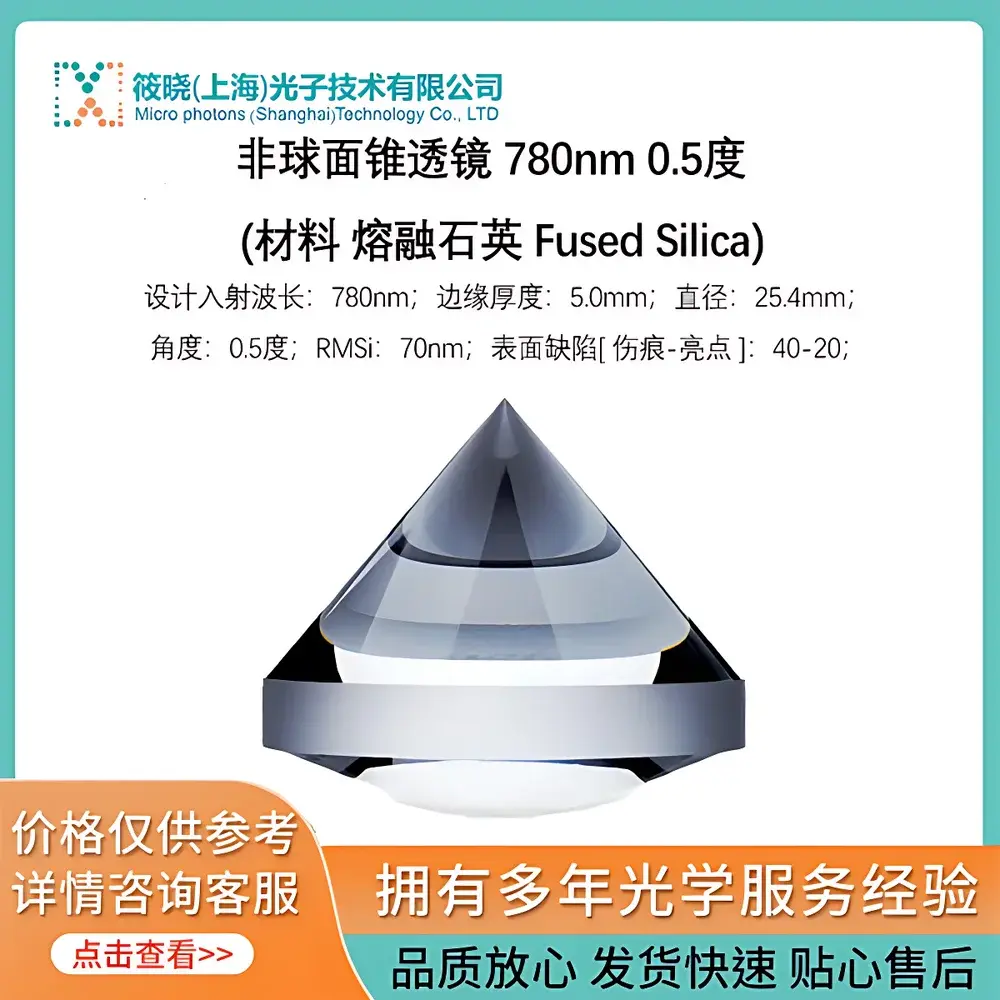
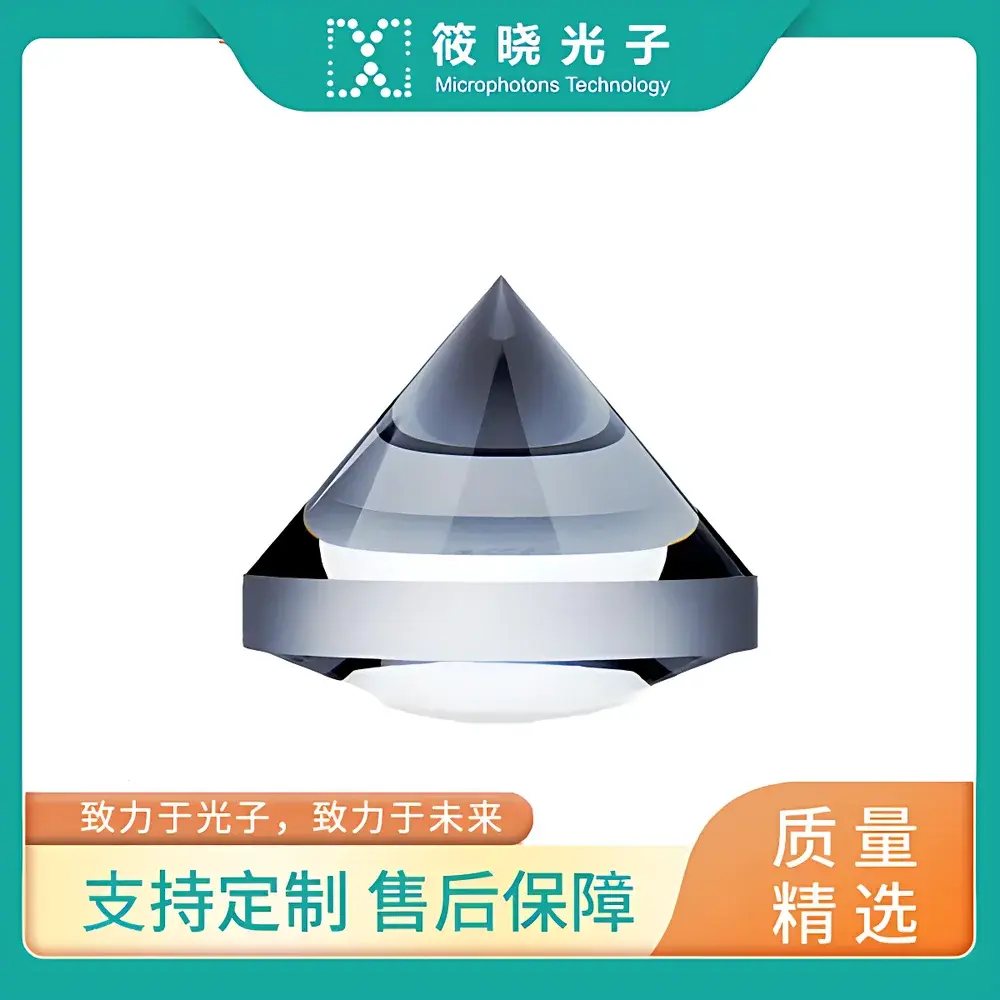
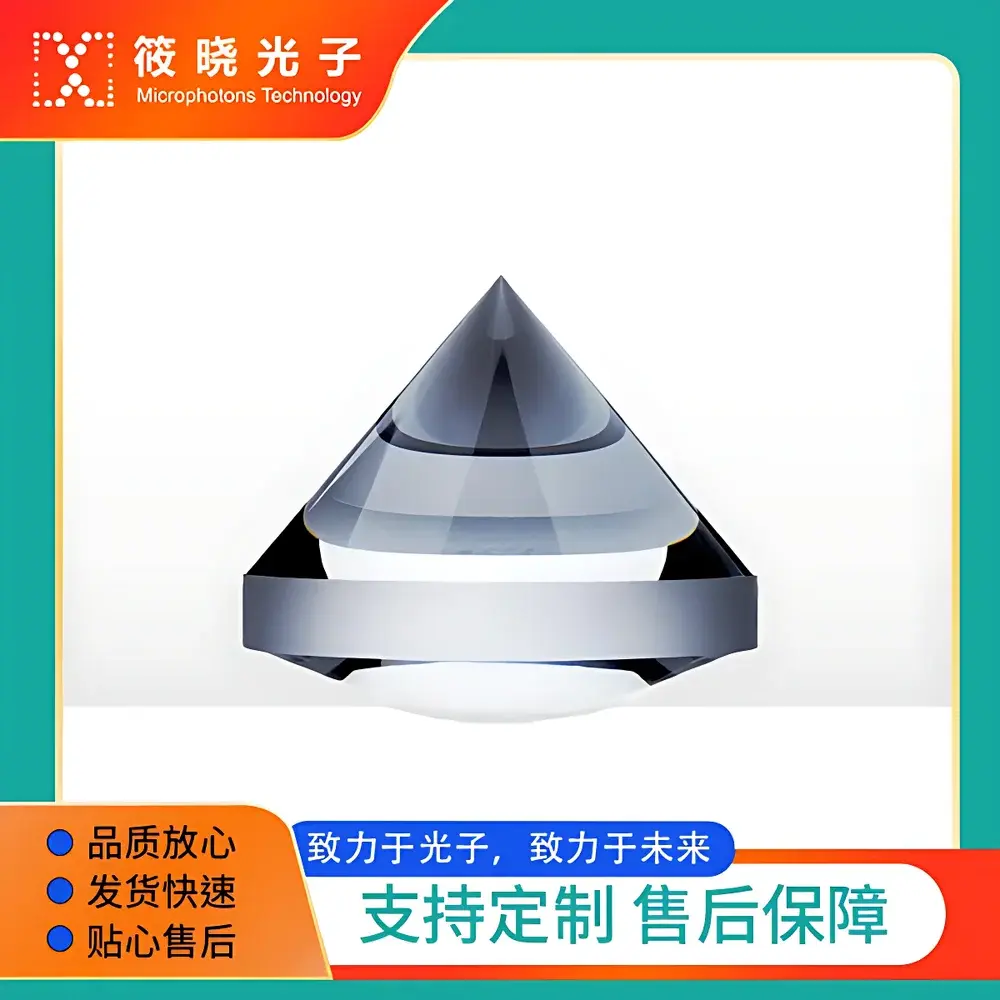
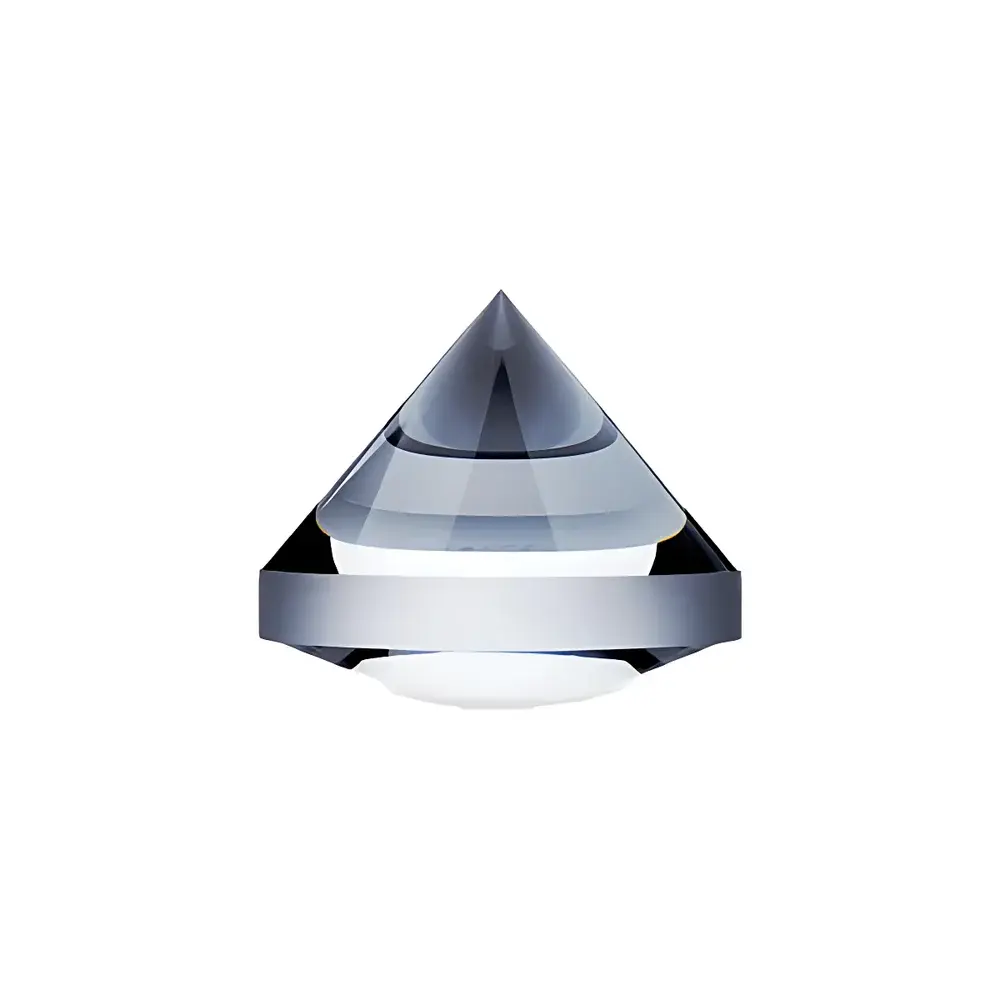
Asphericon XFL25-005-U Fused Silica Aspheric Axicon Lens (780 nm, 0.5° Apex Angle)
| Brand | Asphericon |
|---|---|
| Origin | Germany |
| Model | XFL25-005-U |
| Material | Fused Silica |
| Design Wavelength | 780 nm |
| Apex Angle | 0.5° |
| Component Type | Optical Element |
| Coating | AR-Coated for 780 nm (Standard) |
| Surface Quality | 20–10 Scratch-Dig |
| Wavefront Error | λ/10 @ 633 nm (typ.) |
| Clear Aperture | ≥90% of Diameter |
Overview
The Asphericon XFL25-005-U is a high-precision fused silica aspheric axicon lens engineered for generating quasi-Bessel beams in near-infrared laser systems operating at 780 nm. Unlike conventional conical lenses, this axicon employs a rotationally symmetric aspheric surface profile—mathematically defined to minimize spherical aberration and maximize axial intensity uniformity over extended propagation distances. Its 0.5° apex angle is optimized for applications requiring fine control over Bessel beam cone angle and depth of focus, such as optical trapping, laser micromachining, and structured illumination microscopy. Fabricated from synthetic fused silica (SiO₂), the lens exhibits exceptional transmission (>99.5% per surface with AR coating), low thermal expansion (α ≈ 0.55 × 10⁻⁶ K⁻¹), and high laser-induced damage threshold (LIDT > 5 J/cm² at 780 nm, 10 ns pulse, 10 Hz). The monolithic design ensures long-term stability under vacuum, ultra-high vacuum (UHV), or cleanroom environments typical in quantum optics and ultrafast laser laboratories.
Key Features
- Ultra-low wavefront error: ≤ λ/10 RMS @ 633 nm (measured interferometrically), enabling diffraction-limited performance in demanding alignment-critical setups.
- Fused silica substrate with intrinsic homogeneity (Δn < 1 × 10⁻⁶) and UV-to-NIR broadband transmission (185–2100 nm), supporting multi-wavelength compatibility beyond the nominal 780 nm design point.
- Anti-reflection coating optimized for 780 ± 10 nm, achieving R < 0.25% average reflectance per surface and reducing ghosting and etalon effects in cavity-based systems.
- Precision diamond-turned aspheric surface with sub-nanometer roughness (<0.3 nm RMS), verified via white-light interferometry and traceable to PTB (Physikalisch-Technische Bundesanstalt) standards.
- Mechanically robust mounting interface compatible with standard Ø25.4 mm kinematic lens mounts (e.g., Thorlabs KM100, Newport UMB100), including engraved centering marks and rotational alignment notches.
Sample Compatibility & Compliance
The XFL25-005-U is designed for integration into Class 1 and Class 3R laser safety-compliant optical benches per IEC 60825-1:2014. Its fused silica composition meets ISO 10110-3:2019 specifications for surface form accuracy (ΔPV < λ/20) and ISO 10110-7:2019 for surface imperfections. The lens is RoHS 2015/863/EU compliant and certified free of SVHC substances under REACH Regulation (EC) No. 1907/2006. It supports GLP/GMP-aligned calibration workflows when used with NIST-traceable wavefront sensors (e.g., Zygo Verifire™) and is routinely deployed in ISO/IEC 17025-accredited metrology labs for beam characterization validation.
Software & Data Management
While the XFL25-005-U is a passive optical component, its performance parameters are fully integrated into Asphericon’s proprietary optical design library (AXILIB v3.2), accessible via Zemax OpticStudio™ and CODE V® import modules. Beam propagation simulations—including Bessel zone calculation, axial intensity decay modeling, and M²-equivalent analysis—are supported through MATLAB® toolboxes (Asphericon Axicon Toolbox) and Python-based open-source libraries (e.g., PyBeamProp). All delivered units include a digital certificate of conformance (CoC) with full metrology data (interferogram, surface map, spectral transmission curve), stored in HDF5 format for audit-ready traceability in FDA 21 CFR Part 11–compliant environments.
Applications
- Generation of extended-depth-of-field Bessel beams for optical tweezers and particle manipulation in biophotonics.
- Beam shaping in ultrafast Ti:sapphire oscillator-amplifier chains (780 nm fundamental) to enable uniform ablation profiles in transparent dielectrics.
- Alignment reference in ultra-stable interferometers (e.g., gravitational wave detector prototypes) where low birefringence and thermal drift are critical.
- Structured light projection in confocal endomicroscopy systems requiring sub-micron lateral resolution across millimeter-scale working distances.
- Quantum optics experiments involving spatial mode filtering of single-photon sources, leveraging the axicon’s inherent modal selectivity for LP₀₁-like propagation.
FAQ
What is the maximum permissible incident power density for continuous-wave operation at 780 nm?
For collimated 780 nm CW beams, the lens supports up to 1 kW/cm² average power density on the coated surface, assuming active cooling and <1% absorption (verified per ISO 21254-2:2018).
Can this axicon be used with femtosecond pulses?
Yes—when operated within specified fluence limits (≤0.3 J/cm² for 100 fs pulses at 1 kHz repetition rate), the fused silica substrate and AR coating maintain group delay dispersion (GDD) < ±5 fs² across the 750–800 nm bandwidth.
Is custom coating available for other wavelengths?
Asphericon offers optional broadband AR coatings (e.g., 700–900 nm) or V-coatings for specific line lasers (e.g., 785 nm Raman systems); lead time extends by 4–6 weeks.
How is centering error controlled during manufacturing?
Each unit undergoes dual-axis autocollimation testing; mechanical axis to optical axis deviation is guaranteed ≤15 arcsec, documented in the individual CoC.
Does the lens require periodic recalibration?
No—being a passive, non-adjustable element, it does not drift over time. However, periodic verification using a reference interferometer is recommended every 12 months in GxP-regulated environments.





