
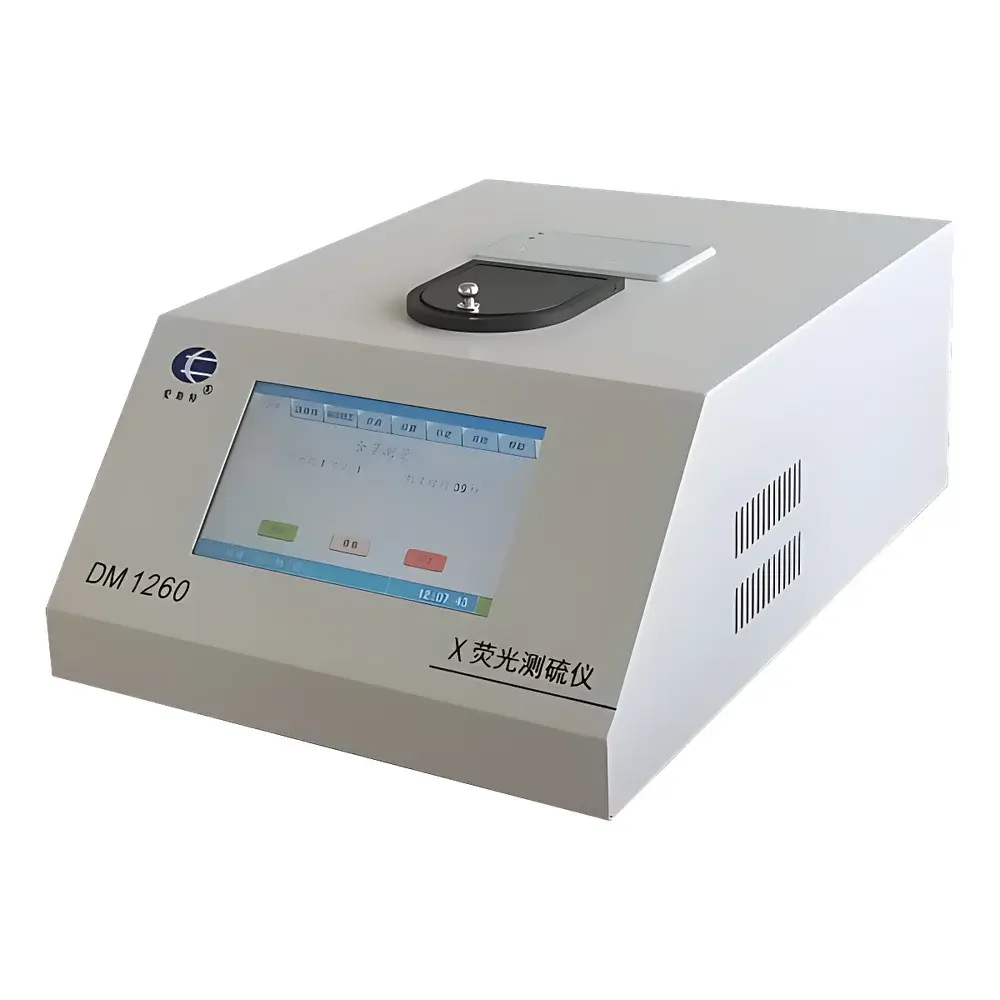
ASTEL DM1260 Energy-Dispersive X-ray Fluorescence (EDXRF) Sulfur Analyzer (2019 Edition)
| Brand | ASTEL/ST |
|---|---|
| Origin | Shanghai, China |
| Model | DM1260 |
| Detection Method | Total Sulfur Quantification |
| Detection Limit (300 s) | 3.9 ppm |
| Compliance | GB/T 17040–2019, GB 17411, ASTM D4294 |
| X-ray Tube | ≤20 kV, ≤1 mA, ≤10 W |
| Detector | Ultra-thin Be-window Proportional Counter |
| Measurement Range | 3×LOD to 9.99 wt% S |
| Analysis Time | 1–999 s (recommended: 100 s for major, 300 s for trace) |
| Operating Environment | 5–40 °C, ≤85% RH at 30 °C, 220 V ±20 V, 50 Hz, ≤100 W |
| Dimensions & Weight | 300 × 410 × 165 mm, 10 kg |
Overview
The ASTEL DM1260 Energy-Dispersive X-ray Fluorescence (EDXRF) Sulfur Analyzer (2019 Edition) is a dedicated benchtop instrument engineered for precise, non-destructive quantification of total sulfur (S) in petroleum products—including gasoline, diesel, jet fuel, residual fuel oil, lubricants, and refinery intermediates—as well as coal, cement, carbon black, and other solid or liquid matrices. It operates on the fundamental principle of energy-dispersive X-ray fluorescence: a low-power X-ray tube (≤20 kV, ≤1 mA) excites sulfur atoms in the sample, inducing characteristic Kα emission at 2.307 keV; this fluorescent radiation is resolved and counted by an ultra-thin beryllium-window proportional counter, optimized with secondary filtration and geometric alignment to minimize background and maximize peak-to-background ratio. Unlike combustion-based methods (e.g., UV fluorescence or microcoulometry), EDXRF requires no acid digestion, gas supply, vacuum system, or consumable reagents—enabling rapid, operator-safe, and environmentally compliant analysis under ambient atmospheric conditions.
Key Features
- Sub-4 ppm detection limit (3.9 ppm at 300 s counting time), fully satisfying the PLOQ (Practical Limit of Quantitation) requirement of 16 ppm specified in GB/T 17040–2019
- Digital pulse processing architecture incorporating FPGA and DSP-based multi-channel analyzer (MCA), reducing dead time and improving count throughput versus legacy analog MCA designs
- Upgraded ultra-low-background proportional counter with thinner Be window (≤8 µm), coupled with refined source–detector–sample geometry and optimized high-voltage/current/target material configuration
- Automatic C/H ratio correction algorithm compensating for matrix effects across diverse hydrocarbon samples, enhancing accuracy without manual dilution or standard matching
- Three-range calibration capability (low: 0–1000 ppm; medium: 0.1–1 wt%; high: 1–4.6 wt%), each supported by five certified reference materials yielding linear calibration curves with r > 0.999
- Integrated 7-inch color touchscreen interface with intuitive workflow navigation, eliminating external keyboard and enabling true one-button operation
- Embedded thermal printer and internal flash memory supporting ≥10,000 measurement records with timestamp, sample ID, and result metadata; data export via USB to PC in CSV format
- Robust industrial-grade housing (10 kg, footprint < 0.13 m²) designed for laboratory, QC floor, and field-deployable use; radiation shielding meets national exemption-level requirements (GBZ 188)
Sample Compatibility & Compliance
The DM1260 accommodates liquid samples (neat or diluted with solvent), viscous fuels (e.g., bunker C), and solid powders (e.g., coal ash, catalysts) in standardized polypropylene or Mylar-film-covered sample cups (typically 35 mm diameter, 1–5 mL volume). No digestion, combustion, or chemical derivatization is required. Its performance has been rigorously validated against internationally recognized standards: it complies with the precision and bias criteria defined in ASTM D4294 (Standard Test Method for Sulfur in Petroleum and Petroleum Products by Energy-Dispersive X-ray Fluorescence Spectrometry), meets the repeatability (r) and reproducibility (R) limits stipulated in GB/T 17040–2019 across all concentration tiers (ppm to %), and satisfies the scope and methodology requirements of GB 17411 (Marine Fuel Oil Specifications). The instrument’s firmware and data handling architecture support audit-ready operation under GLP and ISO/IEC 17025 environments, including full electronic record retention and user-access logging.
Software & Data Management
Firmware version 2019.3 implements a deterministic real-time operating system (RTOS) with secure boot and write-protected calibration parameters. All measurement data—including raw spectra, net peak intensity, background-subtracted counts, and corrected concentration values—are stored with full traceability: operator ID, date/time stamp, sample name, analysis duration, tube settings, and detector gain status. The onboard database supports hierarchical search by batch ID, date range, or concentration interval. USB mass-storage mode allows direct drag-and-drop transfer of .csv files to Windows/Linux systems; optional PC software (ASTEL DataLink v2.1) provides spectral visualization, curve fitting diagnostics, and report generation compliant with ISO 17025 documentation templates. Audit trails are retained for ≥12 months and cannot be altered without administrative authentication.
Applications
The DM1260 serves critical roles across upstream, midstream, and downstream petroleum operations: monitoring desulfurization efficiency in hydrotreaters; verifying compliance with ultra-low-sulfur diesel (ULSD, ≤10 ppm) and marine fuel (IMO 2020, ≤0.5 wt%) specifications; screening crude assay batches; certifying lubricant additive packages; and supporting R&D in catalyst development. Beyond petrochemicals, it is deployed in cement quality control (sulfate content in clinker), coal trading (ASTM D3177 sulfur reporting), environmental testing labs (soil/sediment S screening), and academic research requiring rapid elemental profiling without sample destruction. Its portability and low power demand (<100 W) make it suitable for mobile labs and remote site deployment.
FAQ
Does the DM1260 require vacuum or helium purge for sulfur analysis?
No. It operates under ambient air atmosphere; the thin Be window and optimized spectral deconvolution eliminate the need for gas purging.
Can the instrument analyze solid samples such as catalysts or coal powders?
Yes. Homogeneous solids can be analyzed directly in flat-bottomed cups; particle size reduction and pelletizing (with binder) are recommended for improved homogeneity.
Is method validation support available for regulatory submissions?
Yes. ASTEL provides IQ/OQ documentation templates, linearity/repeatability test reports per ASTM D4294 Annex A1, and instrument-specific uncertainty budgets aligned with EURACHEM/CITAC guidelines.
What maintenance is required beyond routine calibration verification?
Annual verification of X-ray tube output stability and detector resolution (Mn Kα FWHM) is recommended; no consumables or scheduled replacement parts are required within the first five years of operation.
How does the automatic C/H ratio correction improve accuracy for unknown fuel blends?
It applies empirically derived attenuation coefficients based on real-time measurement of carbon and hydrogen Compton/Rayleigh scattering ratios, correcting for variations in density and atomic number without requiring prior knowledge of base hydrocarbon composition.






