
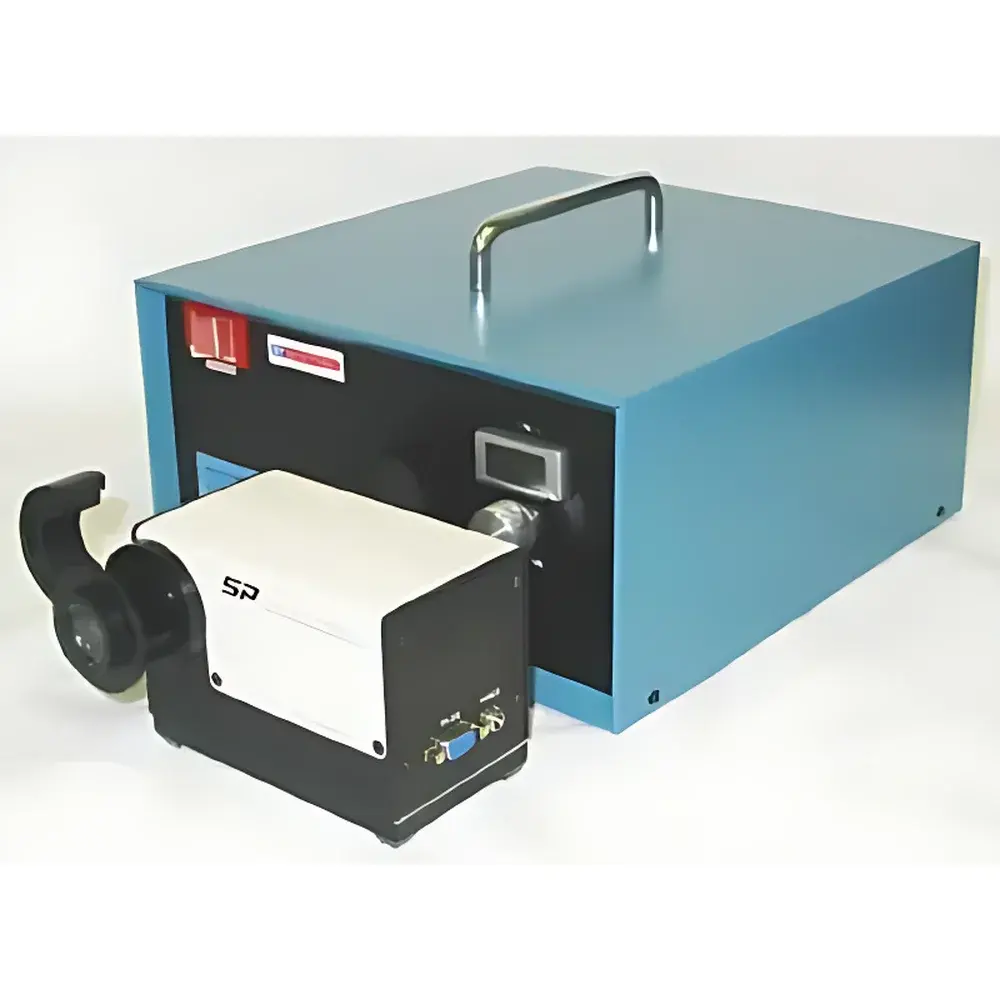
ASTN-D1-W150 Hybrid Deuterium-Halogen Tunable Light Source with IR Extension Capability
| Origin | USA |
|---|---|
| Manufacturer Type | Authorized Distributor |
| Origin Category | Imported |
| Model | ASTN-D1-W150 |
| Component Category | Broadband Tunable Light Source |
| Light Source Configuration | Single 30 W Deep-UV Deuterium Lamp + 150 W Halogen Lamp |
| Typical Deuterium Lamp Lifetime | 1,000 h (min. 500 h) |
| Typical Halogen Lamp Lifetime | 50–2,000 h |
| Monochromator | CM110, f/3.9 |
| Grating Capacity | Dual pre-installed gratings |
| Interface | RS-232 Serial |
| Scan Modes | Bidirectional |
| Scan Units | nm, Å, cm⁻¹, eV |
| Optional IR Extension | SiC Thermal Source (1–16 µm) |
| Fiber Coupling Options | SMA, FC, CS Ferrule (AFCM-L-XX series, sold separately) |
| Filter Mount | AB202 |
| Filter Series | AB3XXX |
Overview
The ASTN-D1-W150 is a high-stability, hybrid broadband tunable light source engineered for precision spectroscopic applications requiring continuous spectral coverage from the deep ultraviolet (185 nm) through the visible and into the near-infrared (up to 2.6 µm). Its core architecture integrates a 30 W deep-UV deuterium lamp—optimized for stable continuum emission below 400 nm—and a 150 W halogen lamp delivering high radiance in the visible to NIR range. The system couples directly to a CM110 monochromator (f/3.9), enabling wavelength selection with high throughput and low stray light. Unlike fixed-wavelength or LED-based sources, this configuration provides true analog spectral scanning with calibrated linearity across multiple units (nm, Å, cm⁻¹, eV), supporting both absorption, reflectance, and fluorescence excitation measurements under controlled irradiance conditions.
Key Features
- Hybrid dual-lamp design ensures seamless spectral continuity from 185 nm to 2.6 µm without manual lamp swapping or intensity discontinuities.
- CM110 monochromator with dual-grating turret enables rapid switching between UV-optimized and VIS-NIR-optimized dispersion profiles—no realignment required.
- Bidirectional scanning with programmable step resolution supports kinetic spectral acquisition and high-reproducibility wavelength calibration traceable to NIST-traceable standards.
- RS-232 serial interface enables full remote control via LabVIEW, Python, or MATLAB; compatible with third-party DAQ systems and automated optical benches.
- Modular fiber coupling (SMA/FC/CS ferrule options) allows direct integration with spectrometers, integrating spheres, or custom sample chambers—mechanical alignment fixtures included as standard.
- Optional SiC thermal source upgrade extends usable output to 16 µm (mid-IR), maintaining mechanical and electrical compatibility with existing monochromator and control firmware.
Sample Compatibility & Compliance
The ASTN-D1-W150 is designed for use in ISO/IEC 17025-accredited laboratories and complies with electromagnetic compatibility (EMC) requirements per FCC Part 15 Class A and IEC 61326-1. Its stable output and calibrated wavelength scale support method validation per ASTM E275 (UV-Vis spectrophotometer qualification) and USP <857> (spectral bandwidth verification). When operated with appropriate attenuators and neutral density filters (AB3XXX series), it meets laser safety Class 1 enclosure requirements for benchtop optical setups. Lamp lifetime specifications are defined under constant-current operation at rated voltage; halogen lamp color temperature variants (low/high) permit optimization for specific detector quantum efficiency curves (e.g., InGaAs vs. Si photodiodes).
Software & Data Management
Control software (provided free of charge) delivers native support for scan parameter scripting, real-time intensity normalization, and automatic grating change compensation. All scan logs—including timestamp, lamp status, grating position, slit width, and encoder counts—are written to CSV and HDF5 formats with embedded metadata (wavelength accuracy ±0.2 nm, repeatability ±0.05 nm). Audit trails comply with FDA 21 CFR Part 11 when deployed on validated Windows OS platforms with user access controls enabled. Raw spectral data exports are fully compatible with OriginLab, Igor Pro, and Python’s SciPy ecosystem for advanced curve fitting and multivariate analysis.
Applications
- UV-Vis-NIR spectrophotometer calibration and performance verification (per ISO 17025 clause 5.5.2).
- Quantitative absorbance measurement of nanomaterials, thin films, and biological chromophores across multi-band transitions.
- Excitation-emission matrix (EEM) spectroscopy for dissolved organic matter (DOM) characterization in environmental water analysis.
- Reflectance standards development for hyperspectral imaging systems operating from 200 nm to 2500 nm.
- In situ optical sensor validation, including fiber-optic pH and oxygen probes requiring broadband excitation stability.
- Photochemical reaction monitoring where precise photon flux control across UV and visible bands is critical (e.g., photocatalysis kinetics).
FAQ
What is the spectral resolution achievable with the CM110 monochromator in this configuration?
Resolution depends on selected grating groove density and exit slit width; typical values range from 0.2 nm (1200 g/mm grating, 10 µm slit) to 2.5 nm (300 g/mm grating, 100 µm slit), measured at FWHM.
Can the system operate in continuous-scan mode for time-resolved measurements?
Yes—scan speed is software-configurable from 0.01 nm/s to 10 nm/s, with position feedback enabling synchronization to external triggers (TTL input/output ports available via optional I/O module).
Is lamp intensity stabilization supported?
Deuterium lamp output is regulated via constant-current driver; halogen intensity is stabilized via closed-loop thermistor feedback. Optional photodiode-based intensity monitor (AB-PDM-1, sold separately) provides real-time correction signals.
How is wavelength calibration maintained over time?
Factory calibration uses Hg/Ne spectral lines; users may perform recalibration using optional AB-CAL-1 mercury-argon reference lamp kit, traceable to NIST SRM 2034.
Are GMP/GLP-compliant installation qualification (IQ) and operational qualification (OQ) protocols available?
Yes—validated IQ/OQ documentation packages, including test scripts, acceptance criteria, and electronic signature workflows, are available upon request for regulated pharmaceutical and clinical diagnostics environments.





