
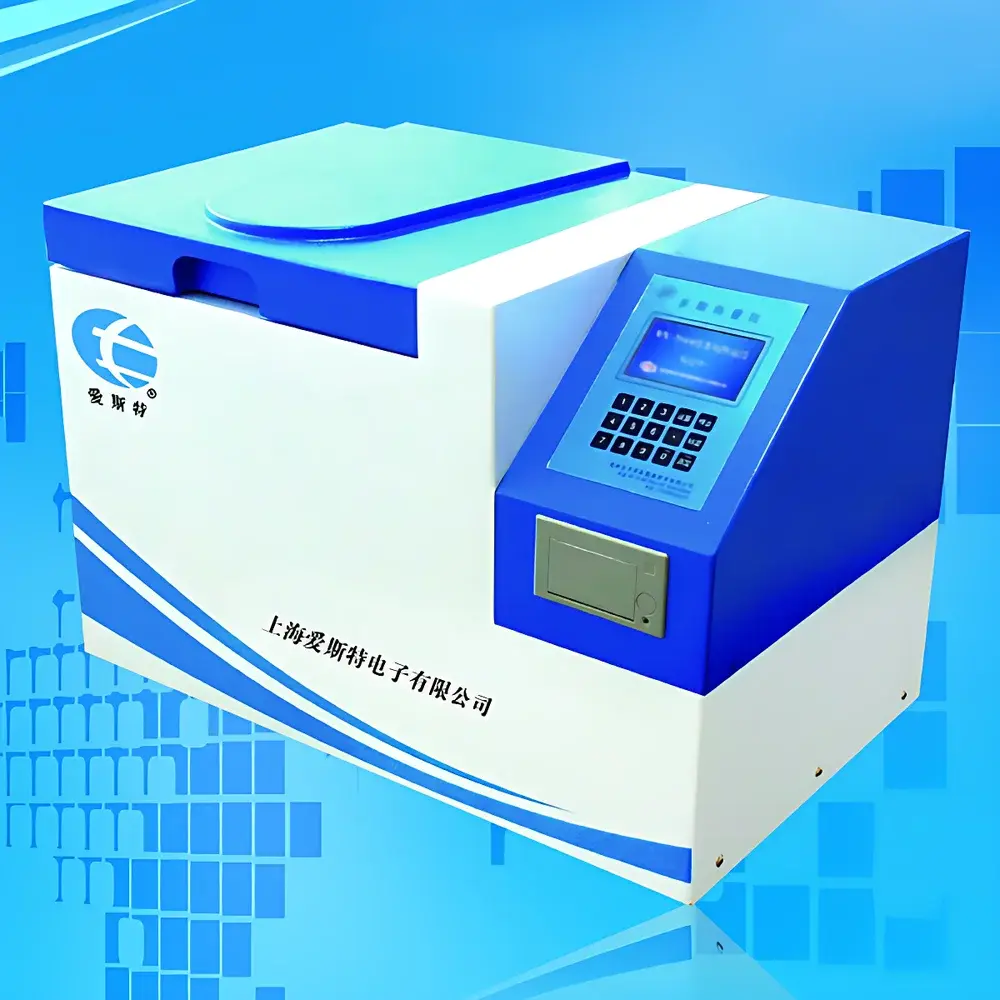
ASTR DM3300 Fully Automated Oxygen Bomb Calorimeter
| Brand | ASTR/ST |
|---|---|
| Origin | Shanghai, China |
| Manufacturer Type | Authorized Distributor |
| Country of Origin | China |
| Model | DM3300 |
| Price | USD 3,500 (FOB Shanghai) |
| Measurement Range | 1,000–40,000 kJ/kg |
| Accuracy | Relative Standard Deviation ≤0.2% |
| Temperature Resolution | 0.0001 K |
| Test Duration | ~15 min per sample |
| Power Consumption | ≤60 W |
| Dimensions | 650 mm × 390 mm × 450 mm |
| Operating Ambient | 10–35 °C, RH ≤80%, 220 V ±10% AC |
Overview
The ASTR DM3300 Fully Automated Oxygen Bomb Calorimeter is a precision adiabatic or isoperibol-style bomb calorimeter engineered for high-reproducibility determination of gross calorific value (GCV) in solid fuels and combustible materials. It operates on the principle of constant-volume combustion calorimetry: a precisely weighed sample is ignited under high-pressure oxygen (typically ≥3.0 MPa) inside a stainless-steel oxygen bomb submerged in a thermally stabilized water jacket. The heat released during complete combustion is quantified via high-resolution temperature measurement of the surrounding water bath, corrected for thermal exchange using an automated cooling correction algorithm based on the Nernst–Planck interpolation method. Designed for compliance with ISO 1928, ASTM D5865, GB/T 213, and EN 14918, the DM3300 delivers traceable, GLP-aligned results suitable for quality control, regulatory reporting, and interlaboratory comparison in coal-intensive industries.
Key Features
- Fully automated operational sequence: auto-filling of inner vessel with distilled water, oxygen pressurization, ignition, stirring, real-time temperature acquisition, thermal drift correction, and result calculation—requiring no manual intervention post-sample loading.
- Integrated high-stability platinum resistance thermometer (Pt1000) with 0.0001 K resolution and NIST-traceable calibration certificate supplied.
- Microprocessor-controlled adiabatic/isoperibol mode selection, enabling adaptive compensation for ambient fluctuations—ensuring consistent accuracy across seasonal variations (10–35 °C operating range).
- Intelligent balance interface via RS232 or USB serial protocol: sample mass data transferred directly to the calorimeter’s control unit, eliminating transcription errors and supporting 21 CFR Part 11–compliant audit trails when paired with validated software.
- Robust stainless-steel oxygen bomb assembly rated to 4.0 MPa burst pressure, compliant with ISO 17025 mechanical safety requirements; includes dual-seal O-rings, nickel-plated ignition electrodes, and corrosion-resistant crucibles.
- Energy-efficient design with ≤60 W total power draw and passive thermal insulation—reducing long-term operational costs without compromising measurement stability.
Sample Compatibility & Compliance
The DM3300 accepts solid heterogeneous samples including bituminous and anthracite coals, coke, biomass pellets, refuse-derived fuel (RDF), and industrial sludges. Sample mass range: 0.5–1.2 g (optimized for <1% moisture content). The system supports both benzoic acid (certified reference material, CRM) and coal standard reference materials (e.g., NIST SRM 1840b, GBW11100 series) for daily calibration and performance verification. All measurement protocols align with ISO/IEC 17025:2017 clause 7.7 (uncertainty estimation), ASTM D5865 Annex A1 (precision statements), and Chinese national standard GB/T 213–2008. Full documentation packages—including instrument qualification (IQ/OQ/PQ) templates, calibration logs, and maintenance records—are provided for GMP and ISO 9001 audits.
Software & Data Management
The embedded firmware runs ASTR CaloSoft v3.2, a Windows-compatible application supporting local data storage (CSV, PDF, XML), password-protected user roles (operator, supervisor, administrator), and configurable report templates per ISO 17025 requirements. Raw temperature-time datasets are retained with timestamps, operator ID, and environmental metadata. Optional upgrade to CaloSoft-GLP enables electronic signatures, change history logging, and FDA 21 CFR Part 11–compliant audit trails. Data export conforms to LIMS-friendly formats (ASTM E1382, HL7) and supports direct integration with enterprise SAP QM or LabWare LIMS modules via OPC UA.
Applications
- Quality assurance laboratories in coal-fired power plants, cement kiln operations, and coking facilities for routine GCV verification against contractual specifications.
- R&D departments evaluating alternative fuels (e.g., torrefied biomass, tire-derived fuel) for energy density optimization and emissions modeling.
- Third-party testing organizations performing accredited calorific value certification per ISO/IEC 17025 scope.
- Government metrology institutes conducting interlaboratory comparisons and proficiency testing schemes.
- Educational institutions teaching thermodynamics, fuel chemistry, and analytical instrumentation principles at undergraduate and graduate levels.
FAQ
What standards does the DM3300 comply with for calorific value testing?
ISO 1928, ASTM D5865, EN 14918, GB/T 213, and DIN 51900.
Can the DM3300 be validated for GLP or GMP environments?
Yes—full IQ/OQ/PQ documentation, calibration certificates, and optional CaloSoft-GLP software enable compliance with FDA 21 CFR Part 11 and EU Annex 11 requirements.
Is external cooling water required?
No—the system uses air-cooled thermostatic jacketing; no chiller or tap-water connection is needed.
How is thermal exchange corrected during measurement?
Via dynamic cooling correction calculated from pre- and post-combustion temperature slopes using the Regnault–Pfaundler method, implemented in real time by the embedded PID controller.
What maintenance intervals are recommended?
O-ring replacement every 500 tests; bomb hydrostatic test annually; thermometer recalibration biannually or per ISO/IEC 17025 internal schedule.



