
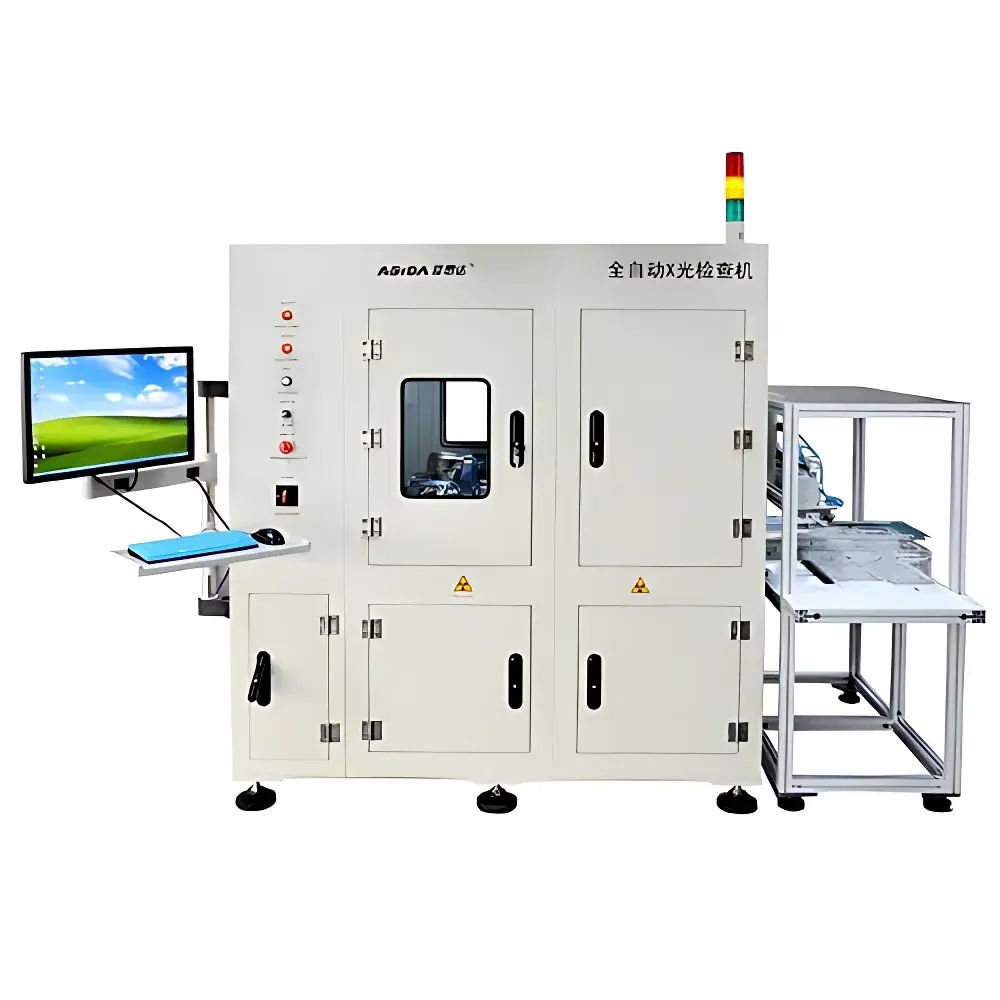
Astroda XG5120 Inline Automated X-ray Inspection System for Pouch Cell Battery Quality Control
| Brand | Astroda |
|---|---|
| Model | XG5120 |
| Origin | Guangdong, China |
| X-ray Tube Voltage | 90 kV |
| X-ray Tube Current | 200 µA |
| Focal Spot Size | 5 µm |
| Cooling Method | Forced Air Cooling |
| Detection Accuracy | 40 µm |
| Radiation Leakage | ≤1 µSv/hr (per IEC 61331-1 & FDA 21 CFR §1020.40) |
| Throughput | ≥30,000 units/day |
| Reconfiguration Time | 0.5–2 h |
| Compliance | CE, ISO 13485 (for medical device manufacturing support), GB/T 18871-2002, IEC 62495 |
Overview
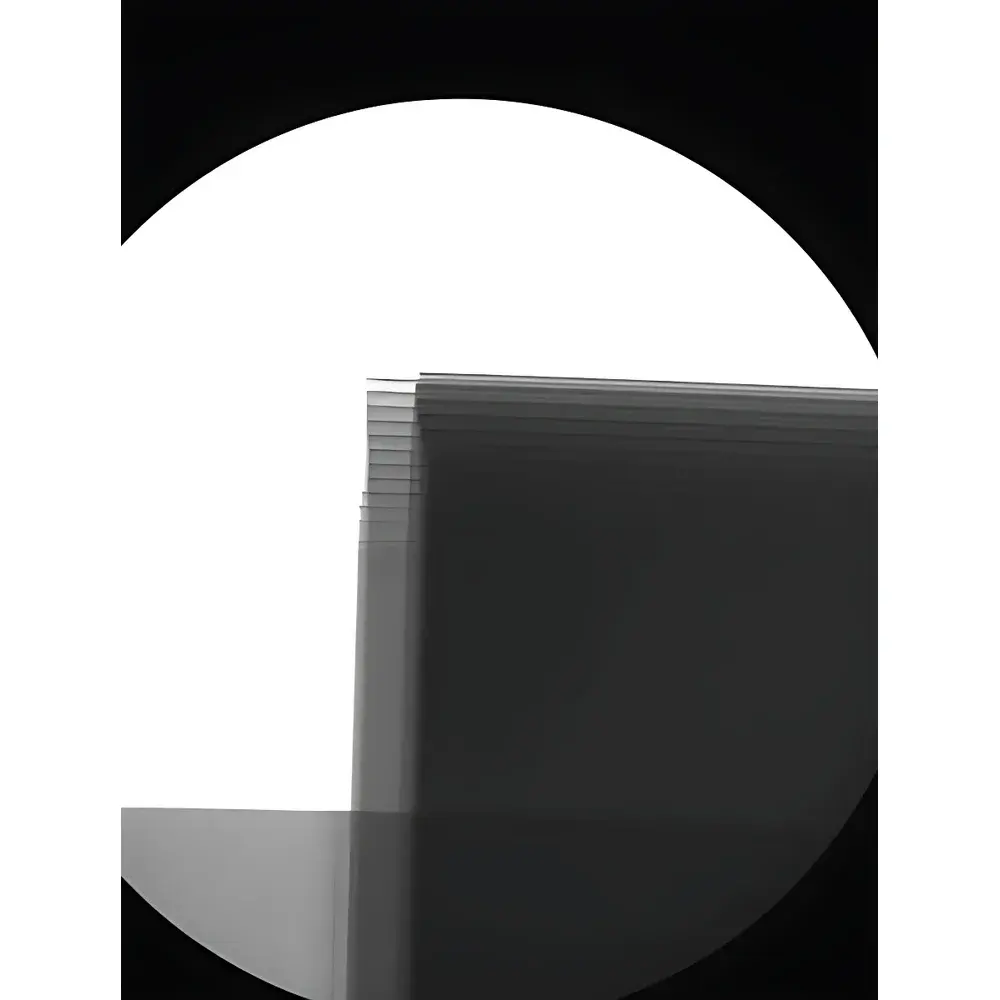
The Astroda XG5120 is an industrial-grade, inline automated X-ray inspection system engineered specifically for high-throughput quality assurance of lithium-ion pouch cells in battery manufacturing environments. It operates on the principle of transmission radiography: a microfocus X-ray source emits photons that penetrate the pouch cell assembly, and dual high-resolution optical imaging systems—comprising scintillator-coupled CMOS detectors with real-time frame synchronization—capture differential attenuation patterns across the anode/cathode stack, tab welds, foil alignment, and sealing integrity. Unlike manual or offline inspection platforms, the XG5120 integrates directly into continuous production lines, enabling 100% in-process verification without interrupting cycle time. Its architecture supports deterministic image acquisition at sub-50 µm spatial resolution, calibrated to detect critical dimensional deviations—including anode-to-cathode height offset (stack misalignment), foil wrinkling, foreign particle inclusion, and seal voids—within the constraints of soft-pack geometry and aluminum-laminated barrier film attenuation.
Key Features
- Inline integration capability: Equipped with standardized conveyor interfaces (modular belt width, photoelectric sensors, and PLC-compatible I/O) for seamless docking with upstream electrode stacking, hot-pressing, and downstream formation/aging lines.
- Dual-channel imaging architecture: Two synchronized detector modules acquire orthogonal projection views—top-down and side-profile—enabling robust 2D metrology of internal layer registration and edge alignment under varying pouch thickness (3–12 mm).
- Automated defect classification engine: Proprietary vision software performs pixel-level geometric analysis of electrode edges, calculates height differential (ΔH) between anode and cathode terminations with ±40 µm repeatability, and classifies outcomes per user-defined tolerance bands (e.g., ΔH ≤ 80 µm = OK; >80 µm = NG).
- Integrated robotic sorting: A 4-axis pick-and-place manipulator, guided by coordinate mapping from inspection results, segregates NG units into designated reject trays while routing OK units via diverter gates onto main conveyance.
- Radiation safety compliance: Fully shielded cabinet with lead-equivalent acrylic viewing window (≥2.0 mm Pb eq), interlocked access doors, and real-time dosimetry monitoring ensure operator exposure remains ≤1 µSv/hr at 5 cm from any external surface—validated per IEC 61331-1 and aligned with FDA 21 CFR §1020.40 requirements.
- Rapid reconfiguration: Modular tooling fixtures and parameterized recipe management allow changeover between common pouch formats (e.g., 120 × 80 × 4 mm vs. 180 × 120 × 8 mm) within 30–120 minutes, minimizing line downtime.
Sample Compatibility & Compliance
The XG5120 accommodates standard and custom-form factor pouch cells used in consumer electronics, power tools, and EV auxiliary battery modules. Compatible dimensions range from 80 mm × 50 mm × 2.5 mm (minimum) to 220 mm × 150 mm × 12 mm (maximum), with maximum weight capacity of 350 g per unit. All mechanical handling components—including vacuum grippers and low-inertia conveyor belts—are designed to prevent creasing, delamination, or electrolyte leakage during transport. The system complies with ISO 13485:2016 for use in regulated manufacturing environments supporting medical-grade battery assembly, and meets electromagnetic compatibility (EMC) requirements per EN 61326-1. Radiation shielding design adheres to national standards GB/T 18871-2002 and international benchmarks IEC 62495 (safety of industrial X-ray equipment).
Software & Data Management
The embedded inspection software (v3.2+) provides traceable, audit-ready data handling compliant with GLP and GMP principles. Each inspected unit is assigned a unique serial ID linked to timestamped images, measurement logs (including raw pixel coordinates, ΔH values, confidence scores), and pass/fail status. Data export supports CSV, XML, and SQL database protocols; optional OPC UA interface enables integration with MES (e.g., Siemens Opcenter, Rockwell FactoryTalk) and SPC platforms. Audit trails record all user actions—including parameter edits, recipe loads, and calibration events—with immutable timestamps and operator authentication. Software validation documentation (IQ/OQ/PQ templates) and 21 CFR Part 11-compliant electronic signature modules are available upon request for regulated facilities.
Applications
- Quantitative evaluation of anode/cathode height differential in sealed pouch cells pre-formation.
- Detection of internal defects including foil folding, separator displacement, tab misalignment, and seal channel inconsistencies.
- Verification of jelly-roll positioning accuracy relative to pouch edge margins.
- Statistical process control (SPC) of electrode stacking precision across multi-shift production runs.
- Root cause analysis support for yield loss in lamination and hot-pressing processes.
- Pre-shipment screening for Tier-1 battery pack integrators requiring zero-defect delivery protocols.
FAQ
What safety certifications does the XG5120 hold for industrial X-ray operation?
The system is certified to IEC 61331-1 for radiation protection, complies with GB/T 18871-2002 national radiation safety limits, and meets mechanical safety standards per EN ISO 13857. Full test reports and type examination certificates are provided with delivery.
Can the XG5120 be integrated with existing factory automation protocols (e.g., Profibus, EtherNet/IP)?
Yes—it features configurable digital I/O, Modbus TCP, and optional EtherNet/IP or PROFINET gateways for direct PLC communication and status feedback to SCADA systems.
Is remote diagnostics and software update support available?
Standard firmware updates and remote troubleshooting are supported via secure TLS-encrypted VNC session, subject to customer network policy approval.
Does the system support custom measurement algorithms beyond anode/cathode height differential?
Yes—Astroda’s SDK allows qualified engineers to deploy validated third-party vision models or extend metrology logic using Python-based scripting within the embedded runtime environment.
What maintenance intervals and service contracts are recommended?
Preventive maintenance is scheduled every 1,500 operational hours or annually (whichever occurs first); extended warranty and response-time SLAs (4-hr remote, 24-hr onsite) are available under Service Level Agreements.



