
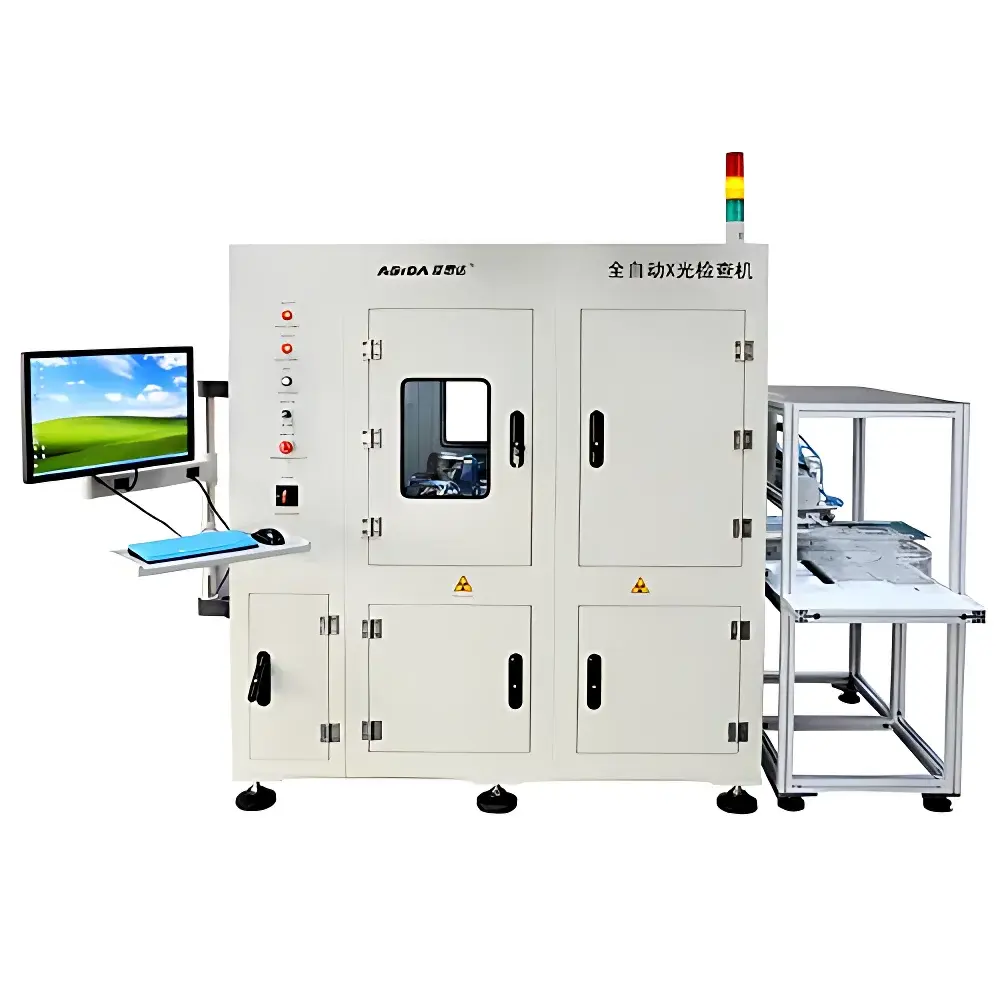
Astroda XG5130 Automated X-ray Inspection System for Pouch Cells
| Brand | Astroda |
|---|---|
| Origin | Guangdong, China |
| Manufacturer Type | Authorized Distributor |
| Country of Origin | China |
| Model | XG5130 |
| Pricing | Available Upon Request |
| X-ray Tube Voltage | 90 kV |
| X-ray Tube Current | 200 µA |
| Focal Spot Size | 5 µm |
| Cooling Method | Forced Air Cooling |
| Detection Accuracy | 40 µm |
| Radiation Leakage | ≤1 µSv/hr (compliant with IEC 61000-4-3 & IEC 62471) |
Overview
The Astroda XG5130 is an industrial-grade, fully automated X-ray inspection system engineered specifically for non-destructive quality control of pouch-type lithium-ion polymer cells. It operates on the principle of transmission radiography: high-energy X-rays penetrate the battery assembly, and differential absorption by internal components—such as anode/cathode foils, separator layers, tab welds, and folding geometry—is captured by dual high-resolution digital imaging systems. The resulting grayscale projection images are processed in real time to quantify critical dimensional parameters—including anode-to-cathode height offset (stack misalignment), electrode overhang, tab positioning accuracy, and foreign material presence. Designed for integration into high-throughput battery manufacturing lines, the XG5130 delivers deterministic pass/fail classification based on user-defined geometric tolerances, supporting statistical process control (SPC) and traceability requirements in ISO 9001- and IATF 16949-certified environments.
Key Features
- Fully automated inline operation: integrated conveyor feed, robotic pick-and-place handling, real-time image acquisition, AI-assisted defect classification, and dual-path sorting (OK/NG) without manual intervention.
- Dual independent imaging architecture: two synchronized flat-panel detectors (FPDs) with pixel pitch ≤40 µm enable simultaneous top-view and side-view radiographic capture, improving defect detection sensitivity for edge-related anomalies (e.g., foil curling, separator shift).
- Rapid model changeover: mechanical and software configuration supports quick adaptation across multiple pouch cell formats (e.g., 30–120 mm width, 50–200 mm length, 3–12 mm thickness); typical reconfiguration time: 30–120 minutes.
- Compliance-ready radiation shielding: lead-lined enclosure with interlocked safety doors, real-time dosimetry monitoring, and verified leakage rate ≤1 µSv/hr at 5 cm from any external surface—meeting IEC 61000-4-3 (EMC), IEC 62471 (photobiological safety), and local regulatory limits for Class II X-ray equipment.
- Robust industrial design: IP54-rated housing, servo-driven precision stages, and vibration-damped optical platform ensure stable imaging performance under continuous 24/7 production conditions.
Sample Compatibility & Compliance
The XG5130 accommodates standard and custom-form factor pouch cells—including bare electrodes, jellied or laminated stacks, and fully assembled modules—with nominal dimensions ranging from 30 × 50 × 3 mm to 120 × 200 × 12 mm. It supports both dry-cell and pre-activated (wet) configurations, provided electrolyte fill levels remain within specified containment limits. All image analysis algorithms are validated per ASTM E2737-22 (“Standard Practice for Digital Radiographic Testing”) and aligned with internal QC protocols used by Tier-1 battery OEMs. System documentation includes full traceability logs compliant with GLP/GMP data integrity principles, including audit trails for parameter changes, operator login events, and measurement result exports.
Software & Data Management
The proprietary Astroda VisionInsight™ software suite provides a calibrated, FDA 21 CFR Part 11–ready environment for image acquisition, metrology, and reporting. Core capabilities include sub-pixel edge detection for electrode height differential measurement (±40 µm repeatability), customizable AOI (Automated Optical Inspection) rule sets, batch-level SPC charting (X-bar/R, Cpk), and CSV/PDF report generation with embedded radiographs and timestamped metadata. Data export supports direct integration with MES platforms via OPC UA or RESTful API. Audit trail functionality records all user actions—including threshold adjustments, calibration updates, and result overrides—with immutable timestamps and electronic signatures.
Applications
- Quantitative measurement of anode/cathode stack height deviation (critical for preventing internal short circuits during cycling).
- Detection of separator wrinkles, electrode folding defects, and tab misalignment beyond ±0.1 mm tolerance.
- Verification of jelly-roll concentricity and foil cut-edge integrity in pre-lamination and post-lamination stages.
- Foreign object detection (FOD) down to 30 µm metallic particulates using contrast-enhanced multi-frame averaging.
- Process validation support for APQP Phase 3 (Production Part Approval Process) and PPAP submissions in automotive battery supply chains.
FAQ
What safety certifications does the XG5130 hold?
The system complies with IEC 61000-4-3 (EMC immunity), IEC 62471 (radiation safety), and meets national Class II X-ray device registration requirements in China (NMPA), EU (CE), and North America (FDA 21 CFR 1020.40). Full compliance documentation is provided upon order.
Can the XG5130 interface with existing factory MES or SCADA systems?
Yes—via standardized OPC UA server or HTTP-based REST API; protocol mapping templates and engineering support are included in the delivery scope.
Is radiation exposure monitoring included as standard?
Yes—the system integrates a real-time Geiger-Müller dosimeter with audible/visual alarms and automatic beam shutdown if ambient dose exceeds 0.5 µSv/hr at designated monitoring points.
What is the minimum detectable feature size for electrode misalignment?
Under optimal conditions (stable thermal environment, calibrated detector gain, and ≥3× averaging), the system achieves consistent resolution of 40 µm for height differential measurements between stacked foils.
Does Astroda provide application-specific algorithm development?
Yes—custom metrology logic (e.g., dynamic overhang calculation, curvature profiling) can be developed and validated under NDA, with delivery timelines aligned to customer APQP milestones.



