
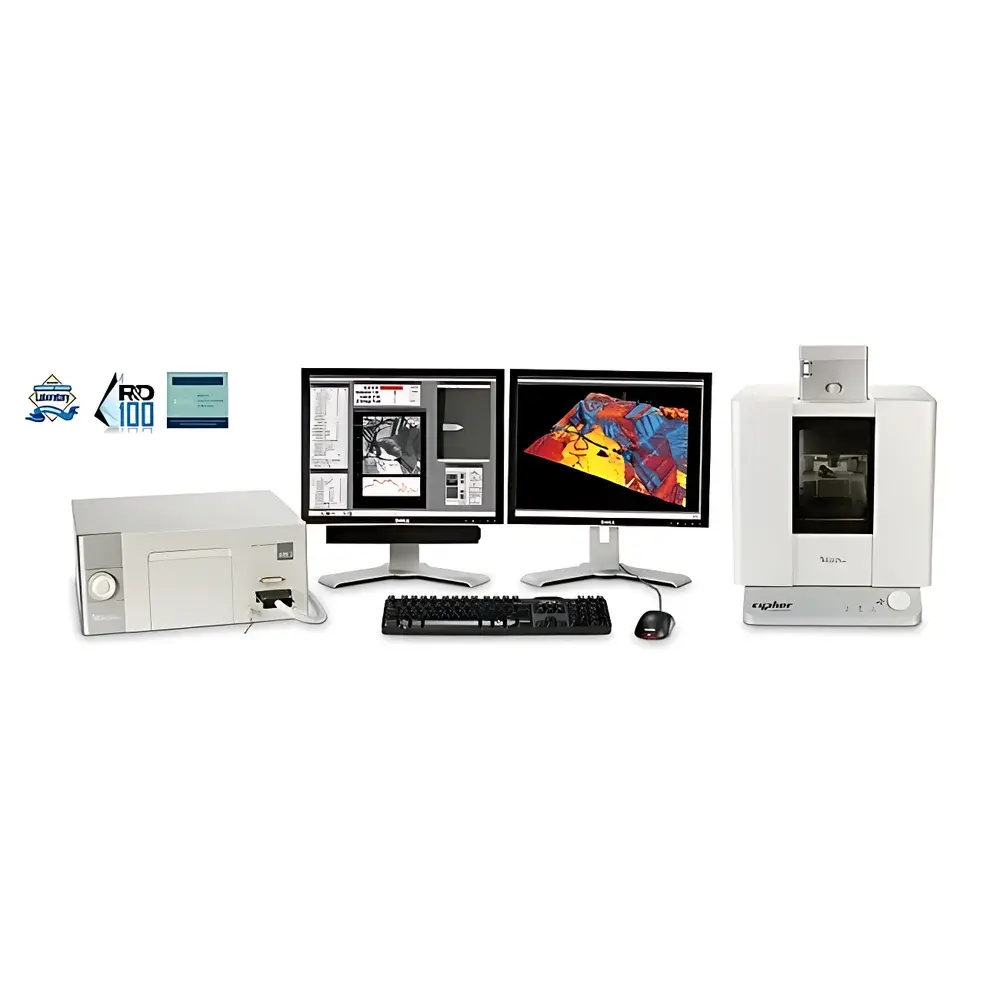
Asylum Research GetReal Automated Cantilever Calibration Module for MFP-3D and Cypher Series AFMs
| Brand | Oxford Instruments |
|---|---|
| Origin | Germany |
| Manufacturer Type | Authorized Distributor |
| Origin Category | Imported |
| Model | GetReal |
| Price Range | USD 13,500 – 68,000 |
| Instrument Type | AFM Calibration Module |
Overview
The Asylum Research GetReal Automated Cantilever Calibration Module is an integrated software-hardware feature engineered exclusively for the MFP-3D and Cypher series atomic force microscopes (AFMs). It implements a rigorously validated dual-method calibration protocol—combining thermal noise analysis and the Sader method—to simultaneously determine both cantilever sensitivity (V/m) and spring constant (N/m) in a fully automated, non-contact manner. Unlike conventional contact-based calibration techniques that require physical indentation of the tip onto rigid substrates—a process prone to tip damage, reproducibility loss, and operator variability—GetReal eliminates mechanical interaction with the sample or calibration surface. This preserves tip apex integrity, ensures consistent probe geometry across measurement sessions, and directly supports quantitative nanomechanical mapping with traceable metrological confidence. The module operates within Asylum’s Interactive Mode™ architecture and requires no additional hardware; it leverages the microscope’s existing photodetector, laser alignment, and thermal noise acquisition capabilities.
Key Features
- Fully automated dual-method calibration: Simultaneous determination of cantilever sensitivity and spring constant using thermal noise and Sader methodologies per Rev. Sci. Instrum. 77, 013701 (2006)
- Non-contact operation: No physical engagement between tip and substrate during calibration—eliminates tip wear, chipping, or blunting
- Single-click workflow: User selects cantilever model from an embedded library; system executes full calibration sequence without manual intervention
- Integrated validation: Real-time signal-to-noise assessment and spectral quality metrics ensure data fidelity prior to result acceptance
- No hardware add-ons required: Fully implemented via firmware and software upgrade on compatible MFP-3D and Cypher AFM platforms
- Backward compatibility: Available as a free software update for qualifying legacy instruments meeting minimum controller and firmware version requirements
Sample Compatibility & Compliance
GetReal is independent of sample properties and does not require reference standards, calibration gratings, or auxiliary equipment. It functions identically across ambient, liquid, and controlled-environment configurations supported by the host AFM platform. Calibration results are traceable to fundamental physical constants (Boltzmann constant, temperature, fluid viscosity, and geometric dimensions), aligning with ISO/IEC 17025 principles for measurement uncertainty estimation. While not a standalone certified instrument, GetReal supports GLP- and GMP-compliant workflows when deployed within validated AFM systems—particularly where force quantification is critical (e.g., cell elasticity assays per ASTM E2524, polymer modulus mapping per ISO 14577-1). All calibration parameters, timestamps, and raw thermal spectra are stored in the native .ibw data format with embedded metadata, enabling audit-ready documentation.
Software & Data Management
GetReal operates natively within Asylum Research’s Igor Pro–based AFM control software (version 9.30 or later). Calibration logs—including cantilever ID, acquisition date/time, ambient temperature, fluid medium (if applicable), thermal power spectral density (PSD) plots, fitted resonance frequency, Q-factor, and final sensitivity/spring constant values—are automatically appended to the experiment metadata header. Export options include CSV for external statistical analysis and HDF5 for interoperability with Python-based scientific computing environments (e.g., SciPy, scikit-learn). Audit trail functionality complies with FDA 21 CFR Part 11 requirements when configured with electronic signatures and role-based access controls enabled at the system level. No third-party licenses or cloud dependencies are required.
Applications
- Quantitative nanomechanical imaging: Elastic modulus, adhesion, and viscoelastic parameter mapping in biological cells, hydrogels, and soft polymers
- Force spectroscopy standardization: Enabling cross-laboratory comparability in single-molecule pulling experiments
- High-throughput screening: Accelerating probe qualification in industrial QC labs performing routine AFM-based material characterization
- Education and training: Providing students with immediate access to metrologically sound calibration practices without requiring advanced instrumentation expertise
- Method validation studies: Supporting ISO/IEC 17025 accreditation efforts for AFM-based mechanical property testing laboratories
FAQ
Is GetReal compatible with third-party cantilevers?
Yes—provided the cantilever geometry and nominal spring constant fall within the validated range specified in the Asylum Research Cantilever Compatibility Matrix (v2.1). Custom cantilevers require user-input geometric parameters for Sader calculation.
Does GetReal replace the need for thermal tuning?
No—it incorporates thermal tuning as an essential input step; however, it automates spectral acquisition, baseline correction, and peak fitting, reducing subjectivity in resonance identification.
Can calibration results be exported for regulatory submission?
Yes—full calibration records, including raw PSD data and processing scripts, are exportable in machine-readable formats compliant with ALCOA+ data integrity principles.
What is the typical calibration duration per cantilever?
Approximately 60–120 seconds, depending on signal-to-noise ratio and environmental stability; no user supervision is required after initiation.
Is GetReal validated against NIST-traceable reference methods?
While Asylum does not claim NIST certification for GetReal itself, its underlying thermal noise and Sader algorithms have been benchmarked against primary-standard interferometric calibration in peer-reviewed interlaboratory studies (e.g., J. Phys. D: Appl. Phys. 50, 485101, 2017).





