
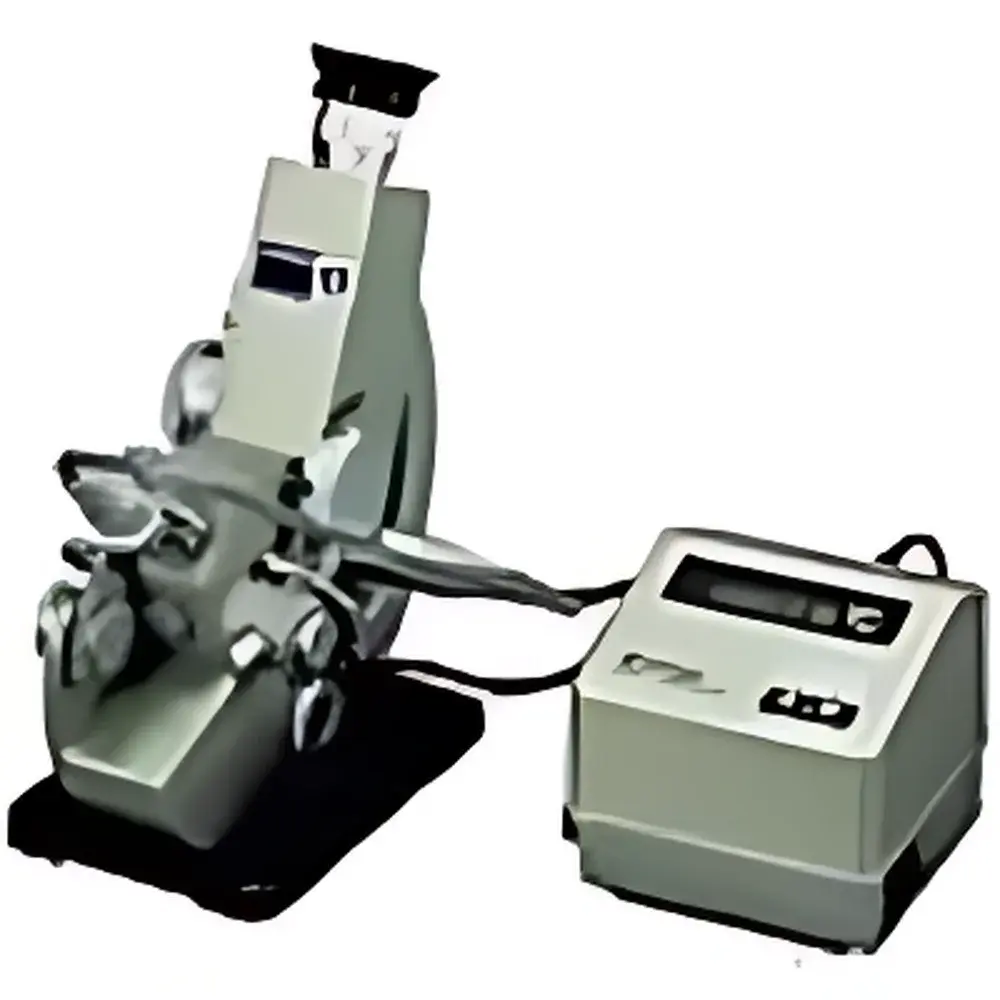
ATAGO 1T Abbe Refractometer
| Brand | ATAGO |
|---|---|
| Origin | Japan |
| Model | 1T |
| Measurement Range | nD 1.3000–1.7000 / Brix 0.0–95.0% |
| Resolution | 0.001 (nD) / 0.5% (Brix) |
| Accuracy | ±0.0002 (nD) / ±0.1% (Brix) |
| Temperature Range | 0.0–50.0°C (Resolution: 0.1°C, Accuracy: ±0.2°C) |
| Light Source | 8 V, 0.15 A tungsten lamp |
| Power Supply | 100–240 VAC, 50/60 Hz, 6 VA |
| Dimensions & Weight | 13 × 18 × 23 cm, 3.4 kg |
Overview
The ATAGO 1T Abbe Refractometer is a precision optical instrument engineered for high-accuracy refractive index (nD) and Brix concentration measurements of transparent or semi-transparent liquids and solids. Based on the classical Abbe principle—utilizing total internal reflection at the prism-sample interface—the instrument determines refractive index by locating the critical angle of refraction under monochromatic illumination approximating the sodium D-line (589.3 nm). Unlike traditional Abbe refractometers requiring external sodium vapor lamps, the 1T integrates a stabilized tungsten-filament light source with an interference filter to deliver spectrally optimized D-line-equivalent illumination, eliminating dependency on fragile or regulated spectral sources while maintaining metrological traceability. Its robust mechanical design, temperature-controlled prism stage, and calibrated ocular scale enable direct analog readout with minimal operator training, making it suitable for routine QC laboratories, academic teaching labs, and R&D environments where ISO/IEC 17025-compliant manual measurement protocols are maintained.
Key Features
- Optical system compliant with Abbe refractometer standards per ISO 21147:2022 and ASTM D1218–21 for refractive index determination.
- Integrated D-line-equivalent illumination using a precision 8 V, 0.15 A tungsten lamp with narrow-band interference filter—no external sodium lamp required.
- High-resolution analog scale with vernier adjustment: 0.001 refractive index units (nD) and 0.5% Brix resolution.
- Temperature-compensated prism assembly with built-in digital temperature sensor (range: 0.0–50.0°C; accuracy ±0.2°C; resolution 0.1°C), supporting manual correction via standard conversion tables (e.g., nF–nC dispersion data).
- Stainless-steel and aluminum alloy chassis ensuring long-term dimensional stability and resistance to laboratory environmental fluctuations.
- Low-power operation (6 VA) compatible with universal AC input (100–240 VAC, 50/60 Hz), certified to IEC 61010-1 for electrical safety in laboratory use.
Sample Compatibility & Compliance
The 1T accommodates both liquid and solid samples—including aqueous solutions, oils, polymers, glasses, and crystalline materials—provided they exhibit sufficient optical clarity and surface flatness for prism contact. Liquid samples require volumes of ~0.1–0.3 mL; solids must be polished to optical flatness and mounted with matching-index immersion oil. The instrument complies with key international standards governing refractometric analysis, including ISO 21147 (optical materials), ISO 2150 (sugar solutions), and AOAC Official Method 932.12 (Brix in fruit juices). While not inherently 21 CFR Part 11 compliant (as it lacks electronic audit trail functionality), its analog output supports GLP-aligned documentation when paired with controlled logbooks and validated SOPs. Calibration verification is performed using certified reference standards traceable to NIST SRM 1484 (water) and SRM 84a (sucrose solutions).
Software & Data Management
The ATAGO 1T operates as a standalone analog instrument without embedded microprocessor or digital interface. Consequently, it does not include proprietary software, USB connectivity, or automated data export. All readings are recorded manually from the ocular scale, supporting paper-based or LIMS-integrated workflows where human transcription is part of documented procedure. For laboratories requiring digital capture, optional third-party USB microscopes or digital eyepiece adapters may be employed—though such configurations fall outside ATAGO’s factory validation scope and require user-specific IQ/OQ validation per GMP Annex 11 guidelines.
Applications
- Quality control of sucrose, glucose, and fructose solutions in food & beverage manufacturing (per USP General Chapter 781 and Codex Alimentarius STAN 1-1985).
- Concentration monitoring of coolants, antifreeze mixtures, and battery electrolytes in automotive and industrial maintenance.
- Refractive index profiling of optical resins, adhesives, and lens materials during formulation and curing studies.
- Educational demonstration of dispersion, Snell’s law, and critical angle phenomena in undergraduate physics and chemistry curricula.
- Raw material verification for pharmaceutical excipients where nD serves as a release specification (e.g., polyethylene glycols, propylene glycol).
FAQ
Does the 1T support automatic temperature compensation (ATC)?
No—it provides real-time sample temperature measurement but requires manual application of published temperature-correction factors (e.g., from ATAGO’s nD/T lookup tables) for reporting at 20°C.
Can the 1T measure opaque or turbid samples?
No—Abbe principle relies on sharp critical-angle definition; suspended particles or high scattering invalidate measurement. Centrifugation or filtration is required prior to analysis.
Is calibration traceable to national standards?
Yes—users calibrate using ATAGO-certified reference fluids (e.g., distilled water, nD = 1.3330 at 20°C) traceable to NIST SRMs via ATAGO’s ISO/IEC 17025-accredited calibration laboratory.
What maintenance is required?
Daily prism cleaning with lens tissue and xylene-free optical cleaner; annual verification of scale alignment and temperature sensor drift by authorized service centers.
Is the 1T suitable for ISO 17025-accredited testing?
Yes—when operated within a documented quality system, with trained personnel, calibrated standards, and uncertainty budgets incorporating repeatability (≤0.0001 nD), reproducibility (≤0.0003 nD), and temperature error contributions.



