
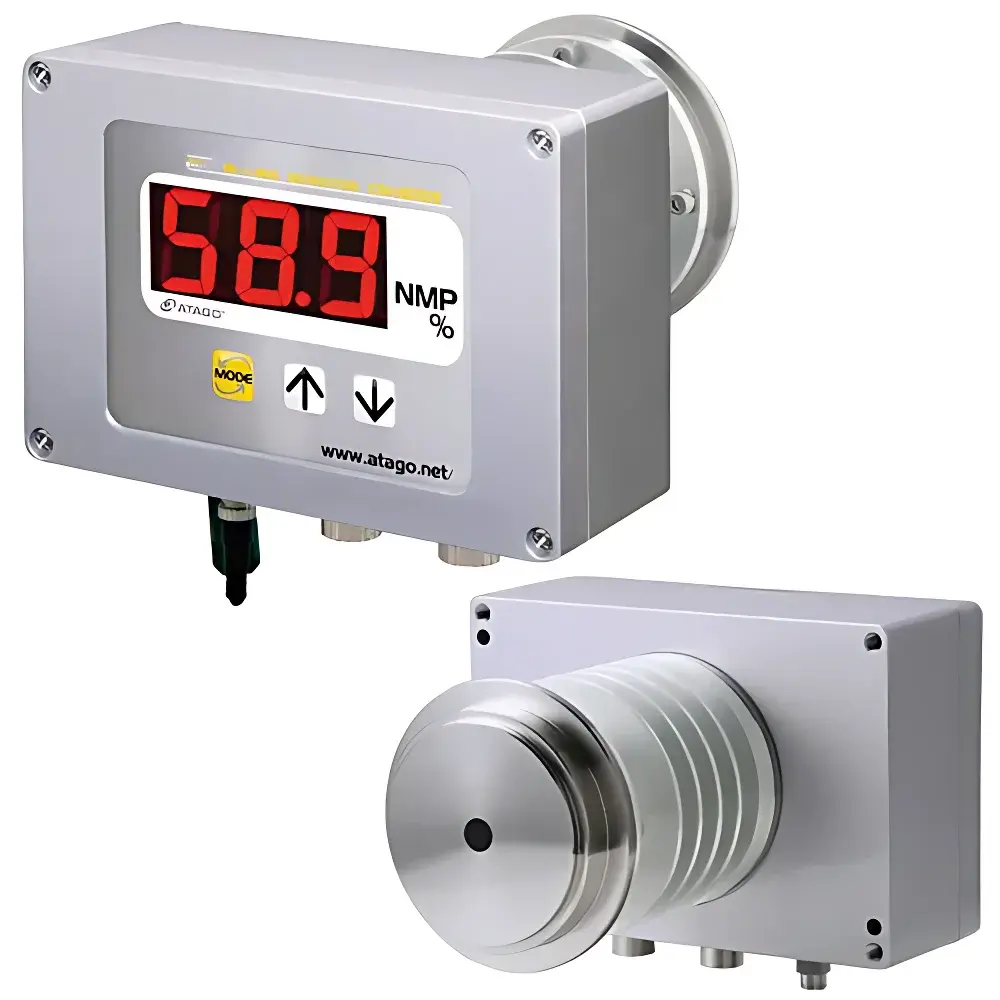
ATAGO CM-800α-NMP In-Line Refractometer for N-Methyl-2-Pyrrolidone (NMP) Concentration Monitoring
| Brand | ATAGO |
|---|---|
| Origin | Japan |
| Model | CM-800α-NMP |
| Product Type | In-Line Refractometer |
| Temperature Control | Yes |
| Digital Display | Yes |
| Measurement Range | Brix 0.00–80.0% |
| Accuracy | ±0.1% Brix |
| Prism Material | Synthetic Sapphire |
| Housing Material | SUS316L |
| IP Rating | IP67 |
| Output | DC 4–20 mA & RS-232C |
| Light Source | LED (D-line equivalent) |
| Auto-Temperature Compensation (ATC) Range | 10–60 °C |
| Operating Ambient Temperature | 5–40 °C |
| Measurement Interval | ~1 second (configurable up to 5 presets) |
| Dimensions | 160 × 167 × 110 mm |
| Weight | 2.4 kg |
| Power Supply | DC 24 V (AC 100 V optional with AD-32 adapter) |
Overview
The ATAGO CM-800α-NMP is a purpose-engineered in-line refractometer designed for continuous, real-time concentration monitoring of N-methyl-2-pyrrolidone (NMP) in industrial solvent recovery and purification processes. Operating on the principle of critical-angle refractometry, the instrument measures the refractive index of process liquid flowing through its flow cell and converts it—via pre-calibrated polynomial algorithms—into precise NMP concentration values expressed as mass percentage (% w/w). Unlike offline sampling methods, the CM-800α-NMP eliminates manual intervention, sample degradation, and time lag, enabling closed-loop control of distillation endpoints during NMP reclamation. Its optical path is sealed within a sapphire prism and stainless-steel (SUS316L) wetted housing, ensuring long-term stability under aggressive chemical exposure and thermal cycling typical in semiconductor, lithium-ion battery electrode coating, and specialty polymer manufacturing environments.
Key Features
- High-stability LED light source emitting at ~589 nm (D-line equivalent), optimized for refractive index linearity across the NMP concentration range (0.0–100.0% w/w)
- Integrated automatic temperature compensation (ATC) spanning 10–60 °C, minimizing thermal drift using an embedded Pt100 sensor with ±1 °C accuracy
- IP67-rated ruggedized enclosure suitable for installation in classified industrial zones, including ISO Class 7 cleanrooms and solvent-handling areas with splash or condensation risk
- Dual-output interface: isolated 4–20 mA analog signal for PLC integration and RS-232C serial communication for direct data logging or host-system configuration
- Configurable measurement interval (default: 1 s; five user-selectable settings) to match process dynamics without oversampling or latency
- Refractometer prism fabricated from synthetic sapphire (Al₂O₃), offering exceptional chemical resistance to NMP, DMF, DMAc, and other polar aprotic solvents
Sample Compatibility & Compliance
The CM-800α-NMP is validated for use with aqueous and non-aqueous NMP solutions, including recycled streams containing trace impurities such as water, residual monomers, or low-volatility by-products. It complies with IEC 61000-6-2 (immunity) and IEC 61000-6-4 (emissions) for industrial electromagnetic compatibility. While not intrinsically safe certified, its DC24V operation and sealed construction support deployment in Zone 2/Class I Division 2 environments when installed per local electrical codes. The device supports audit-ready operation under GLP and GMP frameworks: all calibration events, parameter changes, and output logs can be timestamped and exported via RS-232C, aligning with FDA 21 CFR Part 11 requirements for electronic records when paired with compliant data acquisition software.
Software & Data Management
No proprietary PC software is required for basic operation; however, ATAGO provides the free *Refractometer Utility* application for Windows-based configuration, real-time data visualization, and calibration file management. Through RS-232C, users may select output modes—including refractive index (nD), Brix-equivalent, or custom % w/w—enabling seamless mapping to internal LIMS or MES platforms. All calibration coefficients are stored in non-volatile memory with write-protection against accidental overwrite. The unit retains factory calibration traceability to JCSS (Japan Calibration Service System) standards, with optional NIST-traceable verification reports available upon request.
Applications
- Real-time endpoint detection in NMP solvent recovery loops for lithium battery cathode/anode slurry production
- Concentration feedback control in continuous distillation columns processing spent NMP from polyimide film casting lines
- Process validation and batch release testing in pharmaceutical excipient synthesis where NMP serves as reaction medium
- Quality assurance of incoming NMP shipments via inline verification prior to storage tank transfer
- Monitoring concentration stability during ultrafiltration or membrane separation of NMP-water mixtures
FAQ
Can the CM-800α-NMP measure NMP concentration directly in the presence of dissolved polymers or particulates?
Yes—provided suspended solids remain below 5 µm and do not adhere to the sapphire prism surface. For high-turbidity streams, optional inline filtration (e.g., 5-µm cartridge) upstream of the flow cell is recommended.
Is recalibration required after installation in a new pipeline?
A single-point zero calibration using pure NMP (≥99.9%) is advised post-installation to compensate for minor thermal expansion effects in the flow cell gasket. Full two-point calibration is only necessary if process conditions deviate significantly from factory settings.
Does the instrument support Modbus RTU or Profibus protocols?
No—the native digital interface is RS-232C only. Protocol conversion to Modbus RTU requires an external industrial protocol gateway.
What is the maximum allowable pressure and flow rate for the standard flow cell?
The standard CM-800α-NMP flow cell is rated for continuous operation up to 0.7 MPa (100 psi) and nominal flow rates of 0.5–5 L/min. Custom high-pressure variants (up to 3.5 MPa) are available upon engineering review.
How often should the sapphire prism be cleaned, and what cleaning agents are approved?
Cleaning frequency depends on process fouling tendency; typically every 7–30 days. Use only deionized water followed by lint-free wipe with 99.9% isopropanol. Avoid halogenated solvents, strong acids, or abrasive cleaners.





