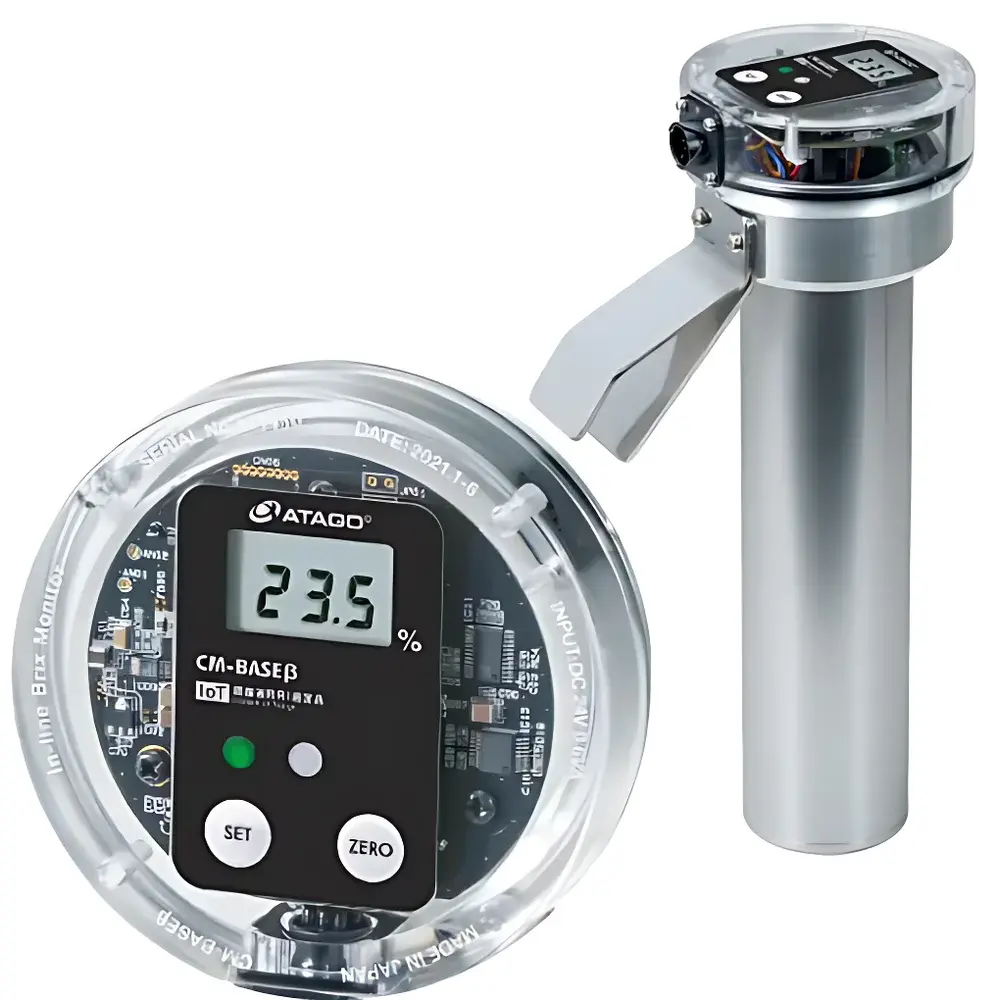
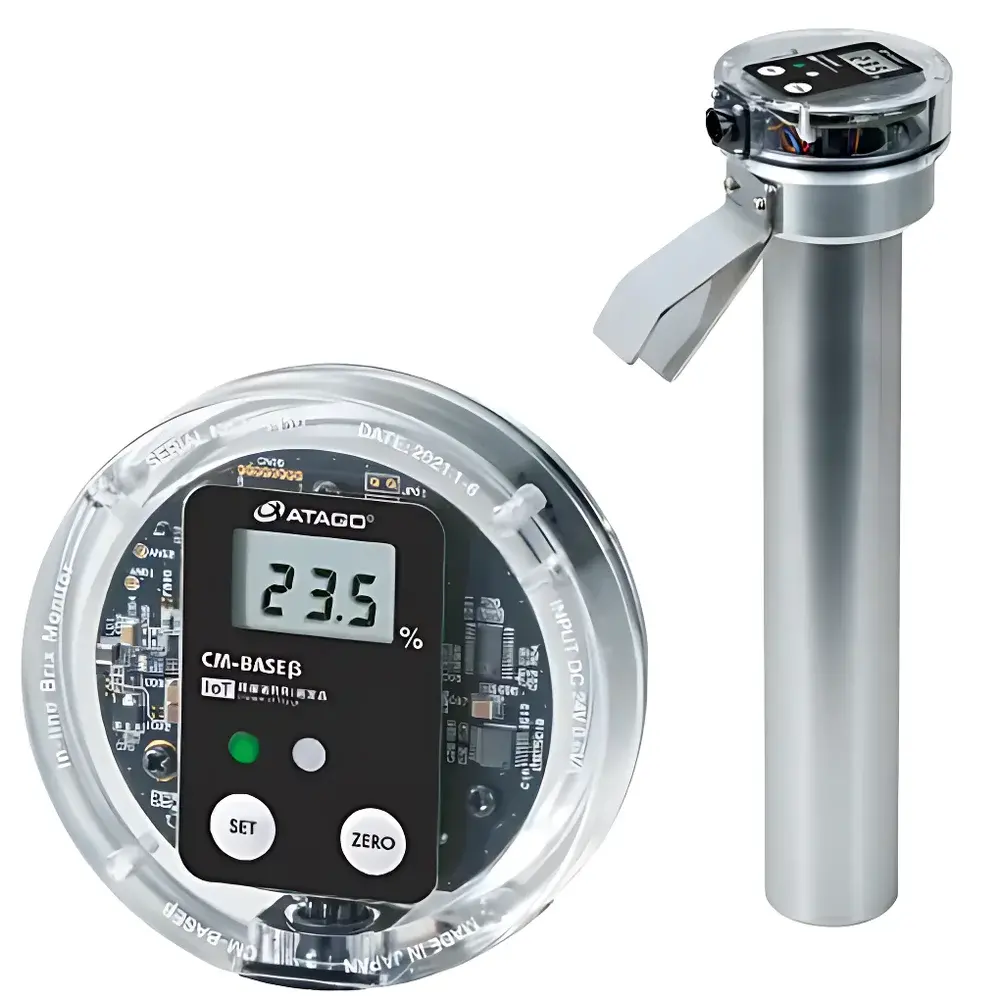
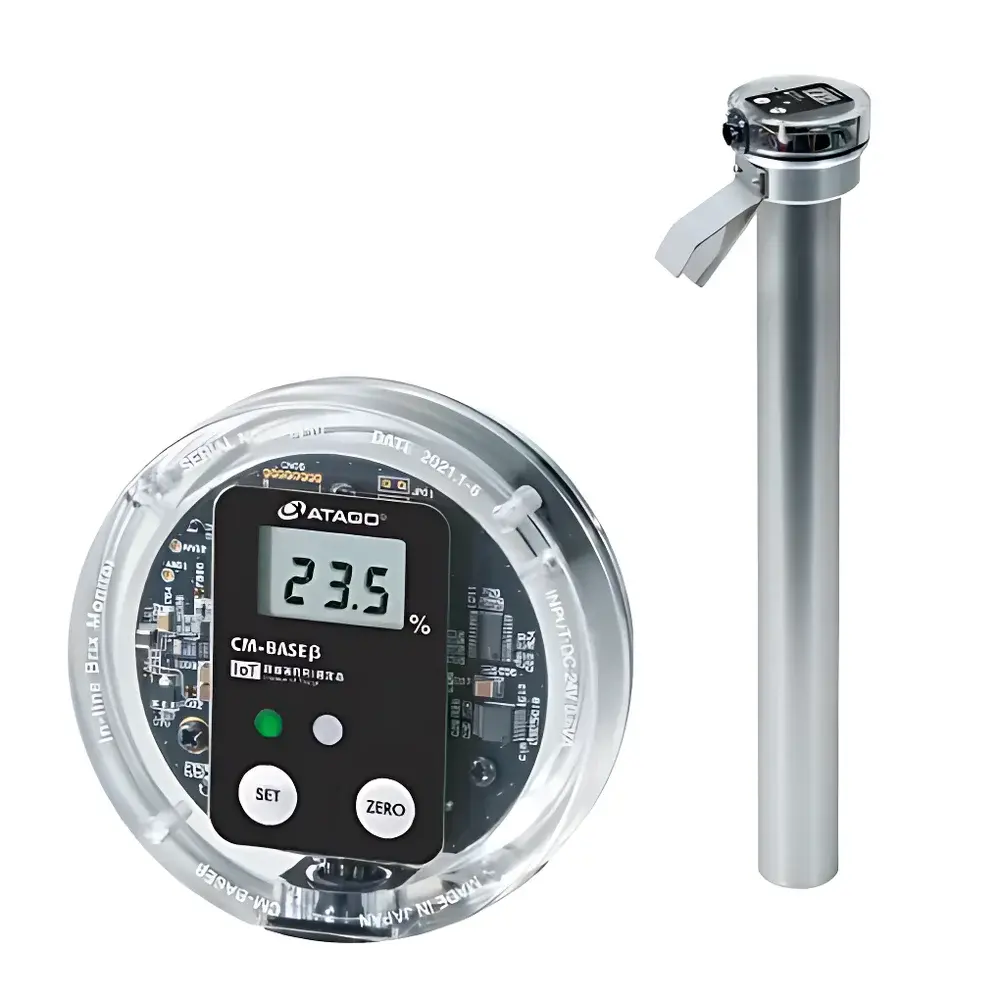
ATAGO CM-BASE β Inline Refractometer (Edge-Mountable for Tanks and Vessels)
| Brand | ATAGO |
|---|---|
| Origin | Japan |
| Model | CM-BASE β (Edge-Mountable) |
| Measurement Range | 0.0–93.0% Brix (ATC) |
| Temperature Compensation Range | 10–95°C |
| Resolution | 0.1% Brix |
| Accuracy | ±0.2% Brix |
| Output | DC 4–20 mA / RS-232C |
| IP Rating | IP67 |
| Power Supply | DC 24 V |
| Probe Length Options | 200 mm (P/N 5851), 300 mm (P/N 5852), 500 mm (P/N 5853) |
Overview
The ATAGO CM-BASE β Inline Refractometer is a robust, edge-mountable process refractometer engineered for continuous, real-time measurement of soluble solids concentration—expressed as Brix—in liquid streams within tanks, vessels, and open troughs. Operating on the principle of critical-angle refractometry, the instrument directs a collimated light beam through the process liquid in direct optical contact with a sapphire prism interface. The refractive index is determined by detecting the angle at which total internal reflection occurs, which correlates directly to solute concentration. Built-in automatic temperature compensation (ATC) ensures stable Brix readings across a wide operational range (10–95°C), eliminating manual correction and supporting reliable process control in dynamic thermal environments. Designed for integration into food & beverage, chemical, pharmaceutical, and bioprocessing lines, the CM-BASE β delivers high reproducibility and long-term stability without requiring flow cells or bypass loops—minimizing installation complexity and maintenance overhead.
Key Features
- Edge-mountable mechanical design enables rapid, tool-free installation on tank rims, vessel flanges, or open-channel edges—no welding, drilling, or process shutdown required.
- Three standardized probe lengths (200 mm, 300 mm, 500 mm) accommodate varying immersion depths and vessel wall thicknesses; each variant carries a unique part number (5851, 5852, 5853) for traceable configuration management.
- Sapphire prism interface provides exceptional chemical resistance, scratch resistance, and thermal stability—suitable for aggressive media including acidic syrups, caustic cleaning solutions, and high-sugar concentrates.
- IP67-rated enclosure ensures full protection against dust ingress and temporary submersion, enabling operation in humid, washdown-intensive environments compliant with USDA and EHEDG hygiene guidelines.
- Dual-output capability: isolated 4–20 mA analog signal for PLC/DCS integration and RS-232C serial interface for local diagnostics, configuration, and firmware updates via terminal software.
- On-device data correction function allows field adjustment of calibration offset based on reference laboratory measurements—supporting ongoing accuracy validation under GLP/GMP-aligned quality systems.
Sample Compatibility & Compliance
The CM-BASE β is validated for use with homogeneous aqueous solutions where Brix serves as a validated proxy for total dissolved solids—including sucrose, glucose, fructose, maltose, and common organic acids found in juice, dairy, fermentation broths, and cleaning-in-place (CIP) solutions. It is not intended for opaque, highly viscous, or particulate-laden slurries that impair optical path clarity. The device complies with IEC 61000-6-2 (EMC immunity) and IEC 61000-6-4 (EMC emissions) standards. Its analog output meets NAMUR NE43 signaling conventions, and its construction supports qualification under FDA 21 CFR Part 11 when paired with validated data acquisition software featuring audit trail and electronic signature functionality.
Software & Data Management
While the CM-BASE β operates autonomously without external software, its RS-232C port enables bidirectional communication with ATAGO’s proprietary configuration utility for setting measurement units, alarm thresholds, temperature compensation parameters, and zero/span calibration points. Process data from the 4–20 mA output can be logged in SCADA, MES, or LIMS platforms with timestamped traceability. For regulated environments, users may implement third-party data historians configured to meet ALCOA+ principles (Attributable, Legible, Contemporaneous, Original, Accurate, Complete, Consistent, Enduring, Available), ensuring alignment with ISO/IEC 17025 and EU Annex 11 requirements.
Applications
- Real-time Brix monitoring during juice concentration, syrup blending, and evaporator feed control in fruit processing facilities.
- Concentration verification of CIP rinse solutions and sanitant dilutions in dairy and beverage plants—supporting automated cycle validation.
- In-line sugar content tracking in confectionery and soft drink bottling lines to maintain flavor consistency and regulatory labeling compliance.
- Monitoring of fermentation broth density in yeast propagation and ethanol production—correlating refractive index with viable cell mass and metabolite accumulation.
- Quality gate checks for incoming raw materials such as molasses, corn syrup, or whey permeate prior to blending or further processing.
FAQ
Does the CM-BASE β require periodic recalibration?
Yes—while the sapphire prism and ATC algorithm ensure long-term stability, ATAGO recommends quarterly verification using certified Brix reference standards (e.g., NIST-traceable sucrose solutions) and adjustment if deviation exceeds ±0.15% Brix.
Can it be installed in pressurized pipelines?
No—the CM-BASE β is designed exclusively for open-tank, free-surface, or low-head static immersion applications. For pressurized line monitoring, ATAGO recommends the PRM series with sanitary tri-clamp mounting.
Is the 4–20 mA output intrinsically safe?
The standard output is non-IS; however, loop-powered isolation barriers compliant with IEC 60079-11 may be integrated upstream to enable use in Zone 2 hazardous locations.
What is the minimum sample depth required for accurate measurement?
A minimum immersion depth of 15 mm above the prism surface is required to ensure stable optical coupling; this is satisfied across all three probe lengths when mounted per ATAGO’s mechanical alignment guide.
How does temperature compensation work in practice?
The built-in Pt1000 RTD sensor measures prism surface temperature in real time; the microprocessor applies a multi-point polynomial correction derived from ATAGO’s empirical Brix–RI–temperature database—validated across 0–100°C for >20 common industrial solutes.
Related Products