
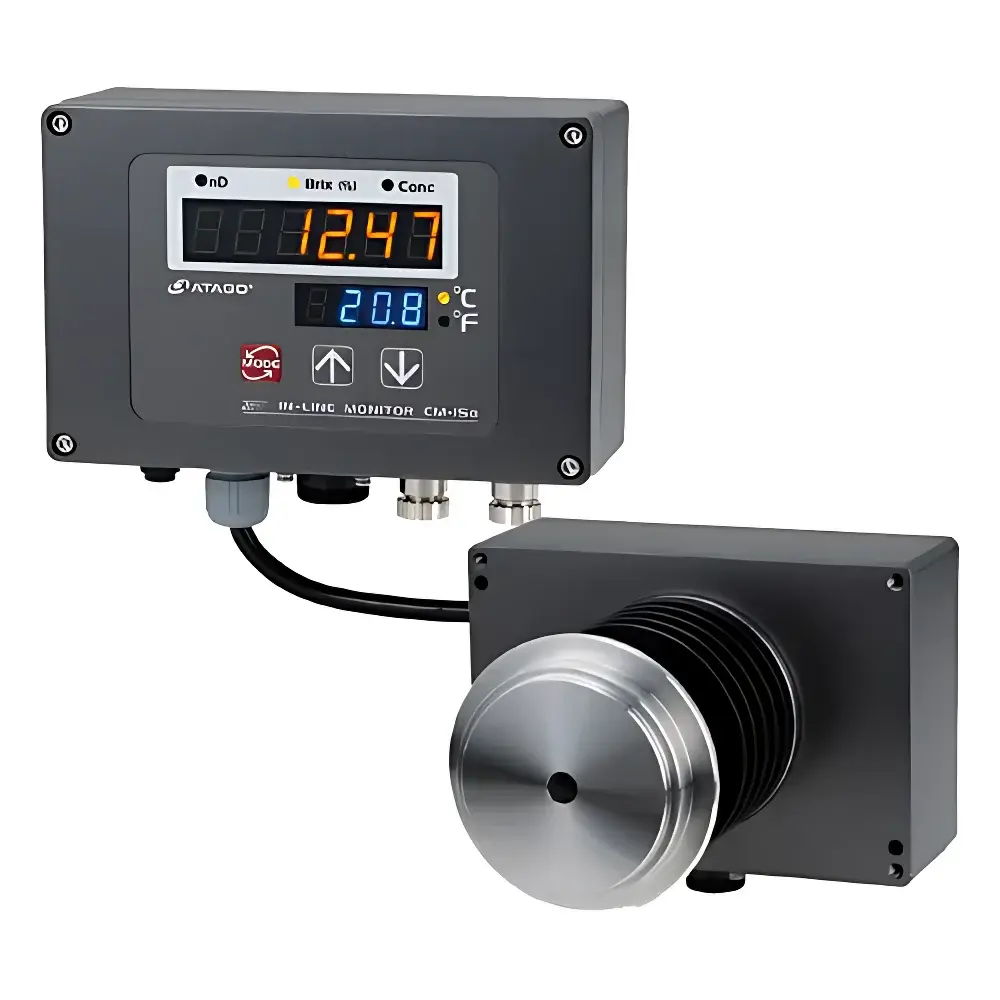
ATAGO CM-ISα Intrinsically Safe In-Line Refractometer for DMF Monitoring
| Brand | ATAGO |
|---|---|
| Origin | Japan |
| Model | CM-ISα |
| Product Type | In-Line Refractometer |
| Temperature Control | Yes |
| Digital Display | Yes |
| Measurement Range | Brix 0.0–80.0% |
| Measurement Accuracy | Refractive Index ±0.0002 |
| Explosion Protection Rating | Ex ia IIB T3 Ga TA |
| Temperature Range | −15 to 160 °C |
| Resolution | RI 0.00001, Brix 0.01% or 0.1%, Temp 0.1 °C |
| Output | 4–20 mA DC or RS-232C |
| Power Supply | 24 V DC |
| ATC Range | 5–100 °C |
Overview
The ATAGO CM-ISα is an intrinsically safe, in-line refractometer engineered for continuous, real-time concentration monitoring of dimethylformamide (DMF) solutions in hazardous industrial environments. Based on the fundamental optical principle of critical-angle refractometry, the instrument measures the refractive index (RI) of process fluids flowing through a sapphire prism interface, then converts the RI value into calibrated Brix (% w/w sucrose equivalent), mass concentration (%), or custom-defined concentration units via factory-established correlation curves. Its core application lies in lithium-ion battery electrode slurry manufacturing, where precise, uninterrupted control of DMF concentration—critical for binder dissolution, slurry viscosity, and coating uniformity—is essential for yield optimization and quality consistency. Unlike offline titration or laboratory-based sampling methods, the CM-ISα eliminates manual intervention, sample handling errors, and measurement latency, delivering traceable, second-by-second data directly into DCS or SCADA systems.
Key Features
- Intrinsically safe design certified to Ex ia IIB T3 Ga TA per IEC 60079-0 and IEC 60079-11, enabling safe deployment in Zone 0/1 classified areas handling flammable solvents such as DMF.
- High-precision sapphire sensing prism with chemical resistance to aggressive organic solvents, abrasion-resistant surface, and minimal fouling under continuous flow conditions.
- Integrated Peltier-based temperature control and high-stability RTD sensor ensure accurate automatic temperature compensation (ATC) across 5–100 °C, critical for maintaining measurement integrity in variable-process thermal environments.
- Dual-resolution Brix output (0.01% or 0.1%) selectable via configuration software, supporting both R&D-grade precision and production-floor robustness.
- Real-time analog output (4–20 mA DC) with HART-compatible protocol and digital RS-232C interface for bidirectional communication, configuration, and firmware updates.
- IP67-rated stainless-steel housing with sanitary tri-clamp or flanged process connections (ANSI/ISO/DIN), suitable for CIP/SIP integration and washdown environments.
Sample Compatibility & Compliance
The CM-ISα is optimized for homogeneous, low-turbidity liquid streams—including DMF, NMP, DMAc, and other polar aprotic solvents used in cathode/anode slurry preparation. It is not intended for suspensions, emulsions, or highly viscous non-Newtonian fluids without prior inline dilution or filtration. The device complies with ISO 21501-4 for optical particle-free fluid characterization methodology and supports audit-ready operation under GLP and GMP frameworks. Its intrinsic safety certification satisfies ATEX Directive 2014/34/EU and NEC 500/505 requirements. Data traceability aligns with FDA 21 CFR Part 11 when integrated with compliant SCADA systems featuring electronic signatures and audit trails.
Software & Data Management
Configuration, calibration, and diagnostics are managed via ATAGO’s proprietary PC-based software (CM-Config Tool), which supports multi-point calibration using certified reference standards (e.g., NIST-traceable sucrose solutions). The software logs all parameter changes, calibration events, and measurement history with timestamps and user IDs. Raw RI, Brix, temperature, and diagnostic flags (e.g., signal strength, prism contamination alert) are timestamped and exportable in CSV format. Optional Modbus TCP gateway modules enable seamless integration with Siemens PCS7, Yokogawa CENTUM VP, or Rockwell FactoryTalk systems for automated setpoint adjustment and SPC charting.
Applications
- Lithium-ion battery manufacturing: Real-time DMF concentration control during PVDF binder dissolution and slurry mixing stages.
- Pharmaceutical solvent recovery: Continuous monitoring of DMF content in distillation overheads and extract streams.
- Chemical synthesis: In-process verification of reaction mixture composition where DMF serves as solvent or reagent carrier.
- Coating and ink formulation: Consistency assurance for DMF-based polymer solutions prior to slot-die or gravure coating.
- Environmental compliance: Verification of DMF residual levels in wastewater pretreatment effluents prior to biological treatment.
FAQ
What is the maximum allowable process pressure for the CM-ISα?
The standard model is rated for continuous operation up to 1.0 MPa (145 psi) at 25 °C; derating applies above 80 °C per ASME B16.5 guidelines.
Can the CM-ISα be calibrated for non-Brix concentration units?
Yes—custom calibration curves for % w/w DMF, % v/v, or density-equivalent units can be programmed using at least three certified reference points.
Is cleaning-in-place (CIP) compatible with the sensor head?
The sapphire prism and 316L wetted parts withstand standard alkaline and acidic CIP cycles (pH 1–13, ≤80 °C, ≤2 hr exposure); validation testing is recommended for site-specific protocols.
Does the device support remote diagnostics over Ethernet?
While native Ethernet is not included, optional RS-232-to-Ethernet converters with Modbus TCP mapping enable remote health monitoring and parameter readout.
How often is recalibration required under continuous operation?
Under stable process conditions and verified prism cleanliness, annual verification against reference standards is recommended; more frequent checks are advised after maintenance, process upsets, or solvent changeovers.




