
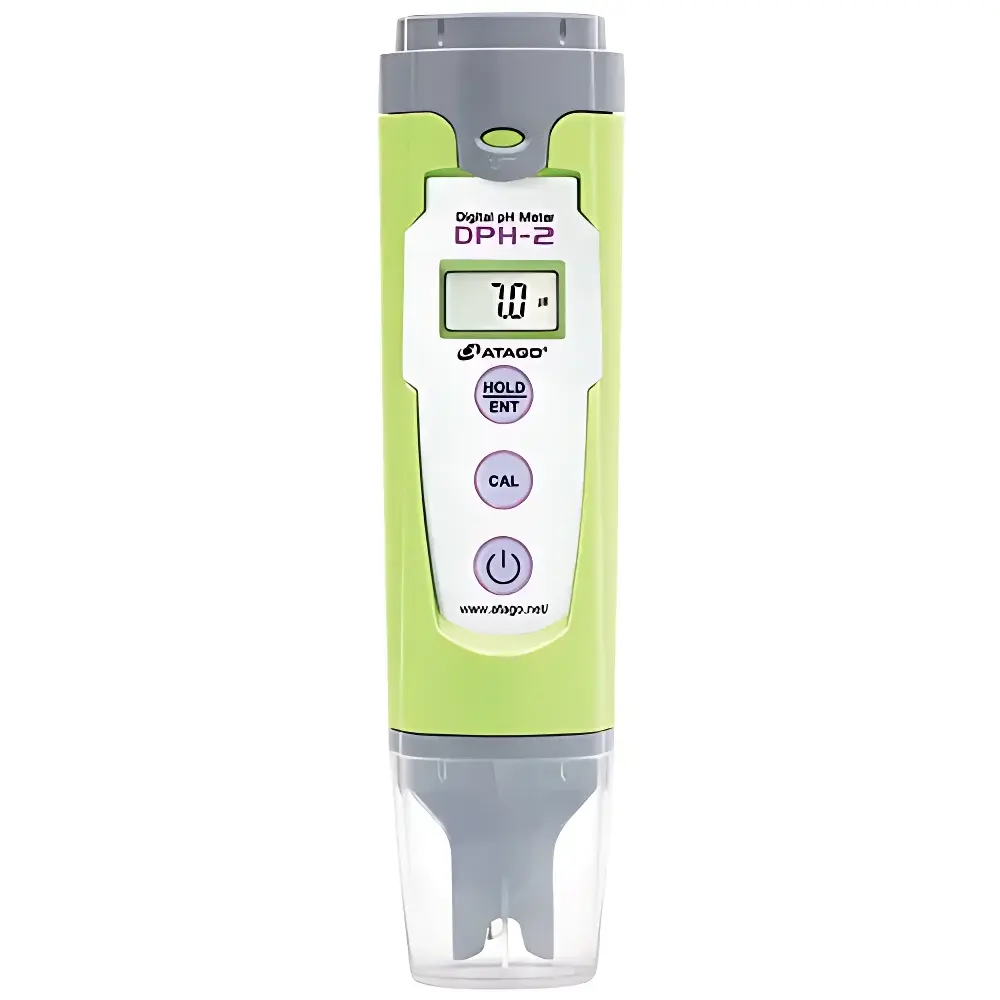
ATAGO DPH-2 Digital Portable pH Meter
| Brand | ATAGO |
|---|---|
| Origin | Japan |
| Model | DPH-2 Digital Portable pH Meter |
| Instrument Type | Pen-style pH Meter |
| Parameter Type | Single-parameter (pH) |
| Measurement Range | 0.0 to 14.0 pH |
| Resolution | ±0.1 pH (2.0–12.0 pH) |
| Accuracy | ±0.1 pH (2.0–12.0 pH) |
| Temperature Range | 0.0–50.0 °C with Automatic Temperature Compensation (ATC) |
| Calibration Points | 4.0, 7.0, and 10.0 pH buffer solutions |
| Ingress Protection Rating | IP67 |
| Power Supply | Four LR44 button cells |
| Dimensions | 4.5 × 3.0 × 16.3 cm |
| Weight | 90 g (without accessories) |
Overview
The ATAGO DPH-2 Digital Portable pH Meter is a compact, pen-style electrochemical instrument engineered for rapid, reliable field and routine laboratory pH measurements across diverse aqueous and semi-aqueous media. Based on potentiometric measurement principles—where the potential difference between a glass pH sensing electrode and a built-in reference electrode is converted into a digital pH reading—the DPH-2 delivers traceable, repeatable results within the full physicochemical pH scale of 0.0 to 14.0. Its integrated Automatic Temperature Compensation (ATC) circuitry utilizes a thermistor embedded in the sensor tip to correct for temperature-induced variations in electrode response, ensuring measurement integrity across ambient conditions from 0.0 °C to 50.0 °C. Designed for operational robustness rather than benchtop complexity, the DPH-2 operates without external power adapters or data cables, relying solely on four standard LR44 alkaline button cells for extended field deployment.
Key Features
- IP67-rated enclosure: Fully dust-tight and submersible up to 1 meter for 30 minutes—enabling direct rinsing under running water or immersion cleaning after exposure to viscous, particulate-laden, or corrosive samples.
- Pen-form factor: Ergonomic, one-handed operation with intuitive single-button interface; ideal for spot-checking in production lines, agricultural fields, wastewater channels, or food preparation zones.
- Triple-point calibration support: Compatible with standard NIST-traceable pH 4.01, 7.00, and 10.01 buffer solutions to maintain linearity and minimize drift over time.
- Stable electrode architecture: Integrated combination pH electrode with low-impedance glass membrane and Ag/AgCl reference system optimized for fast response (<30 seconds to stable reading) and minimal hydration dependency.
- Low-power design: Average battery life exceeds 1,500 measurements per set of LR44 cells; auto-power-off after 10 minutes of inactivity conserves energy without compromising readiness.
Sample Compatibility & Compliance
The DPH-2 is validated for use with aqueous solutions exhibiting moderate ionic strength (≥100 µS/cm), including beverage extracts, fermentation broths, soil leachates, alkaline cleaning agents (pH 11–13), metalworking coolants, and buffered saline preparations. It is not recommended for non-aqueous solvents, highly viscous oils, or samples containing sulfides, heavy metals (e.g., Ag⁺, Pb²⁺), or high concentrations of fluoride—substances known to poison glass electrodes or degrade reference junctions. While not certified to ISO/IEC 17025 or GLP as a standalone unit, its measurement performance aligns with ASTM E70-22 (Standard Test Method for pH of Aqueous Solutions with the Glass Electrode) and supports documentation practices compliant with FDA 21 CFR Part 11 when paired with manual logbooks or validated third-party data capture systems.
Software & Data Management
The DPH-2 operates as a stand-alone analog-to-digital converter with no onboard memory, Bluetooth, or USB connectivity. All readings are displayed in real time on a high-contrast LCD screen and must be manually recorded. This design eliminates firmware vulnerabilities, reduces validation burden in regulated environments, and ensures uninterrupted functionality in electromagnetically noisy industrial settings. For laboratories requiring electronic records, users may integrate the DPH-2 into broader QA/QC workflows by pairing it with validated mobile logging applications or LIMS-compatible handheld scanners—provided such integration undergoes site-specific risk assessment and procedural SOP documentation per ICH Q9 and ISO 13485 requirements.
Applications
- Food & Beverage: Monitoring acidity in fruit juices, dairy products, vinegar, and fermented beverages (e.g., kombucha, soy sauce) to ensure microbial stability and sensory consistency.
- Agriculture & Environmental: Rapid assessment of soil extract pH for nutrient availability modeling, irrigation water quality screening, and effluent monitoring in decentralized treatment units.
- Industrial Maintenance: Verification of alkaline detergent concentration in CIP systems, pH profiling of cutting fluids during machining cycles, and neutralization endpoint detection in waste stream pretreatment.
- Education & Field Training: Used in undergraduate chemistry labs and vocational technician programs to demonstrate fundamental electrochemical concepts, calibration protocols, and Good Laboratory Practice (GLP) documentation standards.
FAQ
What calibration buffers are required for the DPH-2?
The DPH-2 supports two- or three-point calibration using internationally recognized pH 4.01, 7.00, and 10.01 standard buffer solutions at 25 °C. Buffers must be fresh, uncontaminated, and stored at room temperature prior to use.
Can the DPH-2 measure pH in soil directly?
No—it requires a 1:1 or 1:2 soil-to-distilled-water slurry, stirred for 30 minutes and allowed to equilibrate for 10 minutes before measurement, per ISO 10390:2022 guidelines.
Is the electrode replaceable?
The DPH-2 features a sealed, non-serviceable electrode assembly. When performance degrades (e.g., slow response >60 s, drift >0.3 pH between calibrations), the entire unit is replaced per manufacturer recommendation.
Does the IP67 rating apply during active measurement?
Yes—the housing maintains full ingress protection during submersion or rinsing while powered on, though prolonged immersion beyond 30 minutes at depths >1 m is not advised.
How often should calibration be performed?
Calibration is required before each measurement session and repeated if ambient temperature shifts by >5 °C or after measuring samples with extreme pH values (≤2.0 or ≥12.0).






