
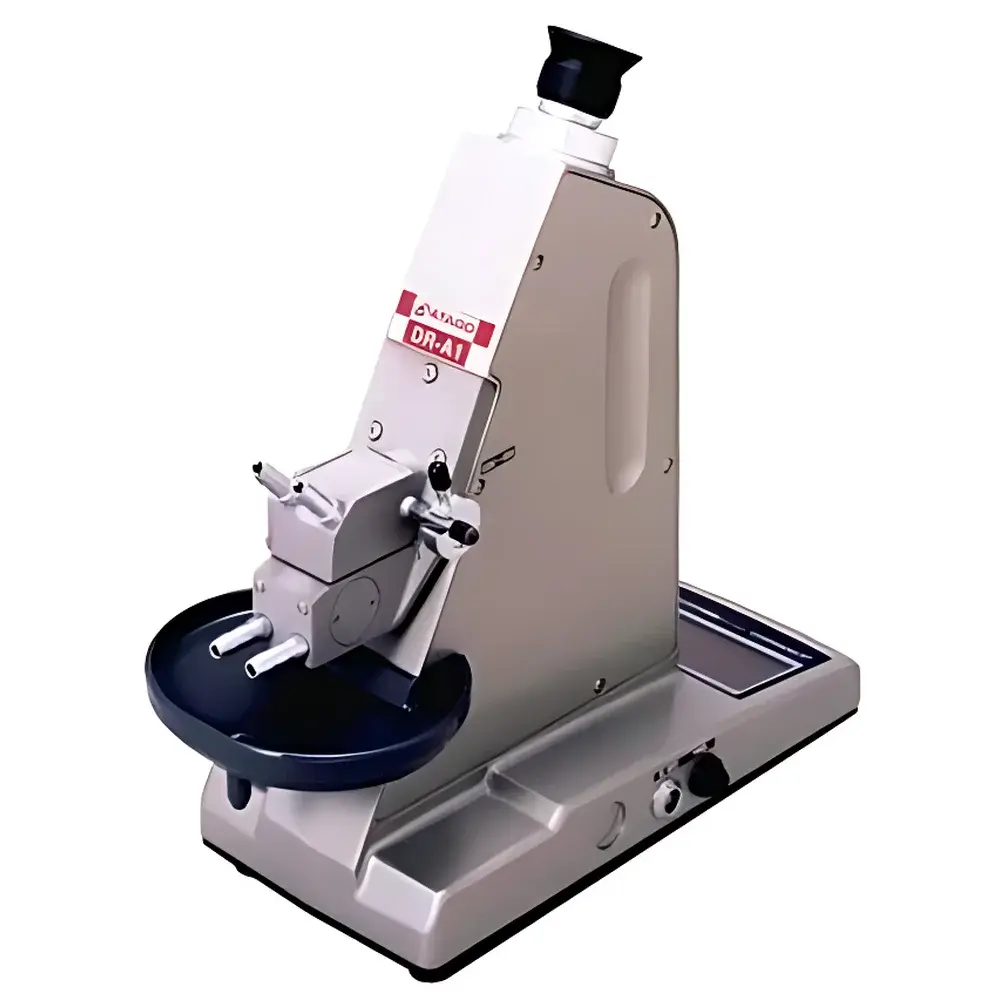
ATAGO DR-A1 Digital Abbe Refractometer
| Brand | ATAGO |
|---|---|
| Origin | Japan |
| Model | DR-A1 |
| Measurement Range | 1.3000–1.7100 (nD) / 0.0–95.0% Brix |
| Resolution | 0.0001 (nD) / 0.1% Brix |
| Accuracy | ±0.0002 (nD) / ±0.1% Brix |
| Automatic Temperature Compensation | 5–50°C |
| Temperature Measurement Range | 5–50°C (0.1°C resolution) |
| Power Supply | 100–240 VAC, 50/60 Hz, 10 VA |
| Dimensions & Weight | 13 × 29 × 31 cm, 6.0 kg |
Overview
The ATAGO DR-A1 Digital Abbe Refractometer is a precision optical instrument engineered for high-reproducibility refractive index (nD) and Brix concentration measurements in laboratory, quality control, and production environments. Based on the classical Abbe principle—utilizing collimated light passing through a prism-sample interface and measuring the critical angle of total internal reflection—the DR-A1 delivers traceable, temperature-compensated results without manual interpolation or vernier estimation. Unlike analog Abbe refractometers reliant on subjective visual alignment of a shadow line, the DR-A1 integrates a dual-channel digital readout system that simultaneously displays both refractive index (nD) and temperature-corrected Brix (% w/w sucrose equivalent) in real time. Its solid-state optical path, thermally stabilized prism assembly, and built-in Peltier-assisted temperature sensor ensure minimal thermal drift and measurement stability across routine daily operation.
Key Features
- Dual-parameter digital display: Simultaneous real-time output of nD (refractive index at sodium D-line, 589.3 nm) and Brix (%) on a high-contrast LCD screen
- High-resolution detection: 0.0001 nD resolution and 0.1% Brix resolution, enabling precise differentiation between closely related formulations
- Automatic temperature compensation (ATC): Integrated thermistor measures sample temperature from 5 to 50°C with 0.1°C resolution; applies ISO 21742-compliant correction algorithms to nD and Brix values
- Calibration traceability: Supports two-point calibration using certified reference standards (e.g., distilled water at 20°C: nD = 1.3330; sucrose solution at 20°C: known Brix)
- Robust mechanical architecture: Precision-ground glass prisms, stainless-steel housing, and vibration-damped base minimize operational error during benchtop use
- No moving parts in optical path: Eliminates mechanical wear, backlash, or alignment drift associated with manual focusing mechanisms
Sample Compatibility & Compliance
The DR-A1 accommodates liquid, semi-liquid, and low-viscosity homogeneous samples—including aqueous solutions, syrups, juices, coolants, pharmaceutical solvents, and polymer precursors—provided they are optically transparent at 589 nm and non-corrosive to BK7 glass prisms. Samples must be free of suspended solids or air bubbles to avoid scattering-induced measurement artifacts. The instrument complies with fundamental metrological requirements outlined in ISO 21742:2005 (Refractometry — General principles and practice) and supports adherence to GLP and GMP documentation workflows when paired with external lab notebooks or LIMS integration via manual data logging. While not FDA 21 CFR Part 11–certified as a standalone system, its deterministic measurement logic, stable calibration history, and unambiguous digital output facilitate audit-ready recordkeeping.
Software & Data Management
The DR-A1 operates as a self-contained, embedded-system instrument with no proprietary software dependency. All measurement data are displayed and retained on-device only during active session; no internal memory or USB export capability is provided. Users are expected to manually record readings into validated electronic lab notebooks (ELN), spreadsheet templates, or enterprise QMS platforms. For laboratories requiring automated data capture, optional RS-232 or analog voltage output modules (sold separately) enable connection to PLCs, SCADA systems, or custom acquisition software—subject to user-configured serial protocol settings (9600 bps, N, 8, 1). Calibration logs, operator IDs, and environmental notes must be maintained externally per ISO/IEC 17025 clause 7.7.
Applications
- Food & Beverage: Quantitative Brix verification in fruit juices, soft drinks, honey, and dairy-based concentrates
- Pharmaceuticals: Excipient concentration checks in syrup formulations and solvent purity screening (e.g., ethanol/water mixtures)
- Chemical Manufacturing: Refractive index profiling of monomer solutions, resin blends, and cleaning agent titrations
- Automotive & Industrial Fluids: Glycol concentration monitoring in engine coolants and brake fluids per ASTM D1120 and SAE J1087
- Academic Research: Teaching core optics principles (Snell’s law, dispersion, critical angle) and validating empirical correlations between nD and solute concentration
FAQ
Does the DR-A1 support measurement of turbid or opaque samples?
No. The instrument requires optically clear samples at 589 nm; particulates, emulsions, or highly absorbing media will yield unreliable or non-convergent readings.
Can the DR-A1 measure temperature-dependent dispersion (e.g., nF, nC)?
No. It is configured exclusively for sodium D-line (589.3 nm) refractive index; multi-wavelength dispersion analysis requires a spectroscopic refractometer.
Is it possible to adjust the Brix conversion algorithm for non-sucrose matrices?
No. The factory-calibrated Brix scale assumes sucrose-water equivalence; users must apply matrix-specific correction factors derived from independent validation studies.
What maintenance is required beyond routine prism cleaning?
Annual verification against NIST-traceable refractive index standards is recommended; prism surface inspection for scratches or coating degradation should occur before each shift in regulated environments.
Does the DR-A1 meet IP or explosion-proof ratings?
No. It is rated for indoor laboratory use only (IEC 61010-1 Class II, Pollution Degree 2) and is not certified for hazardous locations.





