
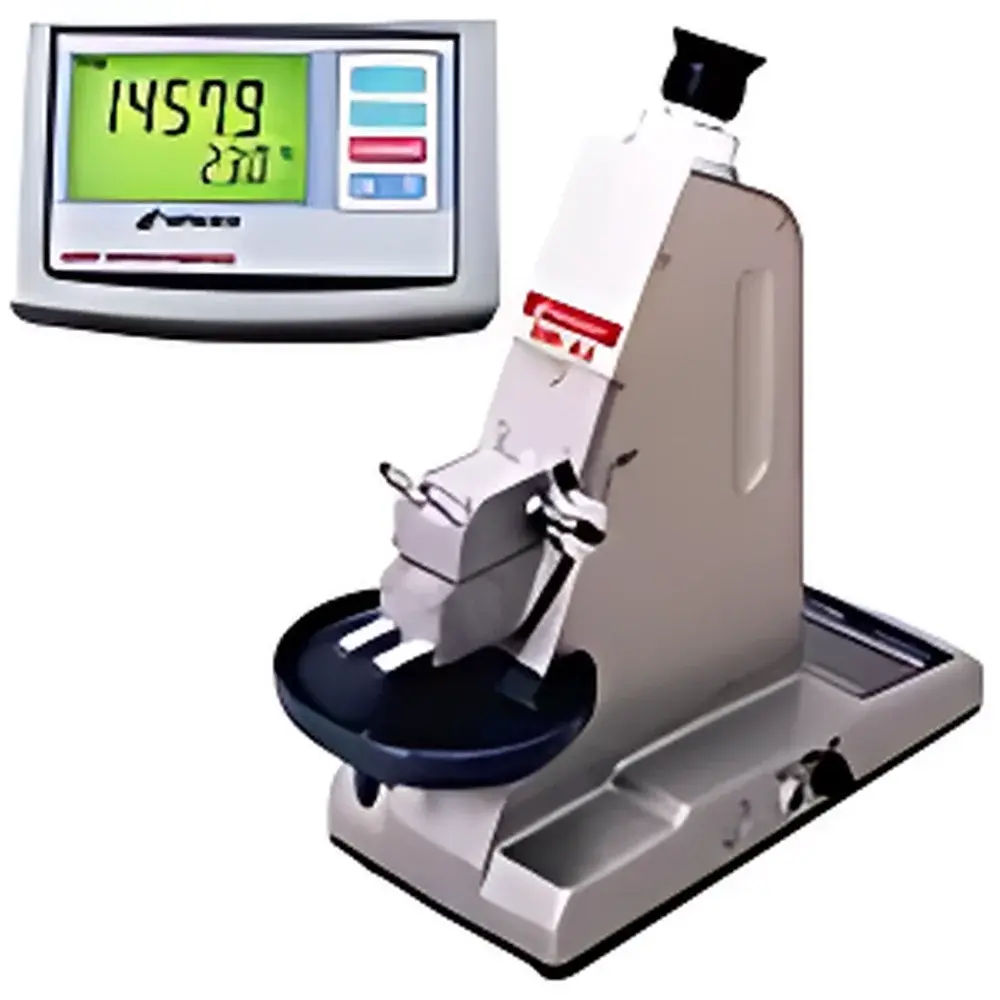

Atago DR-A1 Digital Abbe Refractometer
| Origin | Japan |
|---|---|
| Manufacturer Type | Authorized Distributor |
| Origin Category | Imported |
| Model | DR-A1 |
| Pricing | Available Upon Request |
Overview
The Atago DR-A1 Digital Abbe Refractometer is a precision optical instrument engineered for rapid, high-accuracy measurement of refractive index (nD) and Brix concentration in transparent or translucent liquid samples. Based on the classical Abbe principle—utilizing total internal reflection at the prism-sample interface—the DR-A1 determines the critical angle of refraction and converts it into a digital readout with traceable metrological integrity. Unlike analog Abbe refractometers requiring subjective visual interpolation of scale lines, the DR-A1 employs a high-resolution CCD sensor and real-time image processing to automatically detect the shadow boundary, eliminating parallax error and operator-dependent variability. Its integrated Peltier-controlled temperature sensor ensures continuous monitoring within the 5–50 °C range, enabling automatic temperature compensation per ISO 21748 and ASTM D1218 standards. Designed for routine QC labs, food & beverage production lines, pharmaceutical formulation units, and academic research facilities, the DR-A1 delivers repeatable results without requiring specialized optical training.
Key Features
- Dual-mode digital display: Simultaneous or selectable readout of refractive index (nD) and Brix (% w/w), both with calibrated resolution (nD: 0.0001; Brix: 0.1%)
- Automatic temperature compensation (ATC) across 5–50 °C, referenced to 20 °C per standard practice
- Precision-ground sapphire-coated main and auxiliary prisms (RE-1501 compatible) for long-term surface stability and chemical resistance
- Integrated thermistor with ±0.1 °C resolution and NIST-traceable calibration path
- Low-power AC adapter operation (16 VA, 100–240 V, 50/60 Hz) suitable for benchtop deployment in regulated environments
- Compact footprint (13 × 29 × 31 cm) and robust aluminum housing optimized for vibration-dampened lab benches
Sample Compatibility & Compliance
The DR-A1 accommodates homogeneous, non-volatile, non-opaque liquids including aqueous sugar solutions, glycerol, ethylene glycol, fruit juices, syrups, coolants, and pharmaceutical excipient solutions. It is not suitable for suspensions, emulsions, or highly scattering media due to inherent limitations of monochromatic (589 nm sodium D-line equivalent) Abbe geometry. The instrument complies with ISO 21748:2017 (Refractometry — Guidelines for the determination of uncertainty), supports GLP documentation workflows, and meets mechanical and electrical safety requirements per IEC 61010-1. While not FDA 21 CFR Part 11–certified out-of-the-box, its stable firmware architecture and audit-ready calibration logs (via optional RE-1195 verification kit) facilitate validation under GMP-compliant quality systems.
Software & Data Management
The DR-A1 operates as a standalone instrument with no proprietary software dependency. All measurements are displayed locally with real-time temperature annotation. For data capture and traceability, users may employ standard serial-to-USB adapters (RS-232 interface optional via external module) to log timestamped nD and Brix values into LIMS or Excel-based QA databases. Calibration verification records—including date, reference standard lot number (e.g., RE-110010–RE-110060 sucrose standards), and deviation values—can be manually archived per internal SOPs. Optional accessories such as the RE-1581 film measurement kit extend functionality to thin-film refractive index estimation under controlled contact conditions.
Applications
- Quality control of sucrose, glucose, and fructose concentrations in soft drinks, jams, honey, and dairy products
- Concentration monitoring of antifreeze solutions (ethylene/propylene glycol) in automotive and HVAC maintenance
- Process verification of cleaning agent dilutions in pharmaceutical cleanroom environments
- Raw material identity testing for glycerin, propylene glycol, and ethanol-based solvents
- Educational demonstration of optical dispersion, Snell’s law, and temperature-dependent refractivity in physical chemistry laboratories
FAQ
Does the DR-A1 support measurement of turbid or colloidal samples?
No. As an Abbe-type refractometer, it requires optically clear samples; dispersed particles interfere with critical angle detection.
What is the calibration frequency recommendation under ISO/IEC 17025?
Calibration verification using certified sucrose standards (e.g., RE-110010–RE-110060) is recommended before each analytical session or at least once per shift in production environments.
Can the DR-A1 measure samples below 5 °C or above 50 °C?
No. Operation outside the specified 5–50 °C range invalidates ATC compensation and risks thermal stress to the prism assembly.
Is the RE-1146 polarizing eyepiece compatible with all DR-A1 units?
Yes—RE-1146 is a factory-approved accessory that enhances contrast for borderline-refractive samples without altering optical path length or calibration.
How is measurement uncertainty quantified for this instrument?
Per ISO 21748, combined standard uncertainty is ≤±0.0003 for nD and ≤±0.15% for Brix when used with traceable standards and maintained within environmental Class II lab conditions (20 ±2 °C, <60% RH).




