
ATAGO DR-A1-PLUS Digital Abbe Refractometer for Adhesives and Silicone Materials
| Brand | ATAGO |
|---|---|
| Origin | Japan |
| Model | DR-A1-PLUS |
| Type | Benchtop Digital Abbe Refractometer |
| Refractive Index Range | 1.3000–1.7100 nD |
| Brix Range | 0.0–100.0% |
| Refractive Index Resolution | 0.0001 |
| Brix Resolution | 0.1% |
| Accuracy | ±0.0002 nD / ±0.1% Brix |
| Temperature Compensation | Automatic (5–50 °C) |
| Temperature Accuracy | ±0.2 °C |
| Display | Digital LCD (nD, Brix%, Temp. °C) |
| Interface | RS-232C (printer & PC connectivity) |
| Power | AC adapter (100–240 V, 50/60 Hz), 16 VA |
| Dimensions (main unit) | 13 × 29 × 31 cm |
| Weight (main unit) | 6.0 kg |
Overview
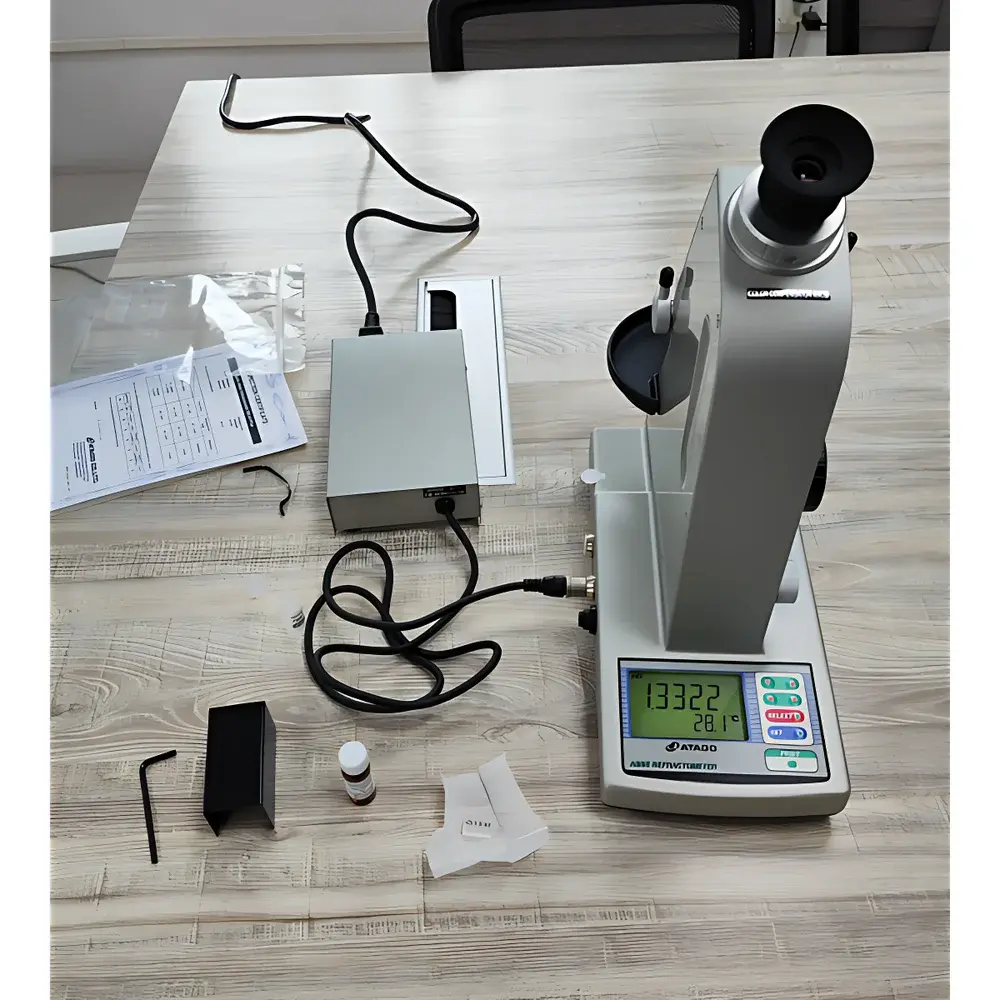
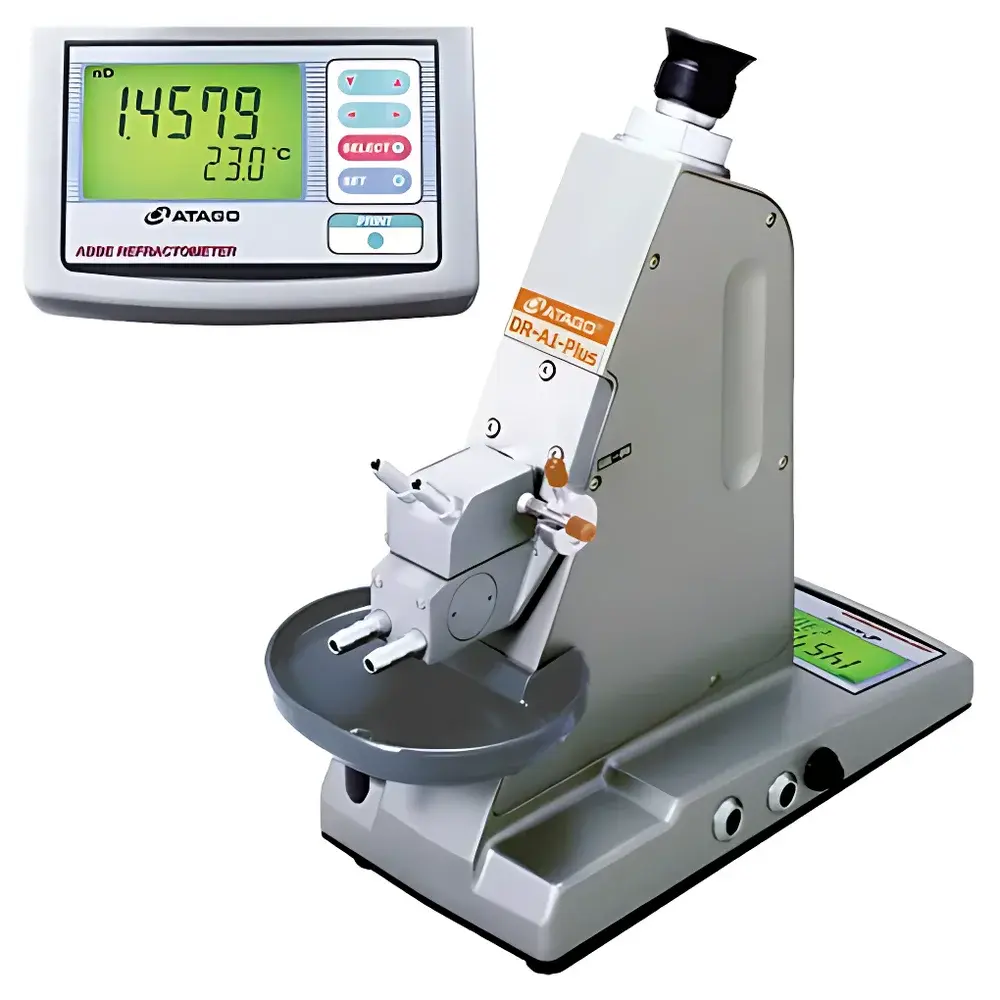
The ATAGO DR-A1-PLUS is a high-precision benchtop digital Abbe refractometer engineered specifically for industrial quality control of optical and rheological properties in adhesive formulations, silicone encapsulants, architectural coatings, and other optically heterogeneous or deeply colored liquid materials. Unlike traditional analog Abbe instruments relying on subjective visual alignment of the shadow line through an eyepiece, the DR-A1-PLUS employs a calibrated CCD sensor array and internal reference prism to capture the critical angle of total internal reflection with sub-millidegree angular resolution. This enables direct, operator-independent calculation of refractive index (nD) at the sodium D-line (589.3 nm), automatically compensated across a 5–50 °C ambient temperature range per ISO 2114 and ASTM D1218 standards. Its wide measurement span—1.3000 to 1.7100 nD—covers low-index solvents (e.g., aliphatic hydrocarbons), mid-range acrylic monomers, and high-index silicone resins used in LED packaging and optical bonding applications. The instrument operates on first-principles optics: incident light undergoes total internal reflection at the sample-prism interface; the resulting shadow boundary position correlates linearly with nD via Snell’s law, digitized and displayed in real time.
Key Features
- Dual-mode digital readout: Simultaneous display of refractive index (nD) and Brix concentration (%) with selectable units—no manual conversion required.
- Optimized optical path design: High-luminance LED illumination and anti-glare prism housing ensure clear boundary detection even for turbid, opaque, or dark-colored samples (e.g., carbon-black-filled adhesives or epoxy pigments).
- Automatic temperature compensation (ATC): Built-in thermistor monitors sample temperature in real time and applies correction coefficients traceable to NIST-certified calibration fluids.
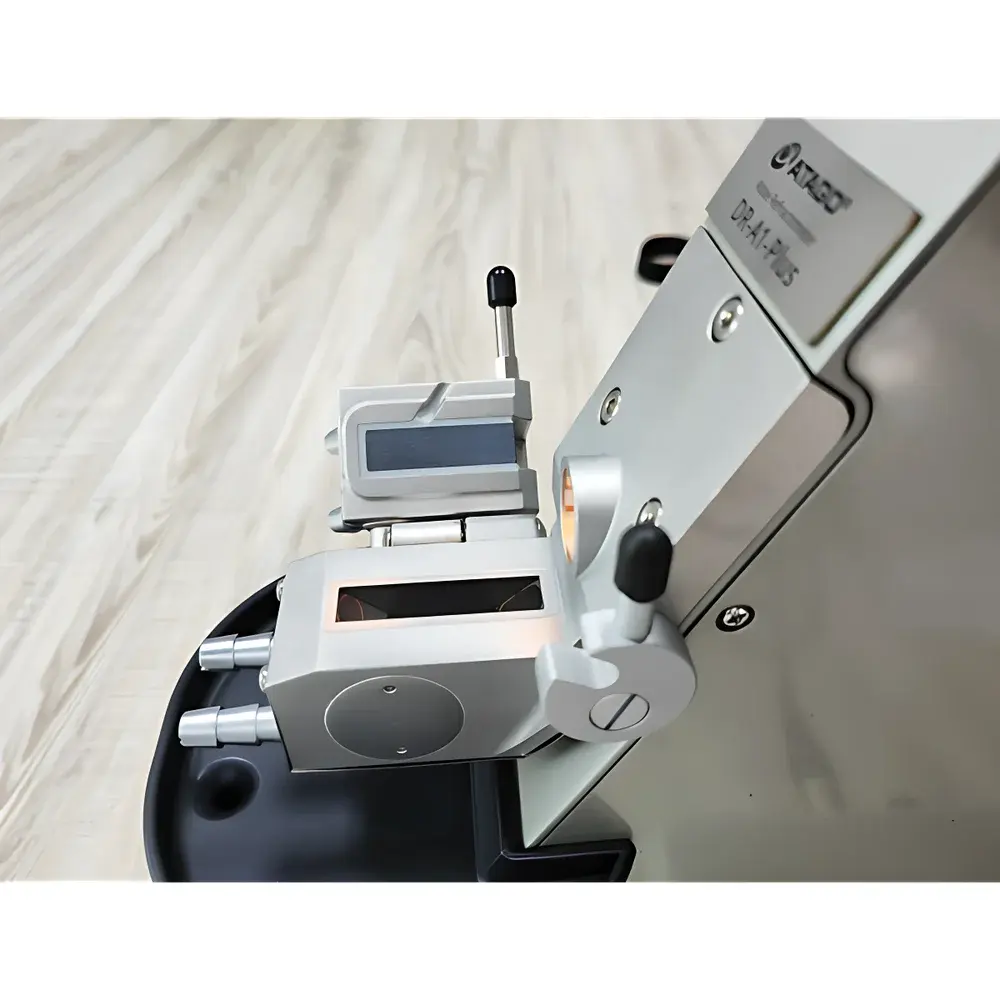
- Robust mechanical architecture: Precision-ground sapphire contact prism (hardness 9 Mohs), stainless-steel sample stage, and vibration-damped base minimize thermal drift and mechanical hysteresis.
- RS-232C serial interface: Enables direct data logging to LIMS or QC databases, supporting 21 CFR Part 11-compliant audit trails when paired with validated software.
- Compliance-ready design: Meets ISO 2114 (plastics—determination of refractive index), ASTM D1218 (refractive index of hydrocarbon liquids), and JIS K 0061 (general rules for refractometry).
Sample Compatibility & Compliance
The DR-A1-PLUS accommodates viscous, non-uniform, and particulate-laden samples typical in adhesive R&D and production environments—including UV-curable acrylates, solvent-based polyurethanes, silicone gels, and waterborne latex dispersions. Its large sample well (≥1.5 mL capacity) and flat, chemically resistant prism surface allow rapid cleaning between measurements using ethanol or isopropanol without risk of scratching. All calibration and verification procedures follow ATAGO’s documented SOPs aligned with GLP and ISO/IEC 17025 requirements. Certified reference standards (e.g., ATAGO Standard Liquids #1–#4, traceable to NMIJ/JNLA) are supplied with individual uncertainty budgets (k=2). Instrument validation includes linearity verification across the full nD range and repeatability testing per ISO 5725-2 (repeatability standard deviation ≤0.00015 nD under controlled lab conditions).
Software & Data Management
While the DR-A1-PLUS operates as a standalone instrument, its RS-232C port supports bidirectional communication with ATAGO’s optional “ReflaX” PC software (v3.2+), enabling automated report generation, statistical process control (SPC) charting, and batch-level trend analysis. Data export formats include CSV and XML, compatible with LabWare LIMS, SAP QM, and custom MES platforms. Audit trail functionality records user ID, timestamp, measurement value, temperature, calibration status, and instrument serial number for each reading—fully compliant with FDA 21 CFR Part 11 electronic record requirements when deployed with appropriate access controls and electronic signatures.
Applications
- Quality assurance of silicone optical adhesives (SOA) in LED module assembly—verifying refractive index match between encapsulant and chip substrate (e.g., GaN vs. silicone nD ≈ 1.41–1.53).
- In-process monitoring of solvent evaporation rate in architectural sealants by tracking real-time Brix shift during drying cycles.
- Batch release testing of pressure-sensitive adhesives (PSAs) per ASTM D3121—correlating nD with monomer conversion and crosslink density.
- R&D screening of novel bio-based resin systems where refractive index serves as a proxy for aromatic content and molecular weight distribution.
- Regulatory documentation support for ISO 9001:2015 clause 8.5.1 (control of production) and IATF 16949 section 8.5.1.2 (process validation for adhesives in automotive bonding).
FAQ
Does the DR-A1-PLUS require periodic recalibration with certified standards?
Yes. ATAGO recommends quarterly verification using NIST-traceable reference liquids and annual full recalibration by an accredited service center per ISO/IEC 17025.
Can it measure samples below 5 °C or above 50 °C?
No. The ATC algorithm is validated only within 5–50 °C. For out-of-range measurements, use external thermostatted sample cells and disable ATC mode.
Is the prism resistant to aggressive solvents like DMF or THF?
The sapphire prism is chemically inert to all common organic solvents; however, prolonged exposure to hot concentrated acids or alkalis may affect the aluminum housing—clean immediately after use.
How is measurement repeatability ensured across operators?
By eliminating eyepiece dependency: the CCD-based boundary detection removes inter-operator variability, yielding RSD <0.05% for homogeneous samples under ISO 5725-2 protocols.
Does ATAGO provide IQ/OQ documentation for GMP environments?
Yes. Factory-issued Installation Qualification (IQ) and Operational Qualification (OQ) protocols are available upon request, including test scripts, acceptance criteria, and blank execution records compliant with Annex 15 and USP .





