
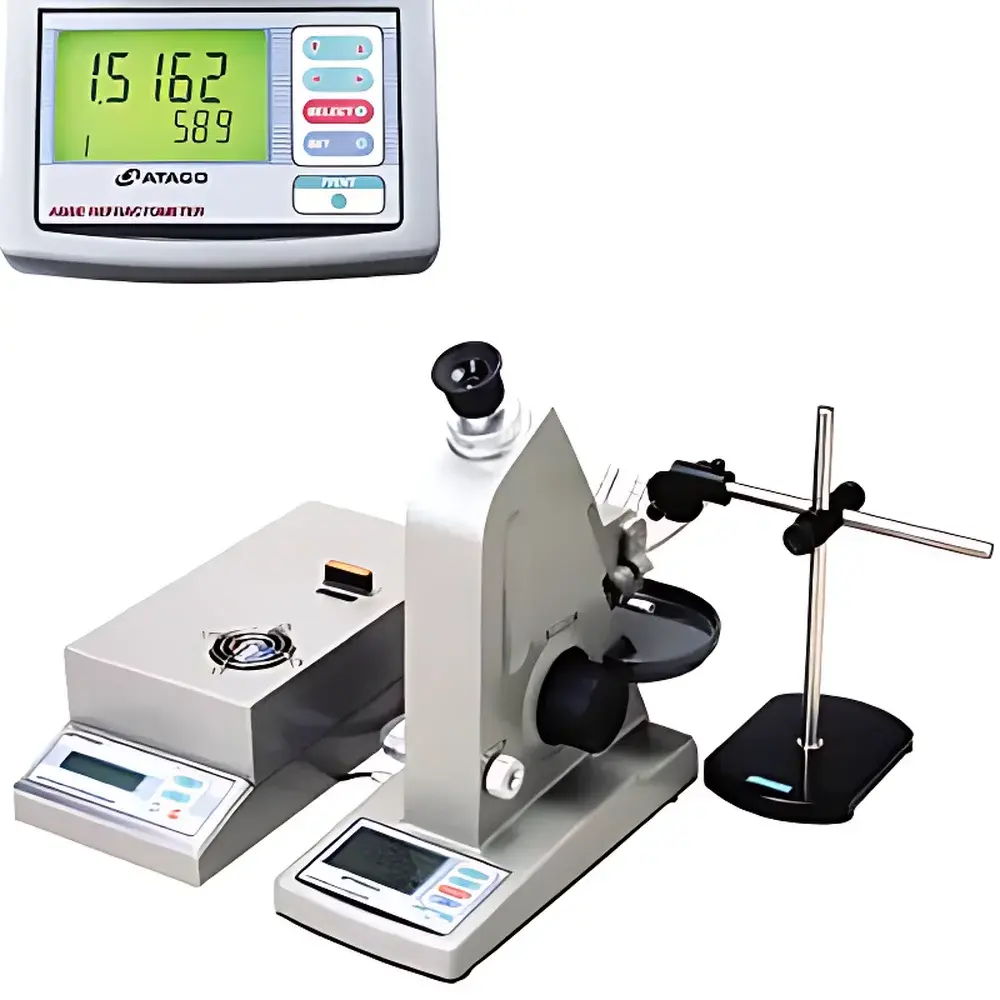
ATAGO DR-M4/1550 Multi-Wavelength Abbe Refractometer
| Brand | ATAGO |
|---|---|
| Origin | Japan |
| Model | DR-M4/1550(A) |
| Type | Benchtop Refractometer |
| Digital Display | Yes |
| Temperature Control | None |
| Refractive Index Range | 1.5167–1.9166 (at 450 nm) |
| Accuracy | ±0.0002 RI (at 589 nm) |
| Wavelength Range | 450–1550 nm |
| Resolution | 0.0001 RI / 0.1 Abbe Number |
| Operating Temperature | 5–50 °C |
| Power Supply | AC 100–240 V, 50/60 Hz |
| Dimensions (Main Unit) | 13 × 29 × 31 cm |
| Weight (Main Unit) | 6.0 kg |
Overview
The ATAGO DR-M4/1550 Multi-Wavelength Abbe Refractometer is a precision benchtop optical instrument engineered for high-accuracy refractive index (RI) and Abbe number measurements across a broad spectral range—from 450 nm (visible blue) to 1550 nm (near-infrared). Based on the classical Abbe principle—employing collimated monochromatic light incident at the critical angle on a prism-sample interface—the system determines RI by detecting the sharp boundary between illuminated and dark fields in the observation eyepiece or digital sensor array. Unlike conventional single-wavelength refractometers, the DR-M4/1550 integrates tunable monochromatic illumination and calibrated wavelength selection, enabling direct correlation of dispersion behavior (dn/dλ) with material composition and molecular structure. This capability is essential for characterizing optical glasses, specialty polymers, semiconductor thin films, infrared-transmitting materials (e.g., Ge, ZnSe, chalcogenide glasses), and high-refractive-index fluids used in photonic packaging and lens design.
Key Features
- Multi-wavelength measurement capability spanning 450–1550 nm with discrete, factory-calibrated wavelength settings (including standard lines at 450 nm, 589 nm, 680 nm, 1100 nm, and 1550 nm)
- Digital RI and Abbe number display with 0.0001 resolution for RI and 0.1 for Abbe value—eliminating parallax error and subjective interpolation inherent in analog scales
- High-precision optical path design incorporating temperature-stabilized prisms and anti-reflective coated optics to minimize thermal drift and stray light interference
- Integrated RS-232 interface for direct connection to PCs and thermal printers—supporting automated data logging, CSV export, and time-stamped measurement records
- Compliance with ISO 17025 traceability requirements when used with certified reference standards (e.g., NIST-traceable calibration glasses)
- Robust mechanical architecture with aluminum alloy housing and vibration-damped base—optimized for stable operation in shared lab environments without active temperature control
Sample Compatibility & Compliance
The DR-M4/1550 accommodates solid, liquid, and paste-like samples compatible with standard Abbe prism contact geometry (minimum sample volume: ~0.1 mL for liquids; polished flat surfaces ≥10 mm × 10 mm for solids). It supports routine verification per ASTM D1218 (Standard Test Method for Refractive Index and Refractive Dispersion of Hydrocarbon Liquids) and ISO 760 (Determination of Refractive Index of Transparent Liquids). While the instrument lacks built-in Peltier temperature regulation, its operational range of 5–50 °C permits ambient-condition testing aligned with GLP documentation practices. All firmware and output protocols are compatible with 21 CFR Part 11-compliant laboratory information management systems (LIMS) when paired with validated third-party data acquisition software.
Software & Data Management
The refractometer outputs ASCII-formatted measurement data via RS-232 serial communication—including wavelength ID, RI, Abbe number, timestamp, and operator ID (if configured). No proprietary software is required; standard terminal emulators (e.g., Tera Term, PuTTY) or custom Python/Excel VBA scripts can parse and archive results. Optional ATAGO-provided utilities enable batch export to .csv and generation of dispersion curves (n vs. λ), supporting comparative analysis against Cauchy or Sellmeier equation fits. Audit trails—including parameter changes, calibration events, and user logins—are maintained externally through host-system logging, satisfying GMP audit requirements for method validation documentation.
Applications
- Optical material qualification: Verification of RI uniformity and dispersion profiles in fused silica, BK7, SF10, and IR-grade substrates
- Pharmaceutical excipient characterization: Refractive index mapping of high-viscosity solvents and polymer carriers across NIR bands for formulation consistency
- Semiconductor process monitoring: In-line RI assessment of spin-on glass (SOG) films and photoresist coatings pre- and post-bake
- Academic research in photonics: Empirical determination of Sellmeier coefficients for novel nonlinear crystals and metamaterials
- Quality control of specialty adhesives and encapsulants: Batch-to-batch refractive matching for LED packaging and fiber-optic coupling applications
FAQ
Does the DR-M4/1550 support automatic temperature compensation (ATC)?
No—this model operates without integrated temperature control or ATC. Measurements must be performed within the specified ambient range (5–50 °C), and users are advised to thermally equilibrate samples prior to analysis.
Can it measure opaque or highly scattering samples?
No—consistent with Abbe principle limitations, the instrument requires optically transparent or semi-transparent samples that permit clear critical-angle detection. Turbid emulsions or particulate suspensions are not suitable.
Is NIST-traceable calibration available for this instrument?
Yes—ATAGO provides optional calibration services using NIST-traceable reference glasses (SRM 1040, SRM 1041) at user-specified wavelengths, with full uncertainty budgets compliant with ISO/IEC 17025.
What is the typical warm-up time before measurement stability?
A minimum 15-minute stabilization period after power-on is recommended to ensure thermal equilibrium of the optical train and light source output.
How frequently should recalibration be performed?
Calibration interval depends on usage intensity and environmental conditions; ATAGO recommends annual verification under normal laboratory use, or after any physical impact or relocation.





