
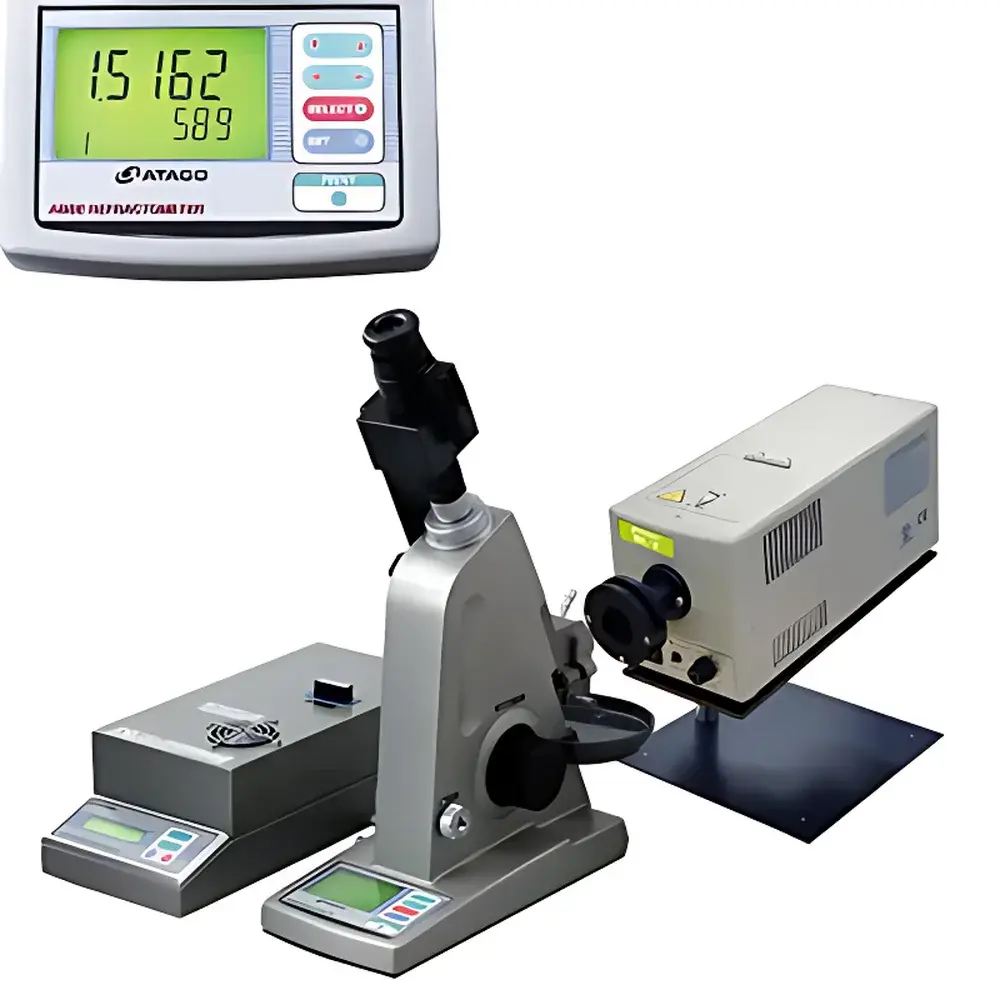
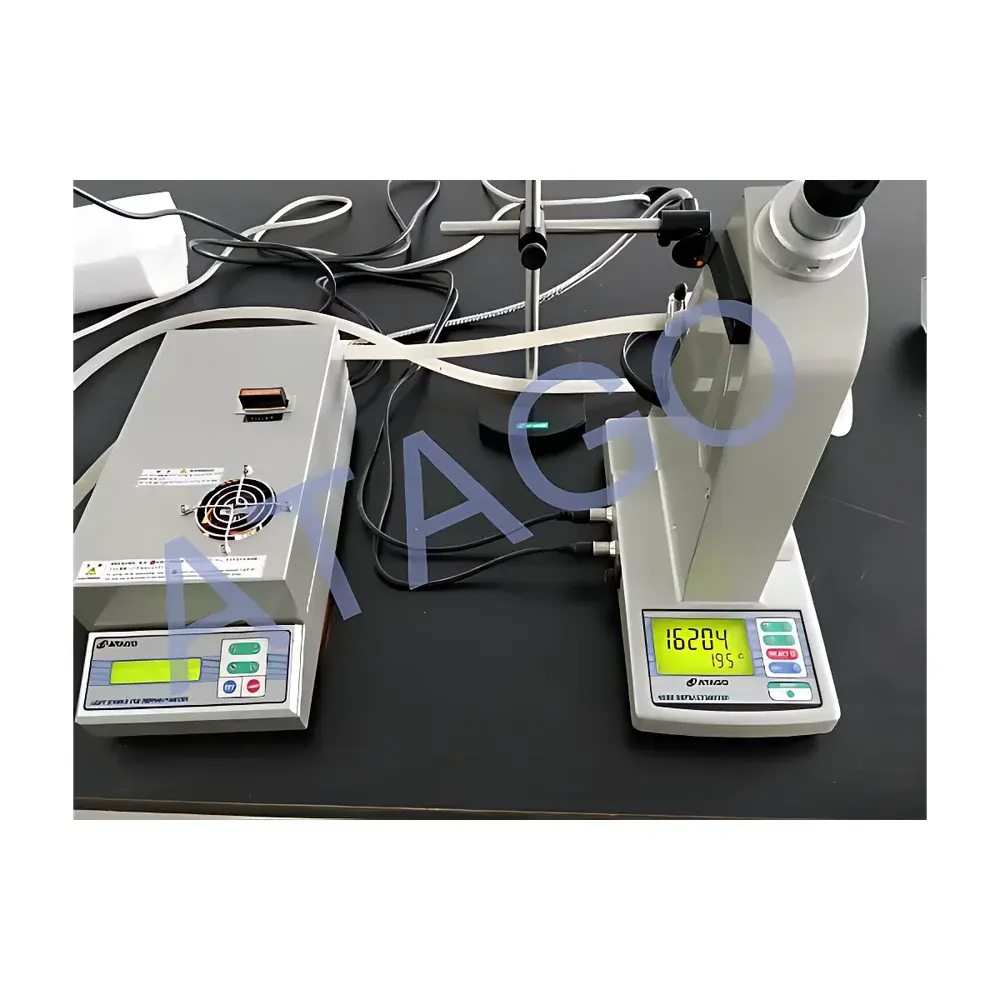
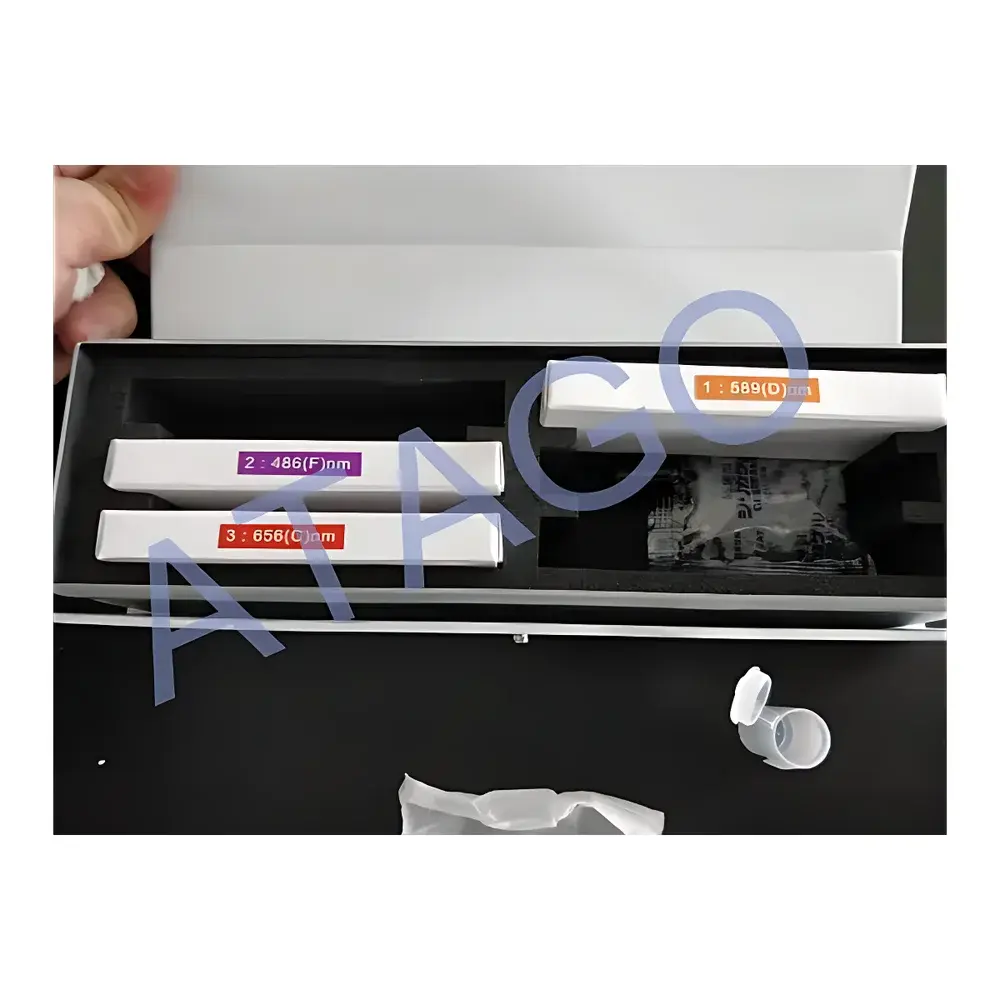
ATAGO DR-M4/1550 Multi-Wavelength Abbe Refractometer
| Brand | ATAGO |
|---|---|
| Origin | Japan |
| Type | Benchtop Refractometer |
| Temperature Control | Yes |
| Digital Display | Yes |
| Refractive Index Range | 1.5167–1.9166 |
| Measurement Accuracy | ±0.00002 (with 500–650 nm interference filters) |
| Wavelength Selection | 5 discrete wavelengths from 450 nm to 1550 nm |
Overview
The ATAGO DR-M4/1550 Multi-Wavelength Abbe Refractometer is a precision optical instrument engineered for high-accuracy refractive index (nD) and dispersion characterization of transparent and semi-transparent materials. Based on the classical Abbe principle—utilizing critical angle measurement at a solid–liquid or solid–solid interface—the DR-M4/1550 extends conventional single-wavelength capability by integrating five selectable, narrow-band interference filters spanning the visible to near-infrared spectrum (450 nm, 589 nm, 650 nm, 1064 nm, and 1550 nm). This multi-wavelength architecture enables direct determination of dispersion curves (n vs. λ), Abbe number (νD), and partial dispersion ratios—critical parameters in optical glass specification, polymer formulation validation, and lens material qualification. Designed for laboratory and R&D environments, the instrument features a thermally stabilized prism stage with Peltier-based temperature control (±0.1 °C stability), ensuring measurement repeatability under ISO 17025-aligned conditions.
Key Features
- Five precisely calibrated wavelength channels (450 nm, 589 nm, 650 nm, 1064 nm, 1550 nm) for full spectral dispersion profiling
- High-resolution digital display with 0.00001 RIU resolution and ±0.00002 accuracy (at 500–650 nm)
- Integrated Peltier temperature control system (range: 10–50 °C, programmable in 0.1 °C increments)
- Abbe-type optical configuration with high-stability sapphire measuring prism and collimated LED illumination
- Benchtop ergonomic design with anti-vibration base and adjustable eyepiece for visual verification
- Compliance with JIS K 0061 and ASTM D1218 standards for refractive index measurement
Sample Compatibility & Compliance
The DR-M4/1550 accommodates liquid samples (e.g., monomers, solvents, optical adhesives), molten thermoplastics, cured polymer films, and polished optical substrates—including BK7, SF6, fused silica, and chalcogenide glasses. Sample volume requirement is ≤0.1 mL for liquids; solid samples require flat, parallel, optically polished surfaces ≥10 mm × 10 mm. The instrument meets mechanical and optical safety requirements per IEC 61010-1 and is compatible with GLP documentation workflows. All wavelength-specific calibration data are traceable to NIST-certified reference standards (SRM 1389a, SRM 1480c). Data output supports audit-ready records compliant with FDA 21 CFR Part 11 when paired with ATAGO’s optional PC interface software.
Software & Data Management
While the DR-M4/1550 operates as a standalone instrument with front-panel controls and real-time digital readout, optional RS-232 or USB connectivity enables integration with ATAGO’s proprietary RefData Manager v3.2 software. This application supports automated wavelength sequencing, temperature ramp logging, multi-point dispersion curve generation (nλ vs. λ), and export of CSV/Excel-compatible datasets. Audit trails include operator ID, timestamp, wavelength ID, temperature setpoint, and raw sensor voltage—structured to satisfy internal QA review and external accreditation audits (e.g., ISO/IEC 17025 clause 7.7). No cloud storage or third-party telemetry is employed; all data reside locally unless explicitly exported by authorized users.
Applications
- Optical material certification: Verification of nD, νD, and partial dispersion (e.g., Pg,F
- Photopolymer development: Real-time monitoring of refractive index shift during UV-curing of acrylates and epoxies
- IR-transmissive material analysis: Dispersion modeling of ZnSe, Ge, and CaF2 windows across telecom and thermal imaging bands
- Pharmaceutical excipient characterization: Refractive index mapping of glycerin/water and propylene glycol/water blends for formulation consistency
- Academic research: Teaching Abbe principle fundamentals and experimental dispersion physics in undergraduate optics laboratories
FAQ
What wavelength standards are used for calibration?
Calibration is performed using NIST-traceable interference filters certified at 450 nm, 589.3 nm (sodium D-line), 650 nm, 1064 nm, and 1550 nm, with uncertainty <±0.1 nm.
Can the DR-M4/1550 measure opaque or highly scattering samples?
No. The instrument requires optical transmission through the sample-prism interface; turbid, crystalline, or heavily pigmented materials are incompatible.
Is temperature compensation applied automatically across all wavelengths?
Yes. The Peltier-controlled prism block maintains constant thermal equilibrium; each wavelength measurement is recorded with synchronized temperature metadata, enabling post-hoc thermal drift correction.
Does the device support custom wavelength filters?
No. Only the five factory-installed, laser-verified interference filters are supported; filter replacement requires ATAGO factory recalibration and re-certification.
How is measurement reproducibility verified during routine operation?
Users perform daily verification using ATAGO-certified reference oils (e.g., NIST SRM 1480c at 23 °C); deviation >±0.00003 RIU triggers recalibration per ATAGO Service Manual Rev. 4.2.





