
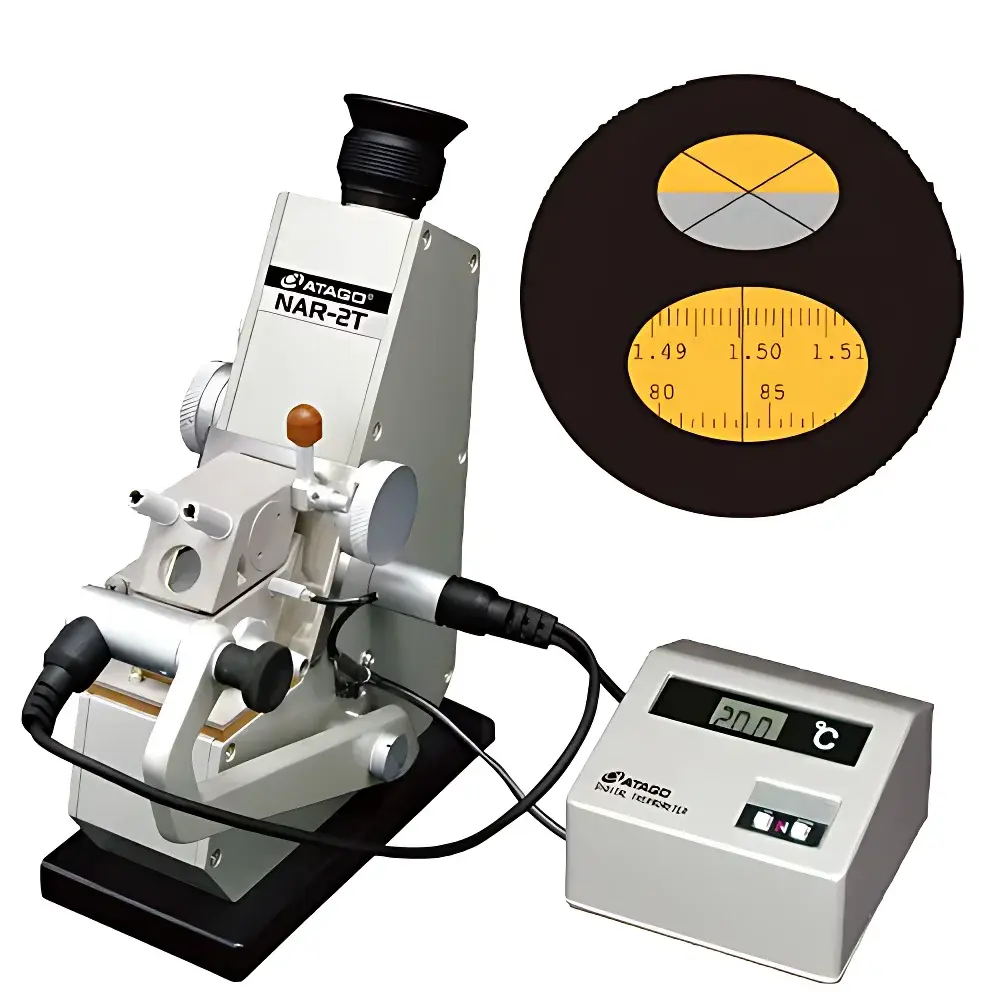
ATAGO NAR-2T.UH High-Index Abbe Refractometer
| Brand | ATAGO |
|---|---|
| Origin | Japan |
| Model | NAR-2T.UH |
| Type | Benchtop Refractometer |
| Temperature Control | Yes |
| Digital Display | Yes |
| Refractive Index Range | 1.7000–2.0800 |
| Accuracy | ±0.0002 nD |
| Brix Accuracy | ±0.1% |
Overview
The ATAGO NAR-2T.UH High-Index Abbe Refractometer is a precision optical instrument engineered for accurate and repeatable measurement of refractive index (nD) in liquids with exceptionally high optical density—specifically within the range of 1.7000 to 2.0800. Unlike standard Abbe refractometers limited to nD < 1.70, the NAR-2T.UH employs an optimized optical path, high-transmittance prisms, and thermally stabilized illumination to maintain measurement integrity across demanding high-refractive-index media. Its design adheres to the fundamental principle of total internal reflection at the prism-sample interface, where the critical angle is precisely determined via calibrated crosshair alignment and converted to nD using built-in calibration algorithms traceable to NIST-certified reference standards. The instrument is routinely deployed in R&D laboratories and QC environments where refractive index serves as a primary indicator of composition, purity, or molecular density—particularly in optical materials, specialty chemicals, and advanced thin-film processing.
Key Features
- Extended refractive index measurement range: 1.7000–2.0800 nD, enabling characterization of halogenated hydrocarbons, organosulfur compounds, concentrated inorganic salt solutions, and metal-organic precursors.
- Integrated Peltier temperature control system with ±0.1 °C stability, supporting measurements from ambient up to +120 °C—critical for viscosity-sensitive or thermally activated high-nD fluids such as bromonaphthalene or dimethyl sulfoxide (DMSO).
- Digital readout with 0.0001 resolution and ±0.0002 nD accuracy, validated per ISO 21348 and ASTM D1218 protocols for refractometric instrumentation.
- Benchtop architecture with ergonomic sample stage, quick-clamp prism cover, and anti-dust optical housing—designed for daily use in regulated environments including GLP-compliant labs.
- Auto-zero function and dual-wavelength LED illumination (589.3 nm nominal) ensure consistent sodium-D line referencing without manual lamp alignment or warm-up delays.
Sample Compatibility & Compliance
The NAR-2T.UH accommodates a broad spectrum of high-refractive-index samples commonly used in optics, photonics, and materials synthesis—including but not limited to methylene iodide (nD ≈ 1.74), bromonaphthalene (nD ≈ 1.66), zinc chloride saturated solution (nD ≈ 1.72), and triethylbismuth (nD ≈ 1.82). Its stainless-steel sample well and chemically resistant prism coating resist corrosion from aggressive solvents and halogen-rich media. The instrument complies with IEC 61010-1 for electrical safety and meets CE marking requirements for laboratory equipment. While not inherently 21 CFR Part 11 compliant, its digital output supports integration into validated LIMS or ELN systems when paired with ATAGO’s optional RS-232/USB data logging module and audit-trail-enabled software.
Software & Data Management
The NAR-2T.UH operates as a standalone instrument with local display; however, it supports bidirectional serial communication for external data capture. When connected to ATAGO’s proprietary DataMaster™ PC software (v4.2+), users gain access to automated calibration logging, multi-point temperature ramping profiles, statistical process control (SPC) charts, and export to CSV or PDF formats compatible with ISO/IEC 17025 documentation workflows. All measurement records include timestamp, operator ID, ambient temperature, prism temperature, and raw critical angle data—enabling full traceability required under GMP and pharmaceutical development guidelines (e.g., USP ).
Applications
- Optical Material Characterization: Matching refractive indices between immersion oils and solid specimens (e.g., mineralogical thin sections or polymer composites) to eliminate interfacial reflection in transmitted-light microscopy and spectroscopic ellipsometry.
- Fiber Optic Assembly: Verifying refractive index homogeneity of coupling gels (e.g., silicone oils, brominated aromatic fluids) used in fiber pigtailing and connector polishing processes.
- Thin-Film Process Development: Monitoring concentration-dependent nD shifts during spin-coating of high-index sol-gel precursors (e.g., TiO2/SiO2 hybrids) or DMSO-based polymer dispersions.
- Non-Destructive Testing: Quantifying refractive index gradients in penetrant inspection fluids containing ZnCl2 or KI to correlate optical contrast with flaw depth in aerospace-grade alloys.
- Pharmaceutical Excipient Analysis: Assessing batch-to-batch consistency of high-nD solvents used in lyophilization formulations or transdermal delivery systems.
FAQ
What is the maximum operating temperature for liquid samples?
The NAR-2T.UH supports sample measurements up to 120 °C via active Peltier heating; continuous operation above 80 °C requires use of heat-resistant sample applicators and periodic prism cleaning.
Can the instrument measure opaque or highly viscous liquids?
It is optimized for transparent to semi-transparent liquids; turbid or particulate-laden samples require centrifugation or filtration prior to analysis to avoid scattering-induced angular error.
Is calibration verification traceable to international standards?
Yes—ATAGO provides factory calibration certificates referencing NIST-traceable certified refractive index standards (e.g., Cargille Labs Series AA), and users may perform in-house verification using ATAGO’s NAR-CAL series reference fluids.
Does the NAR-2T.UH support Brix measurement for high-index sugar derivatives?
While primarily designed for nD, its dual-scale display includes Brix conversion (±0.1%) for aqueous sucrose analogs—but accuracy degrades outside standard sucrose-water matrices and should not be applied to non-sugar high-nD solutes without empirical correlation.
How often should prism cleaning and recalibration be performed?
Prism surfaces should be cleaned with lint-free wipes and spectroscopic-grade ethanol after each sample; full calibration verification is recommended before each analytical session or at least once per shift in production environments.





