
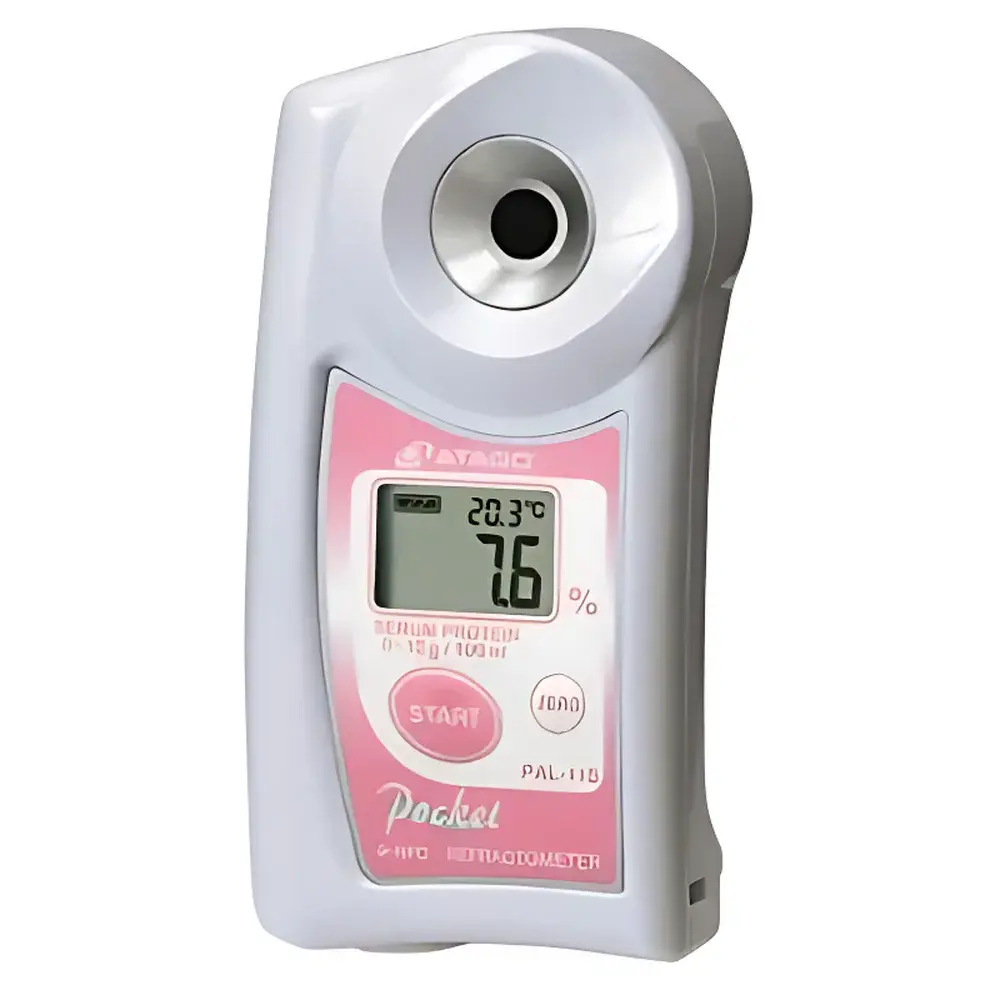
ATAGO PAL-11S Portable Serum Protein Refractometer
| Brand | ATAGO |
|---|---|
| Origin | Japan |
| Model | PAL-11S |
| Product Type | Handheld Refractometer |
| Temperature Control | Yes |
| Digital Display | Yes |
| Measurement Range | 0.1–12.0 g/100 mL |
| Accuracy | ±0.2 g/100 mL |
Overview
The ATAGO PAL-11S Portable Serum Protein Refractometer is a precision optical instrument engineered for rapid, on-site quantification of total serum protein concentration in clinical, veterinary, and point-of-care laboratory settings. It operates on the principle of critical-angle refractometry: light passing through a small sample (typically 0.3 mL of whole blood serum or plasma) undergoes refraction at the prism-sample interface; the resulting angle shift correlates directly with the solution’s refractive index, which—when calibrated against standardized protein solutions—is converted into g/100 mL units using ATAGO’s proprietary temperature-compensated algorithm. Unlike benchtop refractometers requiring manual interpolation from Brix or nD scales, the PAL-11S delivers direct serum protein readouts without conversion tables or secondary calculations. Its compact, ergonomic design integrates an integrated Peltier-based temperature control system (±0.2 °C stability), ensuring measurement consistency across ambient conditions ranging from 10 °C to 40 °C—critical for minimizing thermal drift in field-deployed diagnostics.
Key Features
- Direct serum protein measurement in g/100 mL (0.1–12.0 g/100 mL range), eliminating reliance on empirical Brix-to-protein conversion factors.
- Integrated thermoelectric (Peltier) temperature control maintains prism surface at 35 °C ±0.2 °C during operation—aligned with CLSI EP10-A3 guidelines for temperature-sensitive clinical assays.
- High-resolution LCD with backlight enables legible readings under low-light conditions, including emergency vehicles or mobile veterinary clinics.
- Automatic zero calibration using distilled water and one-point standard verification (e.g., 6.0 g/100 mL reference solution) ensures traceable accuracy per ISO 8655-7 for volumetric calibration and ISO 17025-compliant instrument verification protocols.
- Rugged IP65-rated housing resists dust ingress and incidental splashes, supporting daily use in high-traffic clinical labs, animal shelters, and farm-side diagnostics.
- Battery-powered operation (4 × AAA, ~10,000 measurements per set) enables uninterrupted use during power outages or off-grid deployments.
Sample Compatibility & Compliance
The PAL-11S is validated for use with human and animal serum, plasma, and ascitic fluid samples. It accommodates viscous or mildly lipemic specimens without clogging due to its open-prism architecture and minimal sample volume requirement (0.3 mL). All measurements comply with the optical path length and refractive index linearity assumptions defined in ASTM D1218 (Standard Test Method for Refractive Index of Hydrocarbon Liquids) and adapted for biological matrices under CLIA-waived testing criteria. The device meets IEC 61010-1 safety requirements for laboratory electrical equipment and carries CE marking for medical device Class I (non-invasive, non-measuring diagnostic support) compliance. While not FDA 510(k)-cleared as a standalone IVD, it is routinely employed as a QC tool in CAP-accredited laboratories for rapid screening prior to definitive electrophoresis or immunoassay confirmation.
Software & Data Management
The PAL-11S operates as a standalone instrument with no embedded data logging or USB connectivity. However, its repeatable output supports integration into laboratory quality management systems via manual entry or optional third-party barcode scanning workflows. Each unit ships with a NIST-traceable calibration certificate and a certified reference standard (6.0 g/100 mL bovine serum albumin solution), enabling GLP-aligned calibration documentation. For laboratories operating under 21 CFR Part 11, the absence of electronic records simplifies audit readiness—measurements are treated as operator-recorded analog data, consistent with traditional refractometer validation practices described in USP Analytical Instrument Qualification.
Applications
- Rapid assessment of hypoalbuminemia or hyperproteinemia in emergency triage and critical care units.
- Point-of-care monitoring of protein loss in chronic kidney disease, liver cirrhosis, and malnutrition protocols.
- Veterinary field diagnostics for dehydration status and acute phase response evaluation in companion animals and livestock.
- Quality control of serum-derived reagents and cell culture media in biomanufacturing environments.
- Educational use in biomedical science curricula for teaching optical property–concentration relationships in biological fluids.
FAQ
Does the PAL-11S require routine recalibration?
Yes—daily zero calibration with distilled water and periodic verification with the supplied 6.0 g/100 mL standard are required per ATAGO’s operational protocol and CLSI EP21-A guidance.
Can it measure whole blood?
No—only clear, non-hemolyzed serum or plasma is suitable. Hemolysis or turbidity introduces scattering errors that violate the Beer–Lambert assumption underlying refractometric quantification.
Is temperature compensation automatic?
Yes—the built-in Peltier element actively regulates prism temperature to 35 °C, independent of ambient fluctuations, satisfying ISO 21748 recommendations for reproducible refractive index measurement.
What maintenance is required?
Daily prism cleaning with lens tissue and ethanol; annual verification of Peltier function and optical alignment by an ATAGO-authorized service center.
How does its accuracy compare to automated clinical analyzers?
It provides ±0.2 g/100 mL accuracy—sufficient for trend monitoring and triage—but lacks the multi-analyte specificity of spectrophotometric or immunochemical platforms used for definitive diagnosis.



