
ATAGO PAL-BX|SALT+15 Portable Refractometer for Simultaneous Brix and Salt Measurement
| Brand | ATAGO |
|---|---|
| Origin | Japan |
| Model | PAL-BX |
| Brix Range | 0.0–90.0% |
| Salt Range | 0.00–15.00% |
| Brix Accuracy | ±0.2% |
| Salt Accuracy | ±0.05% (0.00–0.99%), ±5% rel. (1.00–9.99%), ±10% rel. (10.00–15.00%) |
| Brix Resolution | 0.1% |
| Salt Resolution | 0.01% |
| Temperature Compensation | Brix 10–100°C, Salt 10–40°C |
| Custom Scale Capacity | 15 user-defined scales |
Overview
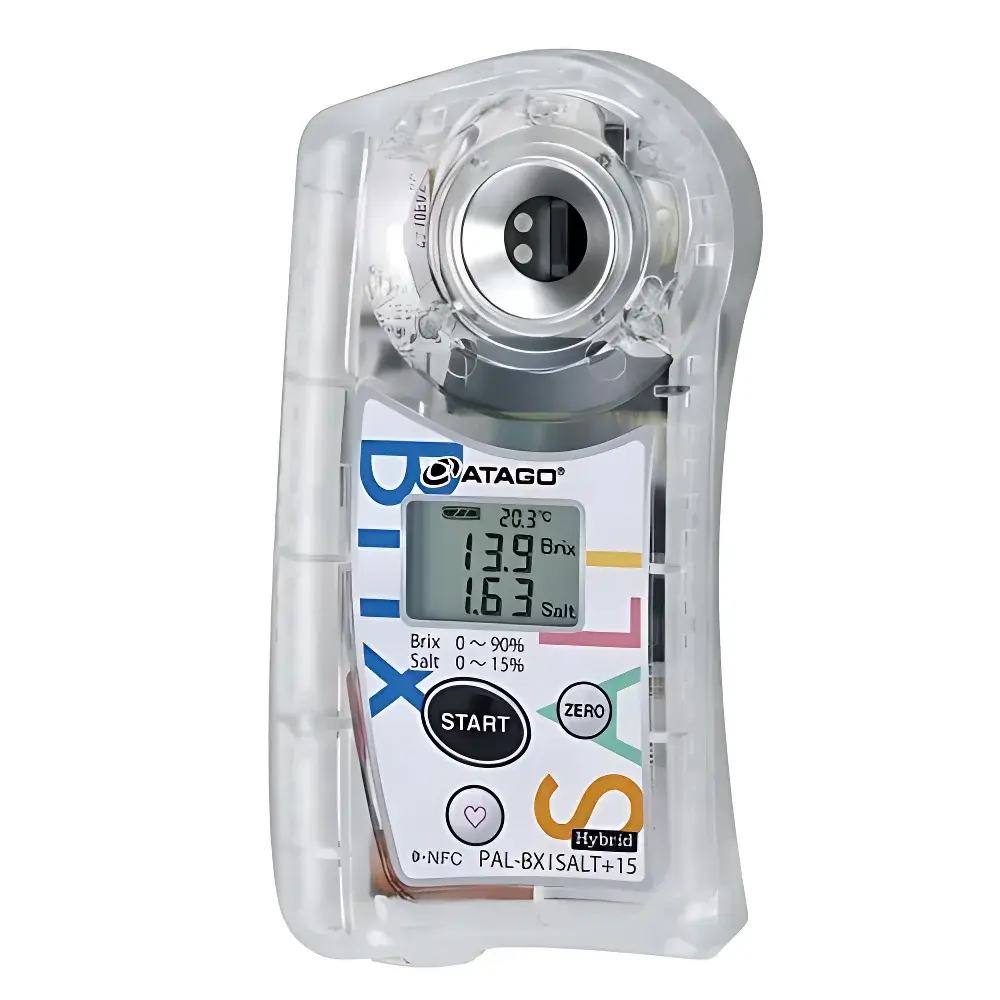
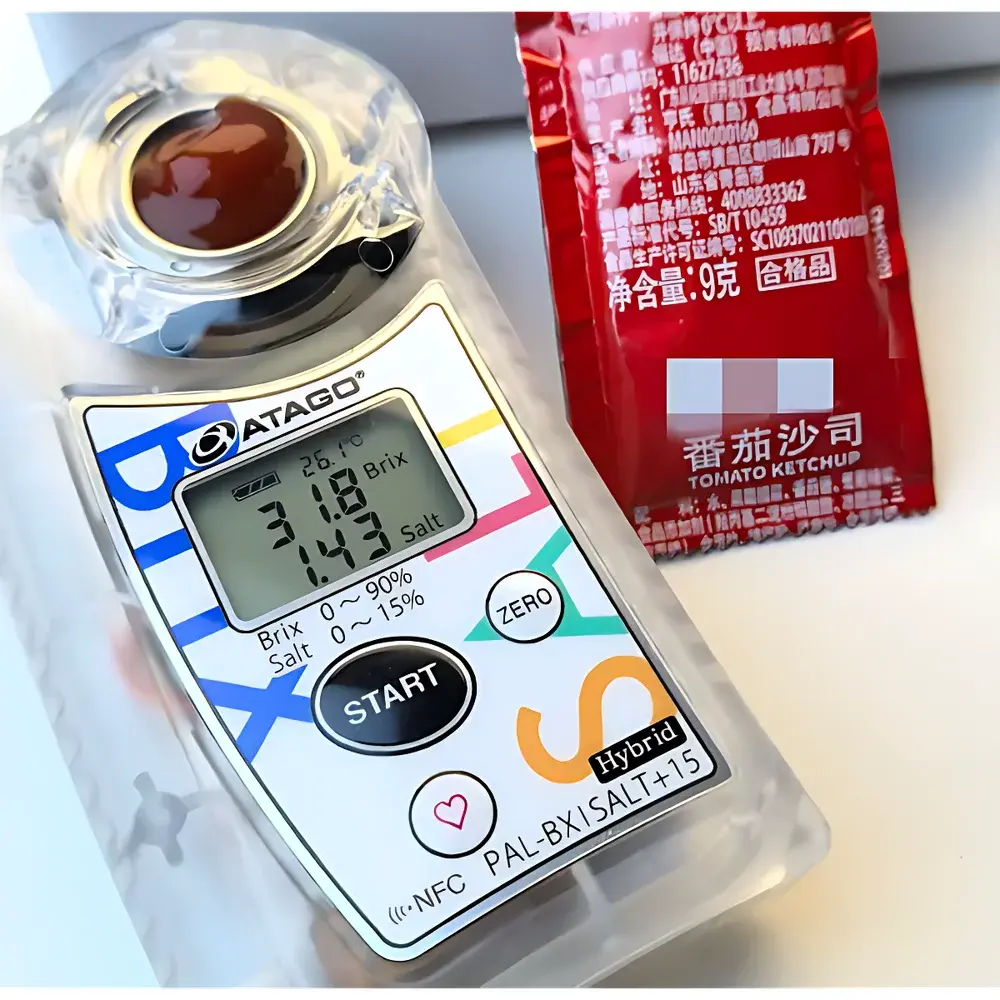
The ATAGO PAL-BX|SALT+15 is a high-precision, handheld digital refractometer engineered for simultaneous quantitative measurement of refractive index-derived parameters—specifically sucrose concentration (Brix % w/w) and sodium chloride concentration (Salt % w/w)—in aqueous solutions. Based on the principle of critical-angle refractometry, the instrument determines solute concentration by measuring the change in light refraction at the prism-sample interface, which correlates directly with solution density and composition. Unlike single-parameter refractometers, the PAL-BX|SALT+15 integrates dual-algorithm firmware calibrated against traceable NIST-traceable reference standards, enabling independent, real-time calculation of both Brix and salt values from a single 0.3 mL sample drop. Its compact ergonomic design, rugged aluminum housing, and IP65-rated ingress protection make it suitable for deployment across production floors, QC laboratories, field sampling sites, and mobile inspection units—without reliance on external power or PC connectivity.
Key Features
- Dual-parameter optical measurement: Simultaneous Brix (0.0–90.0%) and Salt (0.00–15.00%) quantification from one sample application
- Advanced automatic temperature compensation (ATC): Independent compensation algorithms for Brix (10–100°C) and Salt (10–40°C), minimizing thermal drift in non-climate-controlled environments
- 15-user customizable scale memory: Enables storage and rapid recall of application-specific calibration curves—for example, brine formulations, soy sauce blends, or fermented dairy products—supporting method standardization across multi-site operations
- High-resolution LCD display with backlight: Shows Brix, Salt, temperature, and battery status simultaneously; intuitive icon-driven navigation requires no training
- Robust optical architecture: Sapphire-coated measurement prism resists scratching, chemical etching, and thermal shock; validated for >100,000 measurements under routine use
- Battery life: Up to 10,000 measurements per set of two AAA alkaline batteries; auto-power-off after 3 minutes of inactivity
Sample Compatibility & Compliance
The PAL-BX|SALT+15 is optimized for homogeneous, non-turbid, low-viscosity aqueous solutions typical of food processing streams—including fruit juices, brines, marinades, sauces, dairy whey, and beverage concentrates. It is not intended for suspensions, emulsions, or highly viscous media (>100 mPa·s) without prior dilution or filtration. The instrument complies with JIS K 0067 (Japanese Industrial Standard for refractometers), ISO 2173:2003 (fruit juice Brix determination), and AOAC Official Method 932.12 (refractometric solids analysis). While not FDA 21 CFR Part 11–compliant as a standalone device, its measurement data may be integrated into compliant LIMS or ELN systems via manual entry or optional RS-232 output (with adapter). Calibration verification is supported using certified ATAGO standard solutions (e.g., SRM-10, SRM-20, SRM-Salt-5), traceable to NMIJ/AIST reference materials.
Software & Data Management
The PAL-BX|SALT+15 operates as a self-contained measurement terminal with no embedded software stack or firmware update capability—ensuring long-term stability and eliminating cybersecurity vulnerabilities associated with networked instruments. All calibration, scale definition, and unit configuration are performed locally via physical keypad input. Measurement records are not stored internally; however, users may document results manually or integrate the device into paperless workflows using optional serial data logging (via ATAGO’s RS-232 interface kit and compatible terminal software). For GxP-regulated environments, laboratories commonly pair the instrument with audit-trail-enabled electronic notebooks or structured Excel templates validated per ALCOA+ principles. ATAGO provides full calibration certificates and metrological documentation upon request, supporting ISO/IEC 17025 accreditation requirements for testing laboratories.
Applications
- Food & Beverage QA/QC: Rapid verification of sugar-salt balance in ready-to-eat meals, pickled vegetables, cured meats, and condiments
- Contract Manufacturing: In-line batch release testing for co-packers producing private-label sauces, dressings, and soups
- Catering & Hospitality: Consistency control during large-scale meal preparation in hospital, school, or airline catering facilities
- Research & Development: Screening of formulation variants during new product development—e.g., low-sodium alternatives with compensatory sweetener profiles
- Regulatory Sampling: Field-deployable tool for inspectors verifying label claims (e.g., “reduced sodium”) per EU Regulation 1169/2011 or FDA Nutrition Facts compliance
- Agricultural Post-Harvest: On-farm assessment of fruit ripeness (Brix) and post-harvest salinity stress indicators in irrigation runoff
FAQ
Does the PAL-BX|SALT+15 require recalibration before each use?
No. The instrument maintains calibration stability for up to 30 days under normal operating conditions. Daily verification with a standard solution is recommended; full recalibration is required only after prism cleaning, mechanical shock, or when verification fails.
Can it measure salt concentration in non-NaCl solutions (e.g., KCl or CaCl₂)?
No. The salt algorithm is specifically calibrated for NaCl aqueous solutions. Use in other electrolyte systems introduces systematic bias and is not supported by ATAGO’s accuracy specifications.
Is temperature compensation applied automatically during measurement?
Yes. Internal thermistor continuously monitors sample temperature at the prism surface and applies correction in real time—no user intervention required.
What is the minimum sample volume required?
0.3 mL is sufficient to cover the prism surface completely. Excess sample does not improve accuracy and may cause leakage into the housing.
How does the +15 model differ from the base PAL-BX|SALT?
The +15 variant supports up to 15 user-defined scales versus zero in the base model, enabling direct readout in application-specific units (e.g., “soy sauce grade” or “brine saturation %”) without manual conversion tables.





