
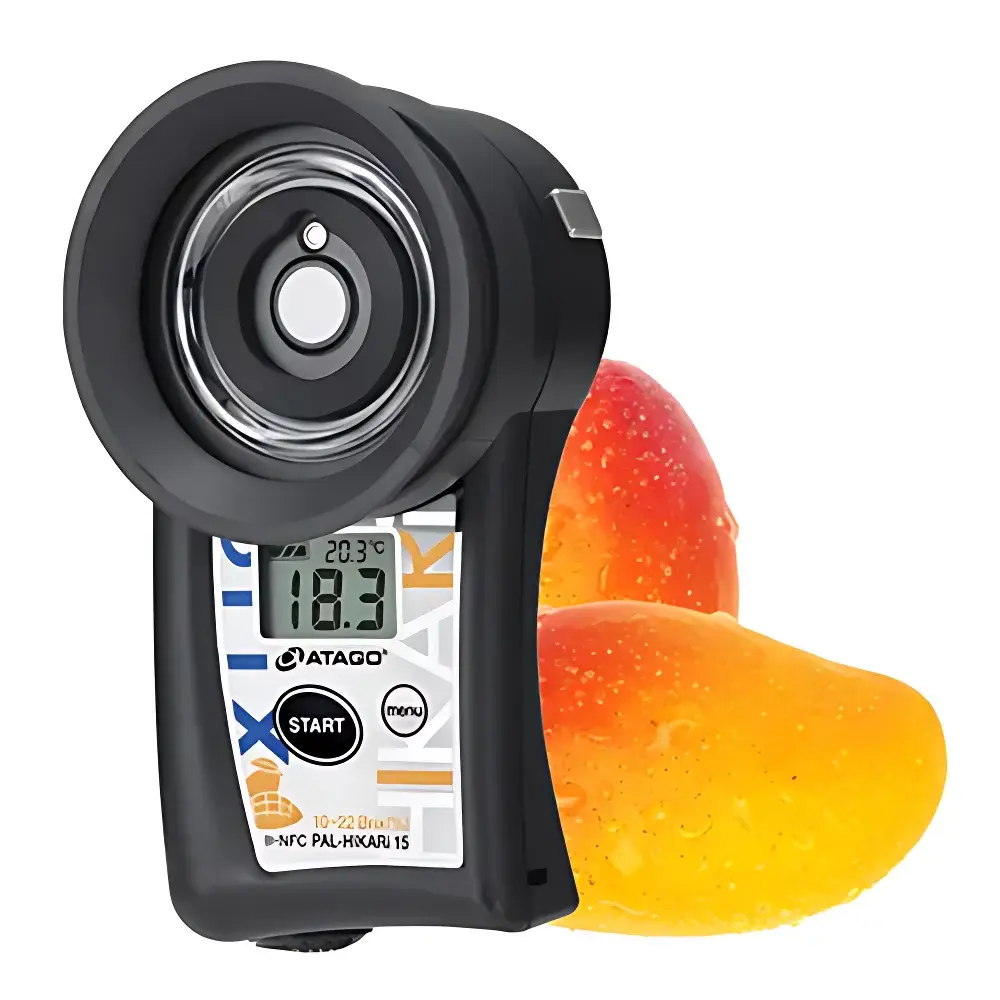
ATAGO PAL-HIKARi 15 Non-destructive Mango Brix Meter
| Brand | ATAGO |
|---|---|
| Origin | Japan |
| Manufacturer Type | Authorized Distributor |
| Origin Category | Imported |
| Model | PAL-HIKARi 15 |
| Pricing | Available Upon Request |
Overview
The ATAGO PAL-HIKARi 15 is a handheld, non-destructive Brix meter engineered specifically for in-situ sugar content assessment of intact mango fruit. Unlike conventional refractometers requiring juice extraction, this instrument employs near-infrared (NIR) reflectance spectroscopy—illuminating the fruit surface with calibrated NIR light and analyzing spectral response characteristics correlated to sucrose, glucose, and fructose concentrations. The measurement principle relies on empirical calibration models developed from extensive mango cultivar datasets, enabling rapid estimation of soluble solids content (SSC), reported as degrees Brix (% w/w), without physical contact disruption or tissue damage. Designed for field-deployable operation, it supports longitudinal monitoring throughout cultivation, harvest scheduling, postharvest quality assurance, and supply chain traceability—aligning with Good Agricultural Practice (GAP) and postharvest quality management frameworks.
Key Features
- Non-invasive measurement: No fruit cutting, peeling, or juice expression required—preserves sample integrity and marketability.
- Optimized mango-specific calibration: Factory-calibrated using representative mango varieties (e.g., Tommy Atkins, Keitt, Kent) across diverse growing regions and ripening stages.
- Real-time digital readout: Brix value displayed within 3 seconds of sensor contact; resolution of 0.1% Brix ensures sensitivity to subtle maturation shifts.
- Integrated automatic temperature compensation (ATC): Compensates for ambient fruit surface temperature variations between 5.0°C and 35.0°C—critical for field use under fluctuating climatic conditions.
- Rugged portable design: IP64-rated enclosure resists dust ingress and water splashing; compact dimensions (61 × 44 × 115 mm) and lightweight construction (120 g, host only) enable one-handed operation in orchards, packing houses, or cold storage facilities.
- Extended battery life: Powered by two AAA alkaline cells; rated for approximately 4,000 measurements per set—minimizing downtime during high-throughput inspections.
Sample Compatibility & Compliance
The PAL-HIKARi 15 is validated exclusively for intact, unblemished mango fruit with smooth, taut skin—excluding over-ripe, bruised, or waxed specimens that may distort optical coupling. It complies with JIS Z 8015 (Japanese Industrial Standard for optical instruments) and meets electromagnetic compatibility (EMC) requirements per IEC 61326-1. While not certified under FDA 21 CFR Part 11 or ISO/IEC 17025 for regulated laboratory reporting, its measurement methodology adheres to principles outlined in AOAC Official Method 932.12 (for refractometric Brix determination) and supports internal quality control documentation aligned with HACCP-based food safety plans. Users are advised to perform periodic verification using reference sucrose solutions (e.g., NIST-traceable standards) to maintain measurement confidence.
Software & Data Management
This standalone instrument does not feature onboard data logging or Bluetooth/Wi-Fi connectivity. Measurement results are displayed numerically on a backlit LCD screen and must be manually recorded. For traceable recordkeeping, users may integrate readings into external LIMS or farm management software via manual entry or barcode-assisted logging workflows. ATAGO provides calibration verification guidelines and technical documentation supporting GLP-compliant usage—including recommended warm-up time (≥30 minutes after battery insertion), surface cleaning protocols (isopropyl alcohol wipe), and environmental acclimatization procedures (allowing fruit to equilibrate to ambient temperature for ≥15 minutes prior to measurement).
Applications
- Orchard management: Enables repeated, non-lethal Brix tracking per tree or per fruit cohort to inform irrigation timing, fertilizer application, and thinning decisions.
- Harvest readiness assessment: Supports objective, cultivar-specific maturity thresholds—reducing subjective visual grading errors and minimizing premature or delayed picking.
- Postharvest sorting & grading: Facilitates real-time lot-level SSC stratification for premium pricing, export compliance (e.g., ASEAN mango import specifications), and cold chain optimization.
- Research & breeding programs: Provides quantitative phenotypic data for evaluating sugar accumulation kinetics across genotypes, rootstock interactions, or climate adaptation trials.
- Supply chain quality assurance: Used at border inspection points, distribution centers, and retail receiving docks for rapid incoming goods verification against contractual SSC specifications.
FAQ
Can the PAL-HIKARi 15 measure other fruits besides mango?
No—this model is factory-calibrated exclusively for mango. Using it on other fruits (e.g., apple, citrus, or grape) will yield unreliable Brix estimates due to differing optical scattering properties and sugar composition profiles.
Does surface moisture affect measurement accuracy?
Yes—excess condensation or rainwater on the fruit surface must be gently blotted dry before measurement to prevent signal attenuation and erroneous low readings.
Is operator training required?
Minimal training is needed; however, consistent probe placement pressure and contact angle significantly influence repeatability. ATAGO recommends standardized operator certification per internal SOPs.
How often should calibration verification be performed?
Daily verification using a certified 15.0% Brix sucrose standard is recommended for critical applications; weekly verification suffices for routine field monitoring.
What is the warranty coverage?
ATAGO provides a 12-month limited warranty covering defects in materials and workmanship under normal use conditions—excluding damage from improper handling, unauthorized modification, or environmental exposure beyond IP64 specifications.



