
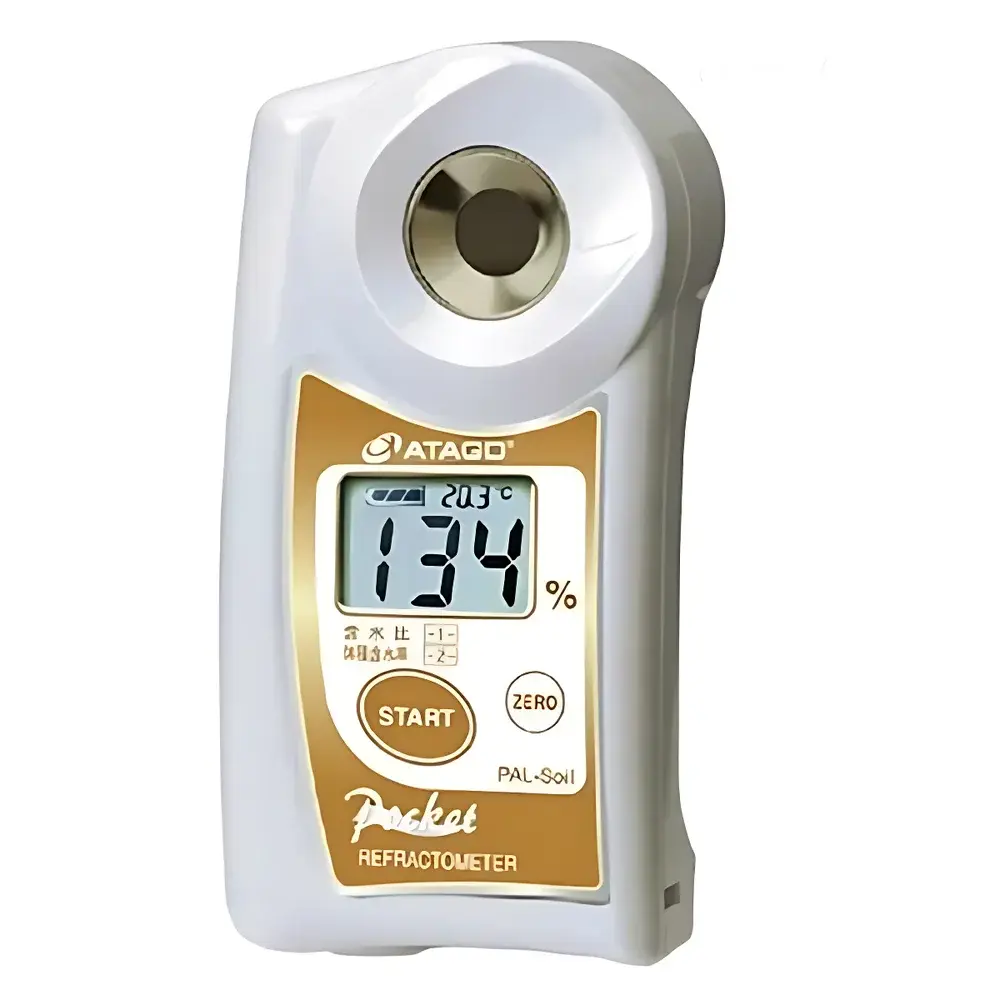
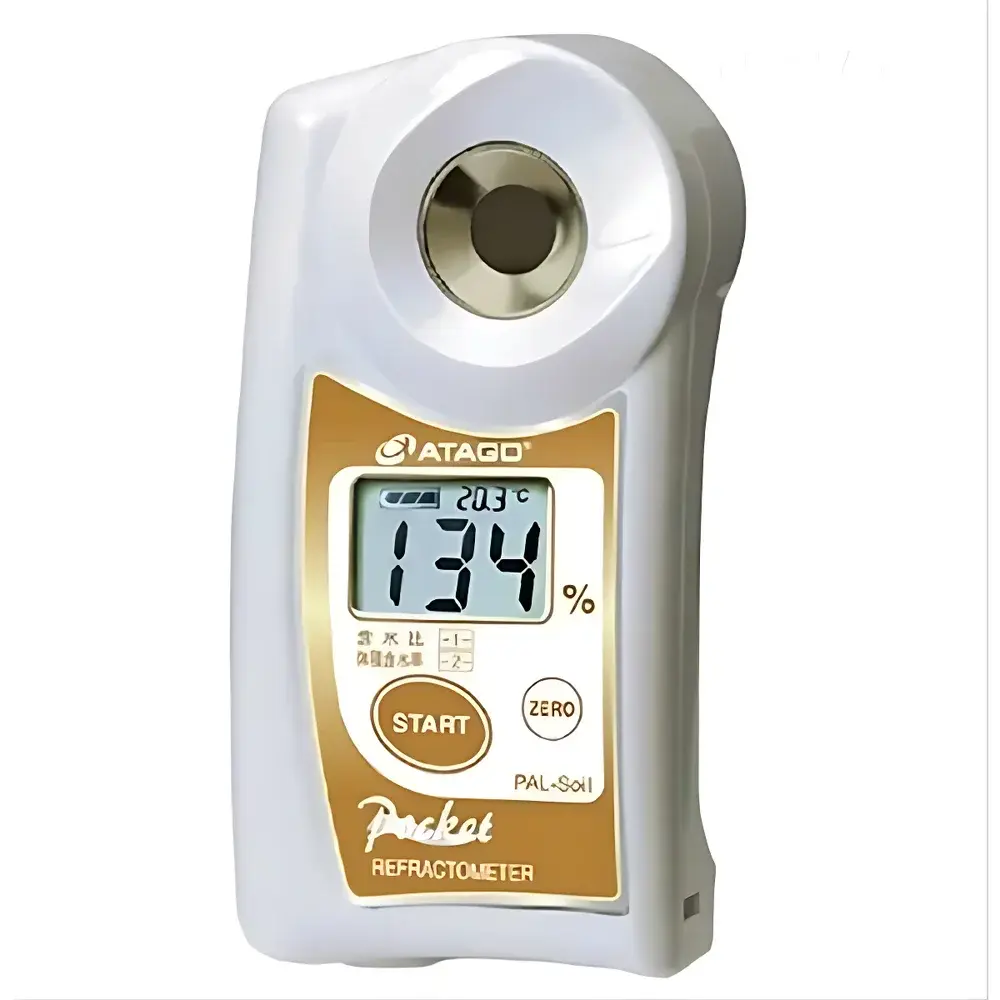
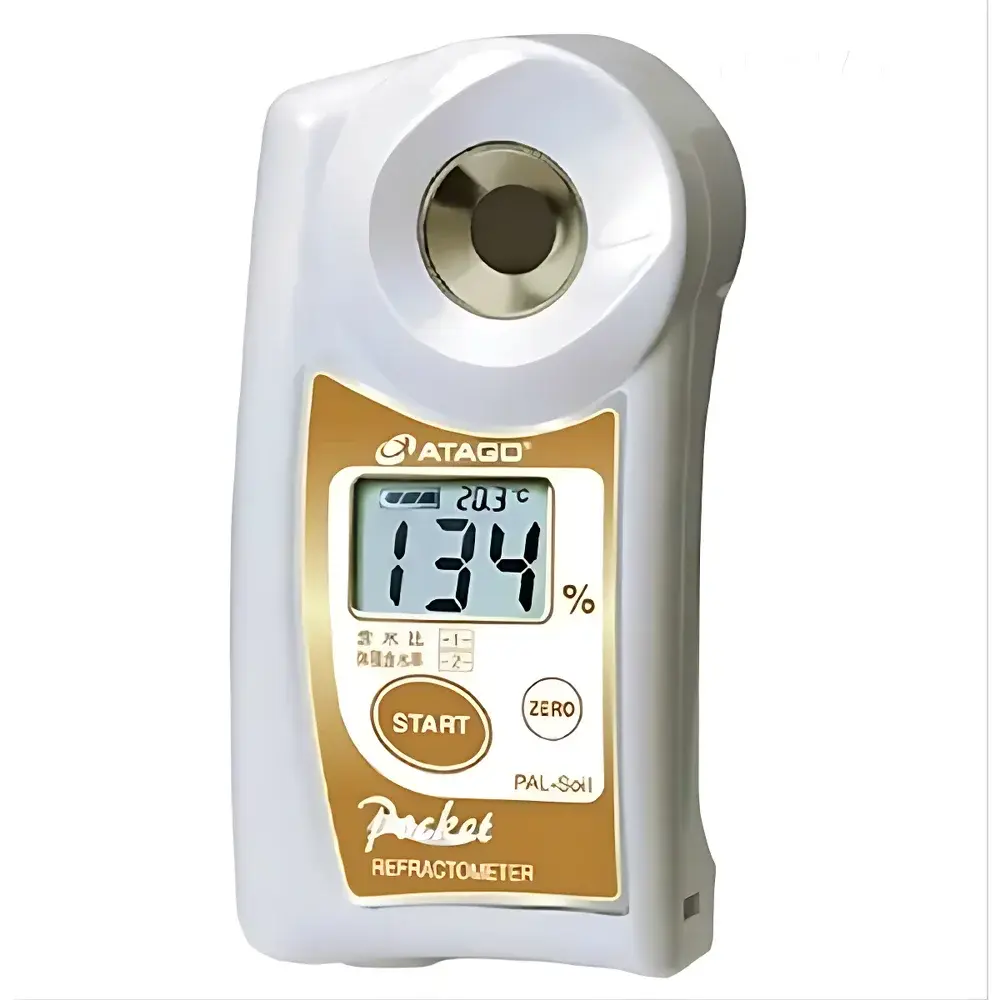
ATAGO PAL-Soil Portable Soil Moisture Analyzer
| Brand | ATAGO |
|---|---|
| Origin | Japan |
| Model | PAL-Soil |
| Measurement Range (w/w) | 0–200% |
| Measurement Range (v/v) | 0–100% |
| Accuracy (w/w) | ±2% (0–40%), ±5% (41–100%) |
| Accuracy (v/v) | ±1% (0–60%), ±2% (61–100%) |
| Temperature Range | 10–40°C (ATC) |
| Resolution | 0.1% |
| Power | 2 × AAA batteries |
| IP Rating | IP65 |
| Dimensions | 5.5 × 3.1 × 10.9 cm |
| Weight | 100 g (instrument only) |
Overview
The ATAGO PAL-Soil Portable Soil Moisture Analyzer is a handheld, refractometer-based instrument engineered for rapid, field-deployable quantification of soil water content using the principle of glycerol-water solution refractometry. Unlike capacitance-, TDR-, or neutron probe-based systems, the PAL-Soil employs a calibrated glycerol extraction method in conjunction with high-precision optical refractive index measurement to determine both gravimetric (weight basis, % w/w) and volumetric (volume basis, % v/v) soil moisture. This approach aligns with ISO 16586:2003 — “Soil quality — Determination of soil water content as volume fraction based on known dry bulk density” — and provides traceable, operator-independent results without requiring soil-specific calibration curves or dielectric property assumptions. Designed for ambient operation between 10 °C and 40 °C with automatic temperature compensation (ATC), the PAL-Soil delivers reproducible readings within seconds per sample, making it suitable for routine agronomic monitoring, irrigation scheduling, and soil physics validation studies.
Key Features
- Simultaneous dual-scale display: gravimetric moisture content (0–200% w/w) and volumetric moisture content (0–100% v/v), pre-calculated using user-input dry bulk density values
- Refractometric detection principle with glycerol-mediated water extraction — eliminates electromagnetic interference, salinity bias, and sensor drift associated with electronic probes
- Automatic temperature compensation (ATC) across 10–40 °C, ensuring consistent refractive index correlation under variable field conditions
- Rugged, IP65-rated housing resistant to dust ingress and low-pressure water jets — validated for extended outdoor use in agricultural and ecological fieldwork
- High-resolution 0.1% readout with documented accuracy: ±2% w/w (0–40%), ±5% w/w (41–100%); ±1% v/v (0–60%), ±2% v/v (61–100%)
- Compact form factor (5.5 × 3.1 × 10.9 cm) and ultra-lightweight design (100 g host unit) enabling one-handed operation and integration into mobile sampling workflows
- Low-power operation via two standard AAA batteries — supports >5,000 measurements per set under typical usage conditions
Sample Compatibility & Compliance
The PAL-Soil is compatible with mineral soils, loams, clay-loams, and organic-rich topsoils exhibiting particle sizes ≤2 mm after air-drying and homogenization. It requires minimal sample preparation: 1–2 g of representative soil is mixed with a fixed volume of glycerol reagent, vortexed, centrifuged (optional), and the supernatant solution is applied to the prism surface. The instrument does not support saturated paste extracts or highly saline soils (>10 dS/m EC) without prior dilution validation. Regulatory compliance includes adherence to ISO 16586:2003 methodology requirements. While not certified for GLP or FDA 21 CFR Part 11 environments, its measurement traceability, documented uncertainty budget, and stable optical architecture support data integrity in QA/QC protocols aligned with ISO/IEC 17025-accredited laboratories.
Software & Data Management
The PAL-Soil operates as a standalone, firmware-controlled instrument with no embedded Bluetooth, USB, or cloud connectivity. All measurements are displayed in real time on a high-contrast LCD screen and retained solely in the operator’s manual logbook or external digital record. No proprietary software, drivers, or firmware updates are required or provided. This architecture ensures long-term operational stability, avoids cybersecurity exposure vectors, and complies with air-gapped laboratory policies common in regulated environmental testing facilities. For traceable documentation, users are advised to record instrument ID (engraved on housing), date/time, sample ID, dry bulk density input, and measured w/w and v/v values per ASTM D2216 and ISO 11274 guidelines.
Applications
- Agronomic irrigation management: real-time decision support for drip and pivot systems by quantifying plant-available water deficits at multiple field locations
- Soil hydrology research: validation of neutron probe or cosmic-ray neutron sensor (CRNS) datasets under controlled plot conditions
- Ecological restoration monitoring: tracking moisture recovery dynamics in post-fire or post-mining reclamation sites
- Green infrastructure assessment: evaluating water retention performance of bioswales, rain gardens, and permeable pavements
- Academic teaching labs: hands-on demonstration of soil water potential concepts, gravimetric-to-volumetric conversion, and ISO-standardized methodology
- Regulatory field screening: preliminary assessment of soil moisture status prior to formal testing per EPA Method 9071B or ISO 11465
FAQ
How does the PAL-Soil differ from TDR or capacitance sensors?
It uses optical refractometry of glycerol-extracted soil water rather than electromagnetic wave propagation — eliminating sensitivity to soil salinity, texture, and temperature-induced dielectric shifts.
Is calibration required before each use?
No. The instrument is factory-calibrated using NIST-traceable glycerol standards; only zero adjustment with distilled water is recommended before daily use.
Can the PAL-Soil measure frozen or waterlogged soils?
No. Samples must be unfrozen, air-dried to remove free surface water, and homogenized prior to glycerol extraction.
What is the minimum sample mass needed?
1.0 g of representative, sieved (<2 mm) soil is sufficient for reliable glycerol saturation and supernatant clarity.
Does the device store measurement history?
No. It is a real-time display instrument only; all data must be manually recorded or captured externally.







