
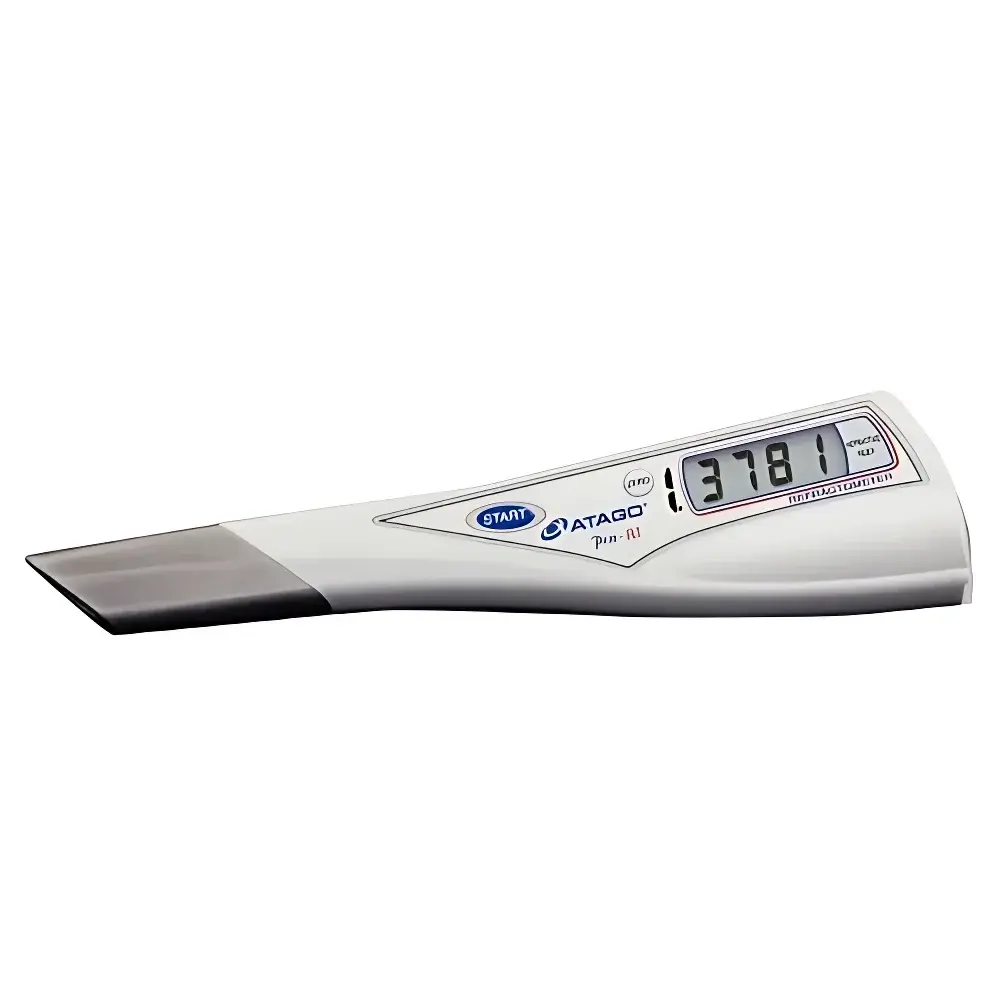
ATAGO PEN-RI Portable Digital Refractometer
| Brand | ATAGO |
|---|---|
| Origin | Japan |
| Model | PEN-RI |
| Refractive Index Range | 1.3200–1.5100 |
| Temperature Range | 10–100 °C |
| Refractive Index Accuracy | ±0.0003 (water at 20 °C) |
| Temperature Accuracy | ±1 °C |
| Display Resolution | 0.0001 RI |
| Temperature Compensation | Automatic (ATC) |
| IP Rating | IP65 (IP67 on prism) |
| Display | Backlit LCD |
Overview
The ATAGO PEN-RI is a precision-engineered portable digital refractometer designed for rapid, field-deployable measurement of refractive index (RI) across diverse industrial and laboratory environments. Operating on the fundamental principle of total internal reflection at the sample-prism interface, the instrument determines RI by detecting the critical angle shift induced by the sample’s optical density. This optical method delivers direct, non-destructive, and solvent-free analysis—ideal for routine quality control, process monitoring, and field verification where speed and reliability are essential. Unlike benchtop models requiring temperature stabilization or complex calibration routines, the PEN-RI integrates real-time automatic temperature compensation (ATC) based on an embedded thermistor adjacent to the sapphire prism surface. This ensures traceable, reproducible RI values across its full operational range (10–100 °C), eliminating manual correction tables and minimizing operator-induced variability. Its compact pen-form factor, combined with robust mechanical design and high optical stability, supports consistent performance in dynamic settings—from food processing lines and pharmaceutical cleanrooms to agricultural field testing and HVAC coolant verification.
Key Features
- High-resolution digital display with 0.0001 RI resolution and backlighting for low-light conditions
- Automatic temperature compensation (ATC) calibrated to ISO 21748 and ASTM D1218 standards
- Sapphire prism surface with IP67-rated protection against particulate ingress and water immersion (up to 1 m for 30 min)
- Full instrument housing rated IP65 for dust-tight operation and resistance to low-pressure water jets
- Single-button measurement initiation with <3-second response time after sample application
- Low sample volume requirement (0.3–0.5 mL) and rapid prism cleaning via rinse-and-wipe protocol
- Battery-powered operation (2 × AAA batteries, ~10,000 measurements per set) with auto-power-off after 3 minutes of inactivity
Sample Compatibility & Compliance
The PEN-RI is validated for aqueous solutions, oils, glycols, alcohols, acids, and polymer solutions within its RI range (1.3200–1.5100). It complies with international refractometry practices defined in ISO 21748 (repeatability and reproducibility of refractive index measurements) and supports GLP/GMP workflows through documented measurement traceability. While not FDA 21 CFR Part 11–compliant as a standalone device (lacking electronic audit trail or user authentication), it is routinely deployed in regulated environments where manual data recording adheres to SOPs aligned with USP <1151> and EP 2.2.7. The instrument’s ATC algorithm follows the standard Sellmeier dispersion model for water-based systems and provides linearized correction for common industrial fluids per manufacturer-supplied calibration curves.
Software & Data Management
The PEN-RI operates as a self-contained, firmware-driven measurement system with no external software dependency. All calibration, ATC logic, and display rendering are executed onboard using ATAGO’s proprietary optical firmware. Calibration is performed manually using distilled water (at 20 °C) or certified NIST-traceable sucrose standards; no PC connection or driver installation is required. For integration into digital quality management systems (QMS), users may log readings manually into LIMS or export via optional ATAGO Data Logger accessories (sold separately), which support CSV output and timestamped batch records. Firmware updates are not field-upgradable—units ship with final production firmware verified under JIS Z 8015 and IEC 61000-4-2 EMC immunity requirements.
Applications
- Food & Beverage: Brix estimation in fruit juices, syrups, dairy concentrates, and honey without sugar-specific assumptions
- Automotive & Industrial Lubricants: Glycol concentration monitoring in engine coolants and brake fluids
- Pharmaceutical Manufacturing: Excipient solution verification (e.g., PEG, propylene glycol) during formulation
- Agriculture: Plant sap solute concentration assessment for irrigation scheduling and nutrient status evaluation
- Chemical Production: Solvent purity checks (e.g., ethanol/water, isopropanol blends) and reaction mixture progress tracking
- Maintenance & Field Service: Quick-check validation of antifreeze concentration in HVAC chillers and solar thermal systems
FAQ
What is the recommended calibration frequency for the PEN-RI?
Calibration should be performed before each measurement session using distilled water at ambient temperature, or more frequently when ambient conditions exceed ±5 °C from the previous calibration point.
Can the PEN-RI measure opaque or highly viscous samples?
No—it requires optically transparent or translucent samples; turbid, emulsified, or particle-laden liquids will scatter incident light and yield unreliable critical angle detection.
Is the prism surface replaceable if scratched?
The sapphire prism is permanently bonded and not user-replaceable; ATAGO recommends prism inspection under 10× magnification prior to critical measurements and discourages abrasive cleaning agents.
Does the PEN-RI meet any ISO or ASTM standards for refractometer performance?
Yes—the instrument’s accuracy specification (±0.0003 RI at 20 °C in water) aligns with the repeatability criteria defined in ISO 21748 Annex A and ASTM D1218 Section 6.2 for handheld refractometers.
How does automatic temperature compensation (ATC) function without external sensors?
A high-stability thermistor is mounted directly beneath the prism base, measuring thermal equilibrium at the optical interface in real time; compensation uses pre-characterized polynomial coefficients stored in firmware.




