
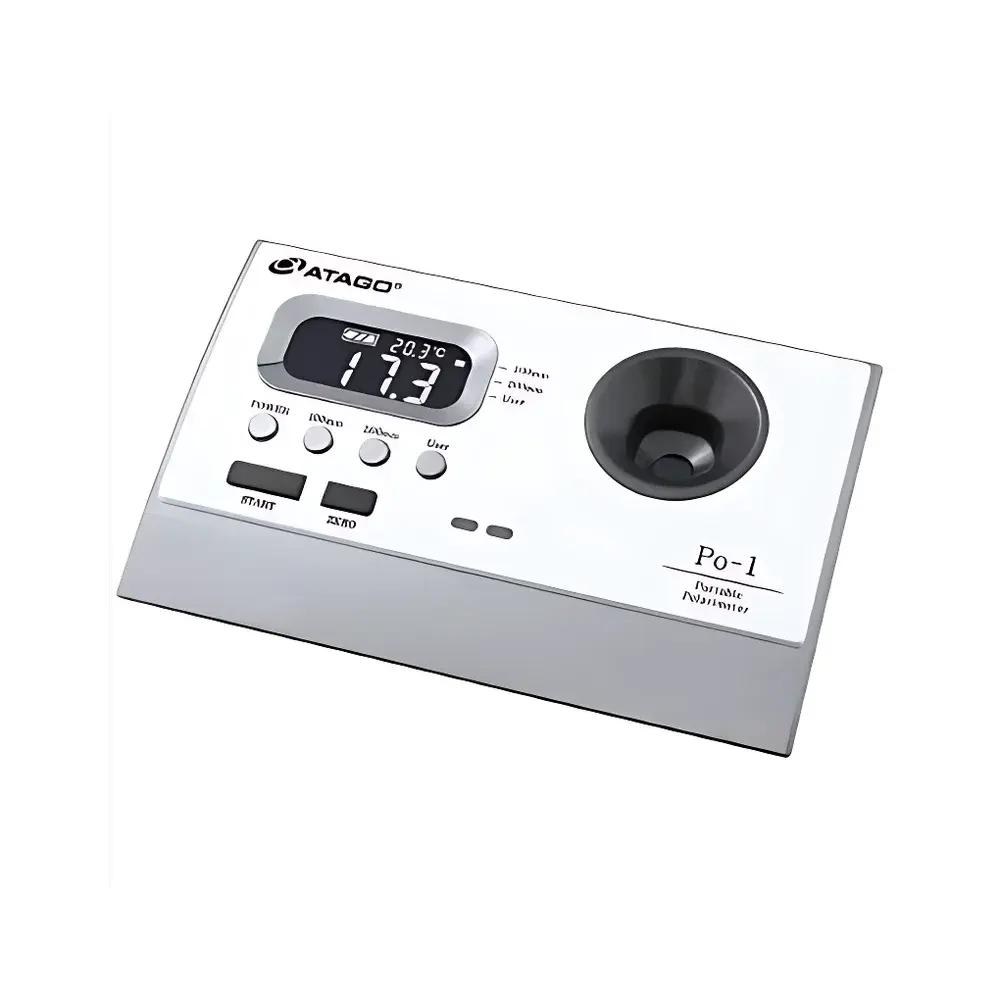
ATAGO PO-1 Portable Digital Polarimeter
| Brand | ATAGO |
|---|---|
| Origin | Japan |
| Model | PO-1 |
| Instrument Type | Automatic Portable Polarimeter |
| Temperature Control | None |
| Display | Digital LCD |
| Light Source | LED (589 nm, sodium D-line equivalent) |
| Optical Path | Compatible with 100 mm and 200 mm sample cells |
| Measuring Range | –25.0 to +25.0° (100 mm cell), –50.0 to +50.0° (200 mm cell) |
| Accuracy | ±0.1° (raw reading at 20 °C), ±0.5° (converted specific rotation using 100 mm cell), ±0.1° (using 200 mm cell) |
| Repeatability | ±0.05° |
| Resolution | 0.01° (–9.99 to +9.99°), 0.1° (outside that range) |
| Temperature Measurement Range | 5.0–40.0 °C (±0.1 °C accuracy) |
| Sample Volume | 3 mL |
| Measurement Time | 7 seconds |
| IP Rating | IP67 |
| Power | 4 × AAA alkaline batteries |
| Dimensions | 160 × 101 × 38 mm |
| Weight | 325 g (host only) |
Overview
The ATAGO PO-1 Portable Digital Polarimeter is a compact, field-deployable optical instrument engineered for rapid, high-reproducibility measurement of optical rotation in chiral liquid samples. Based on the fundamental principle of polarimetry—detection of the angular deflection of plane-polarized light as it passes through an optically active medium—the PO-1 employs a stable 589 nm LED light source approximating the sodium D-line wavelength, ensuring compatibility with standard specific rotation reporting conventions (e.g., [α]D). Unlike benchtop polarimeters requiring fixed-path-length cells and complex alignment, the PO-1 integrates a simplified optical architecture optimized for direct insertion of standard 100 mm or 200 mm sample tubes—eliminating the need for custom cuvettes or manual zeroing procedures. Its lightweight, rugged housing (325 g) and IP67-rated enclosure enable reliable operation in non-laboratory environments—including production floors, cold storage areas, field quality checks, and mobile analytical units—without compromising metrological integrity.
Key Features
- True portability: Battery-powered (4 × AAA) with 7-second measurement cycle and no external power or PC required.
- Minimal sample consumption: Only 3 mL required—ideal for precious, limited-volume, or high-value samples such as pharmaceutical intermediates, natural extracts, or synthetic chiral compounds.
- Dual-path flexibility: Supports both 100 mm and 200 mm standardized sample cells, enabling dynamic range extension from ±25.0° to ±50.0° without hardware modification.
- Integrated temperature sensing: Built-in thermistor provides real-time sample temperature readout (5.0–40.0 °C, ±0.1 °C), critical for accurate specific rotation calculation per ISO 11440 and USP <781>.
- IP67-rated enclosure: Fully dust-tight and submersible up to 1 m for 30 minutes—facilitates rapid cleaning after handling viscous, sticky, or volatile substances.
- Volatile sample support: Optional anti-evaporation cap minimizes solvent loss during measurement, preserving concentration integrity for ethanol-, acetone-, or ether-based solutions.
Sample Compatibility & Compliance
The PO-1 is validated for use with clear, homogeneous, non-scattering liquids exhibiting optical activity—including sucrose solutions, amino acid preparations, essential oils, antibiotics (e.g., penicillin G), and synthetic enantiomers. It complies with core requirements of ISO 11440 (polarimetric determination of optical rotation), ASTM E1254 (standard guide for polarimetry), and supports GLP/GMP-aligned workflows via user-defined calibration logging and traceable measurement records. While not equipped with active thermal regulation, its temperature sensor enables post-hoc correction of observed rotation to standard 20 °C conditions per pharmacopoeial guidelines (e.g., EP 2.2.7, JP 2.05). The absence of moving parts (e.g., rotating analyzers or motorized stages) ensures long-term mechanical stability and low maintenance overhead.
Software & Data Management
The PO-1 operates as a standalone instrument with no embedded software or connectivity interfaces (USB, Bluetooth, or Wi-Fi). All measurements are displayed in real time on a high-contrast LCD screen showing simultaneous values for observed rotation (°), sample temperature (°C), and user-configurable derived parameters—including concentration (%) and specific rotation ([α]D) when path length and sample density are entered manually. Data export is not supported natively; however, users may document readings directly into LIMS or ELN systems via manual entry or external barcode-assisted logging. For regulated environments, the device supports audit-ready documentation through operator-defined user IDs and timestamped manual logbooks—fully compatible with FDA 21 CFR Part 11 principles when implemented with procedural controls.
Applications
- Pharmaceutical QC: Rapid verification of enantiomeric purity in APIs and chiral excipients during release testing.
- Fine chemical manufacturing: In-process monitoring of asymmetric synthesis batches (e.g., epoxidation, hydrogenation).
- Food & beverage analysis: Quantification of sucrose content in syrups, fruit juices, and honey per AOAC 952.03 and ICUMSA methods.
- Academic research: Teaching labs for stereochemistry fundamentals and undergraduate physical chemistry experiments.
- Essential oil authentication: Detection of adulteration in citrus, mint, or camphor oils based on characteristic rotation signatures.
FAQ
Does the PO-1 require calibration with standard quartz control plates?
Yes—ATAGO recommends periodic verification using certified quartz rotatory standards (e.g., QP-100 series) at least daily for critical applications, per ISO/IEC 17025 clause 7.7.
Can the PO-1 measure turbid or colored samples?
No—optical rotation measurement requires >80% transmittance at 589 nm; highly absorbing or scattering samples will yield unreliable or error-flagged results.
Is temperature compensation automatic?
No—the device reports raw observed rotation and measured temperature separately; conversion to [α]D must be performed manually using established equations (e.g., [α]DT = α / (l × c)).
What is the minimum detectable rotation change?
At ±9.99°, resolution is 0.01°; beyond ±10.0°, resolution degrades to 0.1°—consistent with ISO 11440 repeatability thresholds for portable instruments.
How often do the AAA batteries need replacement?
Under typical usage (≈50 measurements/day), battery life exceeds 2,000 measurements; low-power indication appears 30 minutes prior to depletion.




