
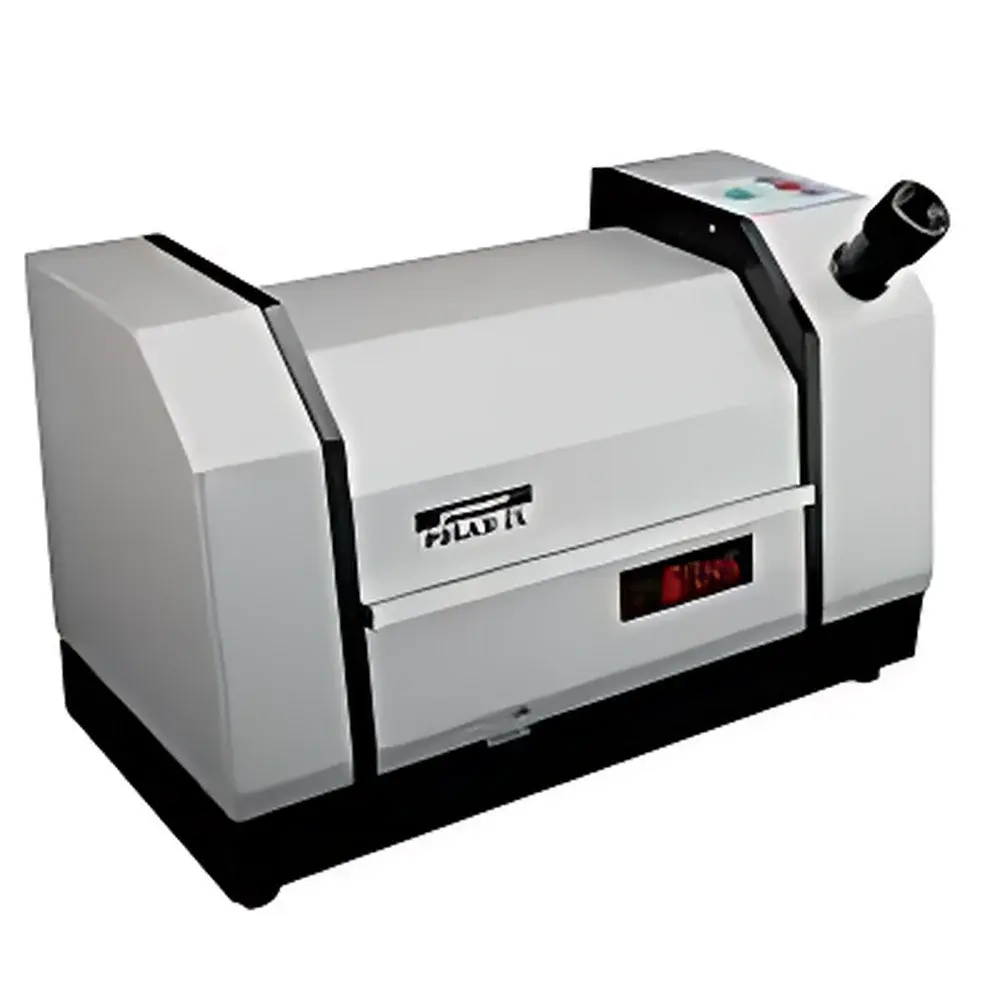
ATAGO POLAX-2L Digital Polarimeter
| Brand | ATAGO |
|---|---|
| Origin | Japan |
| Model | POLAX-2L |
| Measurement Range | ±180° (angular) / ±130°Z (sucrose scale) |
| Resolution | 0.05° (0.1°Z) |
| Temperature Compensation | 5–40 °C |
| Light Source | Long-life LED with 589 nm interference filter |
| Sample Tubes | Two sets — 100 mm and 200 mm pathlength |
| Power Supply | 100–240 VAC, 50/60 Hz, 40 VA |
| Dimensions & Weight | 43 × 22 × 30 cm, 11.5 kg |
Overview
The ATAGO POLAX-2L Digital Polarimeter is a precision optical instrument engineered for the quantitative measurement of optical rotation — the angular deflection of plane-polarized light as it passes through chiral substances. Based on the fundamental principle of polarimetry, the device employs a monochromatic sodium-D line equivalent (589 nm) generated by a stable LED source and narrowband interference filter to ensure spectral consistency and long-term calibration integrity. Optical rotation is directly proportional to the concentration, path length, and specific rotation of optically active compounds — making the POLAX-2L an essential tool for quantitative analysis in pharmaceutical development, fine chemical synthesis, and food quality assurance. Its dual-scale output (degrees angular and degrees Zuckerskala, or °Z) conforms to international sugar industry conventions defined in ISO 5700 and AOAC Official Method 951.02, enabling direct comparability with reference standards used in sucrose assay protocols.
Key Features
- High-stability 589 nm LED light source with integrated interference filter eliminates lamp aging drift and reduces warm-up time compared to traditional sodium vapor lamps.
- Dual-pathlength sample tube configuration (100 mm and 200 mm) supports flexible measurement of low- and high-concentration samples without dilution — critical for API purity verification and syrup analysis.
- Real-time temperature compensation across 5–40 °C ensures measurement accuracy under ambient laboratory conditions; no external water bath required for routine QC testing.
- Digital angular readout with 0.05° resolution (0.1°Z) meets minimum detectability requirements specified in USP and EP 2.2.7 for optical rotation assays of chiral drugs.
- Robust benchtop architecture (11.5 kg mass, vibration-damped base) minimizes mechanical drift during extended measurement sequences typical in GLP-compliant stability studies.
Sample Compatibility & Compliance
The POLAX-2L accommodates standard 100 mm and 200 mm polarimeter tubes with threaded or O-ring sealing interfaces, compatible with aqueous solutions, organic solvents (e.g., ethanol, chloroform), and viscous liquids such as syrups and essential oils — provided they are optically clear and free of suspended particulates. It supports compliance with pharmacopeial methods including USP , EP 2.2.7, and JP 2.07, where optical rotation serves as a release test parameter for enantiomeric purity of APIs like levodopa, ibuprofen, and ampicillin. The instrument’s fixed-wavelength design satisfies ISO/IEC 17025 clause 5.5.2 for traceable photometric performance when calibrated using certified quartz control plates (NIST-traceable SRM 1530 series available separately).
Software & Data Management
While the POLAX-2L operates as a standalone benchtop instrument with direct digital display, its analog voltage output (0–1 V DC proportional to rotation angle) enables integration into centralized LIMS or SCADA environments via optional analog-to-digital converters. All measurements are timestamped and stored internally (non-volatile memory) with operator ID entry capability — supporting audit trails required under FDA 21 CFR Part 11 for electronic records in regulated manufacturing. Raw angular data may be exported via RS-232 interface (optional cable) for post-processing in validated Excel templates or statistical process control (SPC) platforms compliant with ISO 9001:2015 clause 8.5.1.
Applications
- Pharmaceutical QC: Determination of enantiomeric excess (ee%) in chiral drug intermediates and final products per ICH Q5B guidelines.
- Sugar industry: Direct °Z readout for sucrose concentration in cane juice, beet extracts, and invert sugar syrups per ICUMSA Method GS4/3-14.
- Food & flavor chemistry: Verification of authenticity and adulteration in honey, maple syrup, and citrus oils via specific rotation deviation thresholds.
- Academic research: Teaching polarimetric principles in undergraduate physical chemistry labs; kinetic monitoring of asymmetric hydrolysis or esterification reactions.
- Regulatory submissions: Generation of primary analytical data for ANDA, NDA, and CEP dossiers where optical rotation is a compendial identity or purity test.
FAQ
What is the wavelength accuracy specification of the 589 nm LED source?
The interference filter provides center wavelength tolerance of ±0.5 nm at full width at half maximum (FWHM ≈ 1.2 nm), verified per ISO 10110-2:2018 Annex D.
Can the POLAX-2L be used for temperature-controlled measurements below 5 °C?
No — the internal temperature sensor and compensation algorithm are validated only between 5 and 40 °C. Sub-ambient operation requires external thermostatted cell holders (not included).
Is the instrument compliant with FDA 21 CFR Part 11 for electronic signatures?
The standalone unit does not support electronic signatures; however, its analog output and RS-232 interface allow integration into Part 11–compliant systems when paired with validated acquisition software and access controls.
How often should calibration verification be performed?
Daily verification using a certified quartz control plate is recommended before first use and after any transport or mechanical shock, per ASTM E287-22 Section 7.3.
Does the POLAX-2L meet ISO/IEC 17025 requirements for accredited testing laboratories?
Yes — when operated within specified environmental conditions, maintained per ATAGO’s MSA-001 calibration protocol, and supported by documented uncertainty budgets (k=2) derived from repeatability, reproducibility, and reference standard uncertainty.





