
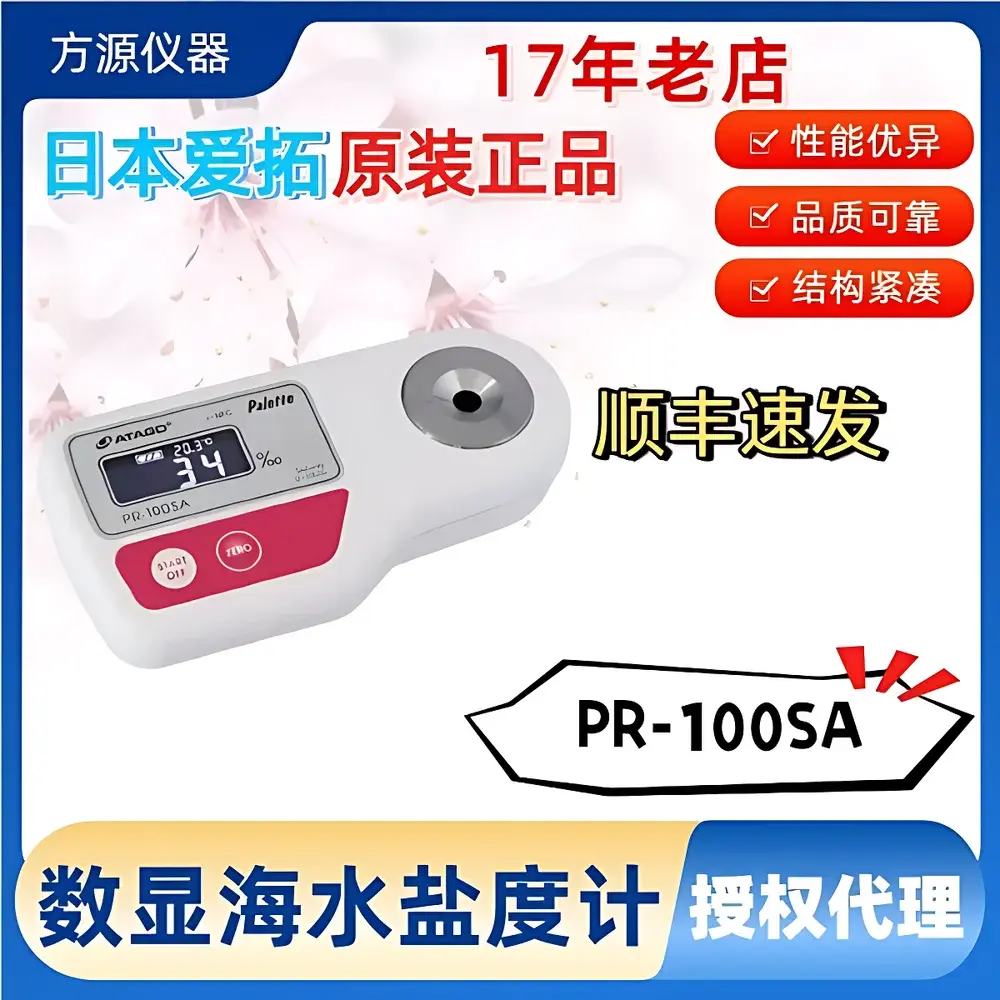
ATAGO PR-100SA Digital Handheld Seawater Salinometer
| Brand | ATAGO |
|---|---|
| Origin | Japan |
| Model | PR-100SA |
| Product Type | Handheld Refractometer |
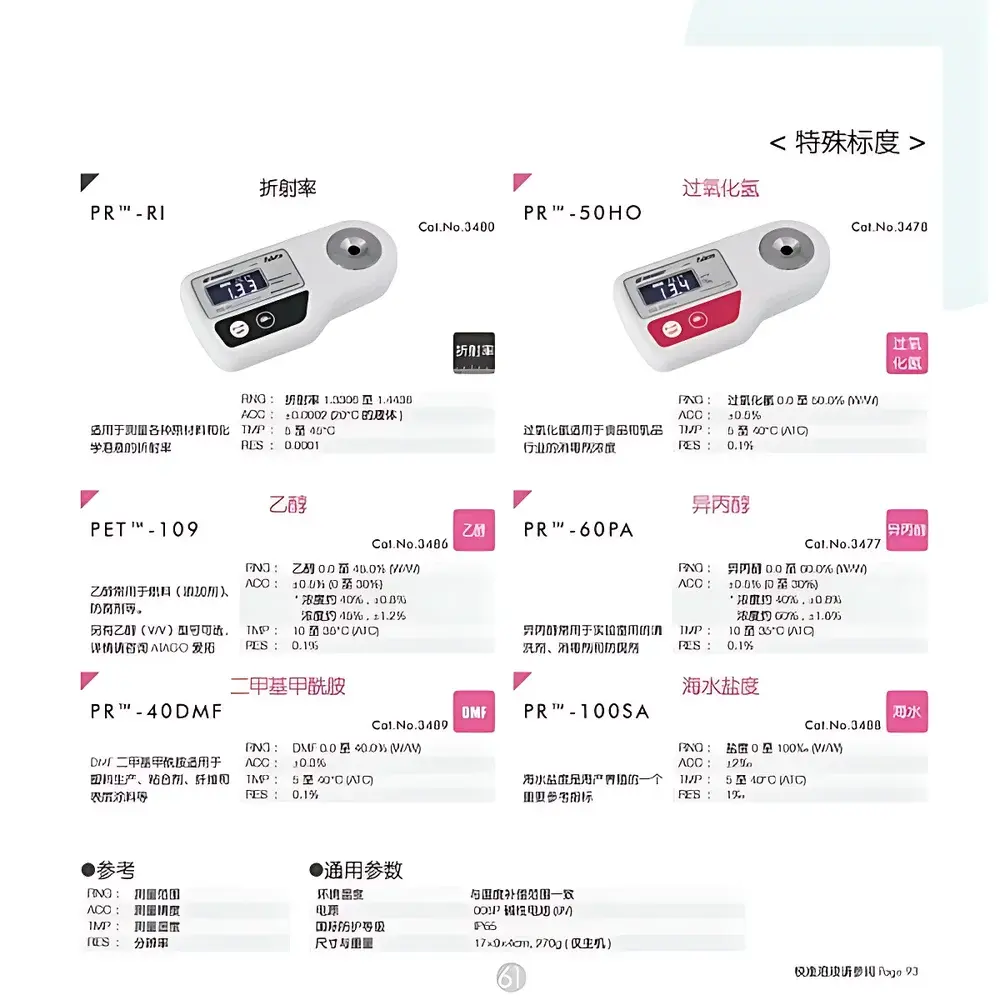
| Measurement Range | Salinity 0–100 ‰ (w/w) |
| Accuracy | ±2% |
| Display | Digital LCD |
| Temperature Compensation | None |
| Certifications | Complies with JIS K 0063 and ISO 2173 for refractometric salinity determination |
Overview
The ATAGO PR-100SA is a compact, field-deployable handheld salinometer engineered for rapid, on-site measurement of seawater and brine salinity using the principle of total internal reflection in optical refraction. Unlike conductivity-based salinity meters, the PR-100SA employs Abbe refractometry—measuring the refractive index of aqueous salt solutions at 20 °C—and converts it to mass-based salinity concentration (g NaCl per kg solution, expressed as ‰ w/w) via a pre-calibrated polynomial algorithm traceable to standard seawater reference materials (e.g., IAPSO Standard Seawater). Its optical path is sealed within a sapphire prism assembly, ensuring long-term stability against corrosion, biofouling, and mechanical abrasion—critical for marine environmental monitoring, aquaculture operations, and desalination plant feedwater screening. Designed for single-point calibration with distilled water (zero point), the instrument operates without external power sources beyond its integrated CR2032 battery, enabling >5,000 measurements per charge.
Key Features
- Optical-grade sapphire prism with anti-scratch and salt-resistant coating for extended service life in high-chloride environments
- Digital LCD display with automatic backlighting for low-light field conditions (e.g., deck operations, nighttime sampling)
- Direct readout in salinity units (0–100 ‰ w/w), eliminating manual conversion from refractive index or Brix
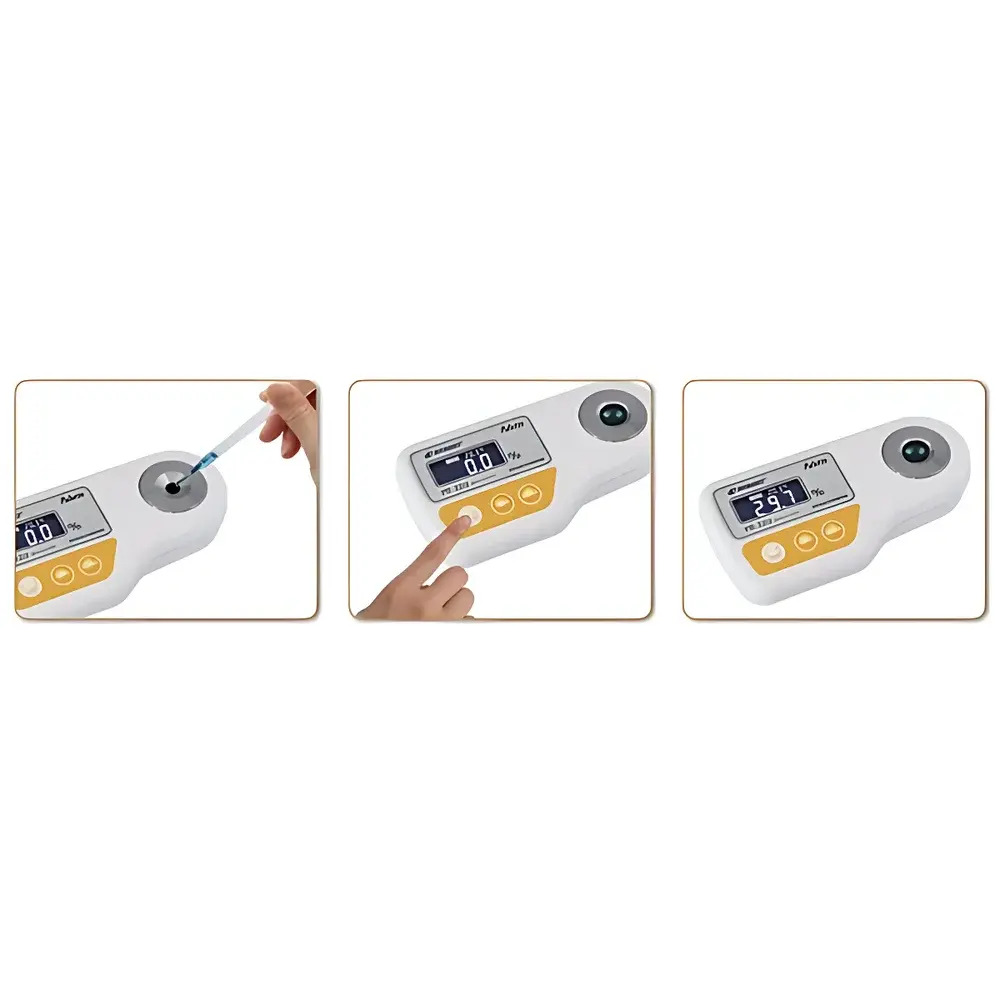
- Auto-zero function (START OFF ZERO) ensures baseline repeatability prior to each measurement sequence
- Ergonomic, IP65-rated housing resistant to seawater spray, dust ingress, and accidental drops from 1 m height
- No temperature control or Peltier element—intended for ambient-temperature use (10–30 °C); results are not compensated for thermal expansion effects
Sample Compatibility & Compliance
The PR-100SA is validated for homogeneous aqueous NaCl solutions, natural seawater, brine effluents, and hypersaline pond samples (up to saturation). It is not suitable for viscous, turbid, or suspended-solid-laden samples (e.g., sediment-laden estuarine water, algal blooms), which scatter incident light and degrade refractive index accuracy. The device conforms to JIS K 0063 (Japanese Industrial Standard for refractometric determination of salt content in food and water) and aligns with ISO 2173:2003 (fruit and vegetable products — determination of soluble solids — refractometric method), though its primary application domain falls under marine environmental standards such as UNESCO Technical Papers in Marine Science No. 67 (1994). While not FDA 21 CFR Part 11 compliant (lacking audit trail or user authentication), it meets GLP documentation requirements when used with manual logbook recording per ISO/IEC 17025:2017 clause 7.8.1.
Software & Data Management
The PR-100SA is a standalone analog-optical-digital hybrid instrument with no Bluetooth, USB, or data export capability. All measurements are displayed in real time and must be manually recorded. This design prioritizes operational simplicity, minimal maintenance, and immunity to electromagnetic interference—key advantages in shipboard, offshore platform, or remote coastal station deployments where connectivity infrastructure is unreliable or prohibited. For laboratories requiring digital traceability, ATAGO recommends pairing the PR-100SA with its optional RS-232-compatible PR-32 digital interface module (sold separately), enabling ASCII-formatted output to LIMS or Excel via serial-to-USB adapter.
Applications
- Real-time salinity verification during ballast water exchange operations (per IMO Ballast Water Management Convention Annex IV)
- Monitoring evaporation rates and crystallization onset in solar salt pans and inland brine ponds
- Quality control of artificial seawater formulations in marine aquarium facilities and research hatcheries
- Rapid assessment of brine concentration in electrochlorination systems for shipboard antifouling
- Field validation of CTD (Conductivity-Temperature-Depth) probe calibrations in coastal oceanography surveys
FAQ
Does the PR-100SA measure electrical conductivity or refractive index?
It measures refractive index optically and displays the derived salinity value (‰ w/w); it does not output raw RI or conductance data.
Can it be calibrated with artificial seawater standards?
Yes—calibration is performed using distilled water (0 ‰), but verification may be conducted against certified reference materials such as IAPSO Standard Seawater (batch-certified for salinity).
Is temperature compensation available?
No—the instrument assumes measurement at 20 °C; users must correct readings manually using published thermal expansion coefficients if ambient temperature deviates significantly.
What is the minimum sample volume required?
Approximately 0.3 mL is sufficient to cover the prism surface; excess liquid is removed with the included microfiber cloth.
How often should the prism be cleaned?
After every measurement in high-salinity or organic-contaminated samples, using distilled water followed by gentle drying with lens tissue—never abrasive paper towels.




