
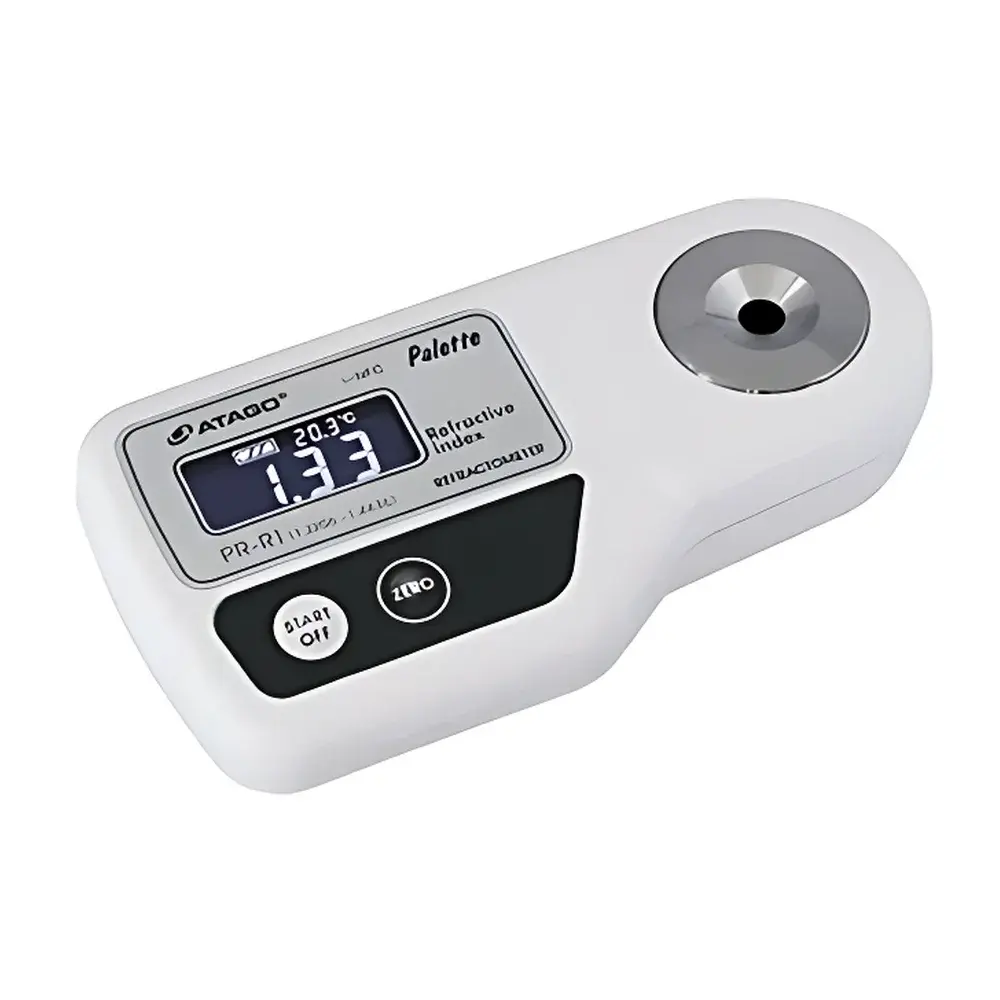
ATAGO PR-RI Digital Handheld Refractometer
| Brand | ATAGO |
|---|---|
| Origin | Japan |
| Model | PR-RI |
| Sample Temperature Range | 5–45 °C |
| Refractive Index (nD) Measurement Range | 1.3306–1.4436 |
| Accuracy | ±0.0002 nD (measured with distilled water at 20 °C) |
| Resolution | 0.0001 nD / 1 °C |
| Display | Dual digital readout (nD + temperature) |
| Temperature Compensation | Automatic (ATC, 5–45 °C) |
| Power | 9 V alkaline battery (006P) |
| IP Rating | IP64 |
| Dimensions | 170 × 90 × 40 mm |
| Weight | 300 g (instrument only) |
Overview
The ATAGO PR-RI Digital Handheld Refractometer is a precision optical instrument engineered for rapid, field-deployable measurement of refractive index (nD) in liquid samples. Based on the principle of total internal reflection at the prism–sample interface, the PR-RI employs a high-stability Abbe-type optical system coupled with a calibrated sapphire prism and integrated thermistor for real-time temperature monitoring. Unlike analog refractometers, the PR-RI digitizes the critical angle displacement and converts it directly into a refractive index value with 0.0001 resolution—enabling trace-level differentiation between chemically similar solutions. Its automatic temperature compensation (ATC) algorithm conforms to ISO 21748 and ASTM D1218 standards for temperature-corrected refractive index reporting, ensuring metrological consistency across ambient fluctuations from 5 °C to 45 °C. Designed for routine QC in regulated environments, the PR-RI delivers repeatable nD values without external calibration fluids beyond distilled water—making it suitable for GMP-aligned workflows where documentation integrity and operator independence are essential.
Key Features
- High-resolution digital display showing both refractive index (nD) and sample temperature simultaneously, with 0.0001 nD and 1 °C resolution
- Integrated ATC (Automatic Temperature Compensation) compliant with ISO 21748:2017 for accurate nD reporting across 5–45 °C sample temperature range
- Sapphire-coated measuring prism offering superior scratch resistance and long-term optical stability versus standard BK7 glass
- IP64-rated enclosure providing dust-tight operation and protection against water splashes—ideal for lab, production floor, or warehouse use
- Single-button START/ON-OFF operation with 3-second measurement cycle; no warm-up time required
- Battery-powered (9 V 006P alkaline), enabling uninterrupted portability without tethering to mains power or USB interfaces
- Zero-point verification and recalibration performed in under 20 seconds using only distilled water—no proprietary standards or service tools needed
Sample Compatibility & Compliance
The PR-RI accepts aqueous and organic liquid samples with viscosity ≤ 500 mPa·s and non-volatile residue < 50 wt%. It is routinely deployed for quality control of solvents, active pharmaceutical ingredients (APIs), excipients, cleaning agents, and intermediate reaction mixtures. The instrument meets mechanical and electrical safety requirements per IEC 61010-1:2010 and carries CE marking for conformity with EU Directive 2014/30/EU (EMC) and 2014/35/EU (LVD). While not FDA 21 CFR Part 11–certified as a standalone data system, its zeroing protocol and stable optical path support ALCOA+ data integrity principles when used within documented SOPs—including audit-ready manual logging of calibration timestamps, operator IDs, and environmental conditions.
Software & Data Management
The PR-RI operates as a stand-alone optical sensor with no embedded memory, Bluetooth, or USB connectivity. All measurements are displayed in real time and must be manually recorded—ensuring full transparency and eliminating electronic record manipulation risks. This architecture aligns with laboratories maintaining paper-based or LIMS-integrated workflows where human-readable output is mandated by internal QA policy or regulatory inspectors (e.g., WHO TRS 992 Annex 4, EU GMP Annex 11). For traceability, users are advised to log zeroing events, ambient temperature, sample identification, and measured nD in bound laboratory notebooks or validated electronic systems. Optional accessories include ATAGO’s PR-CAL-01 calibration certificate (NIST-traceable), issued with each unit upon request.
Applications
- Pharmaceutical manufacturing: Verification of solvent identity (e.g., ethanol, isopropanol, acetone) and concentration uniformity in cleaning validation swab extracts
- Chemical synthesis: Monitoring reaction progress via nD shifts during esterification, hydrolysis, or polymerization steps
- Quality assurance of raw materials: Discrimination between grade-spec variants (e.g., USP-grade vs. technical-grade glycerin)
- Stability testing: Tracking refractive index drift in accelerated storage studies as an early indicator of degradation or phase separation
- Educational labs: Teaching optical property fundamentals—including dispersion, Snell’s law, and temperature dependence of nD
FAQ
How often should I perform zero calibration?
Zero calibration is required before first use each day, after significant ambient temperature shifts (>5 °C), and immediately following battery replacement.
Can the PR-RI measure opaque or particulate-laden samples?
No. The instrument requires optically clear, homogeneous liquids; suspended solids or turbidity will scatter incident light and invalidate the critical angle detection.
Is temperature correction applied automatically to the displayed nD value?
Yes—the ATC algorithm adjusts the raw optical reading to report nD referenced to 20 °C, per ISO 21748 Annex B conventions.
What is the minimum sample volume required?
Approximately 0.3 mL is sufficient to fully cover the 12 mm × 12 mm sapphire prism surface.
Does the PR-RI comply with pharmacopoeial methods?
While not cited verbatim in USP or Ph. Eur. 2.2.6, its optical design, accuracy specification (±0.0002), and ATC implementation satisfy the general requirements for refractometric assays described in those chapters.




