
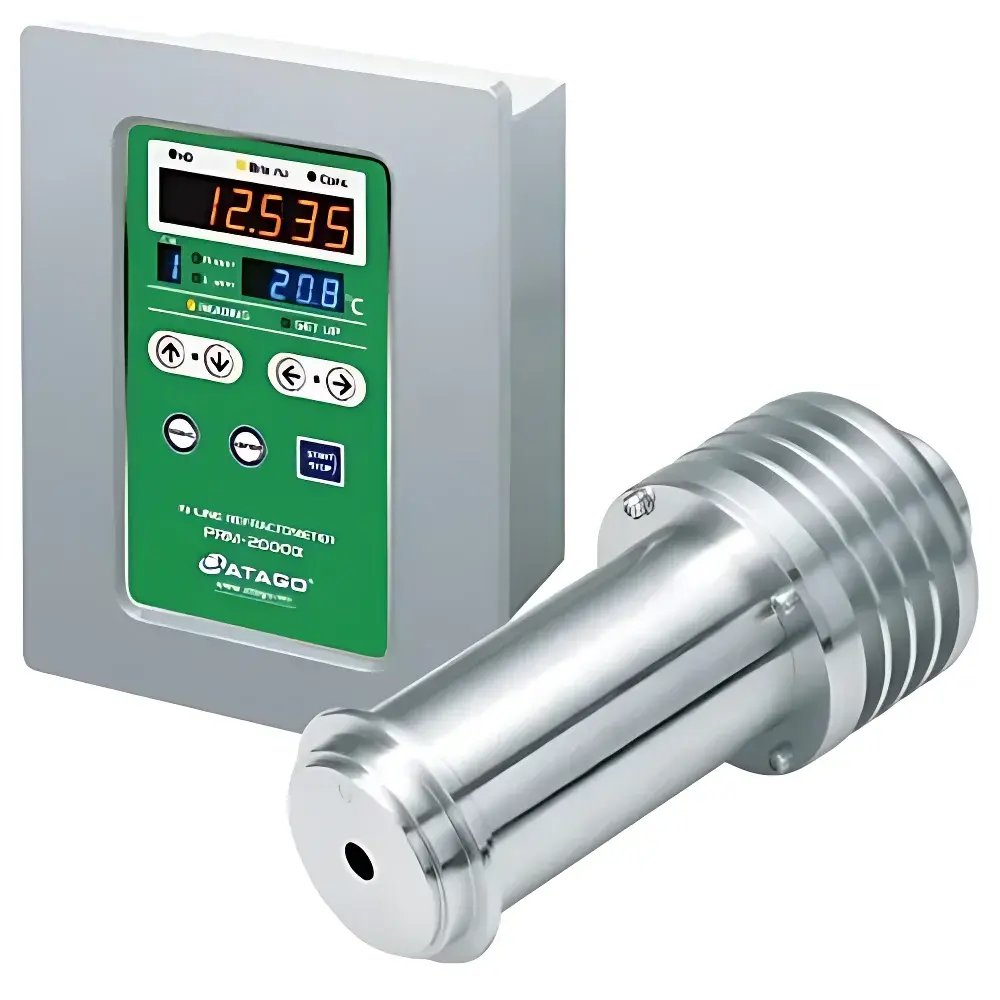
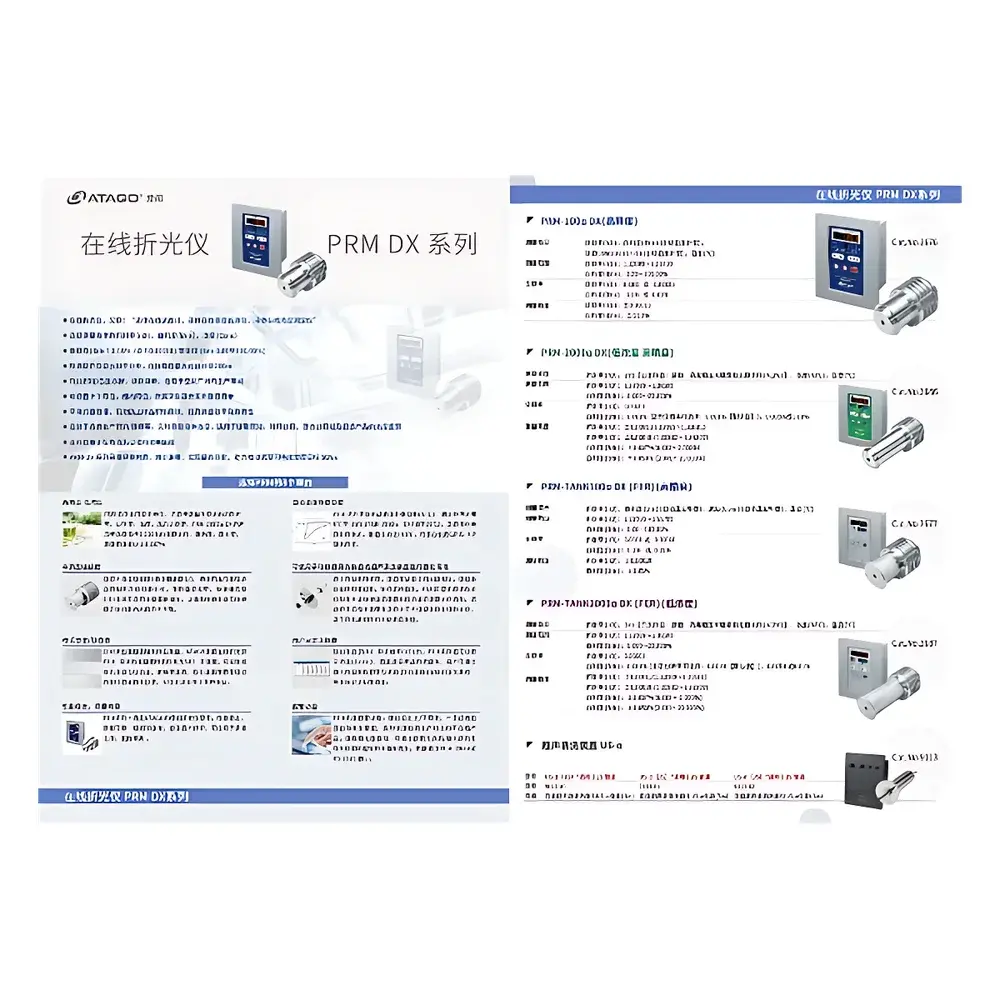
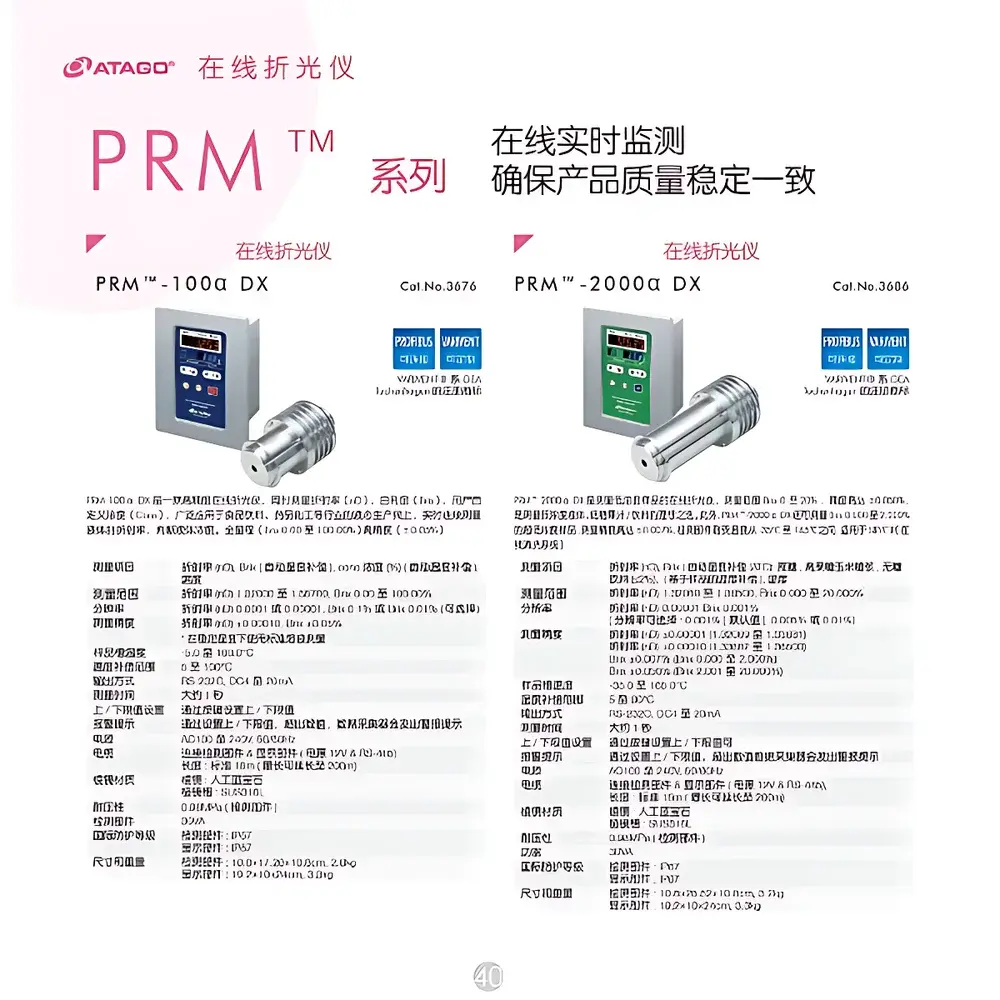
ATAGO PRM-2000α DX Low-Concentration High-Precision In-Line Refractometer
| Brand | ATAGO |
|---|---|
| Origin | Japan |
| Product Type | In-line Refractometer |
| Model | PRM-2000α DX |
| Measurement Range | Refractive Index (nD) 1.32069–1.36500 |
| Measurement Accuracy | ±0.00001 nD (1.32069–1.33681), ±0.00010 nD (1.33682–1.36500), ±0.007% Brix (0.000–2.000%), ±0.050% Brix (2.001–20.000%) |
| Resolution | 0.00001 nD, 0.001% Brix (switchable to 0.005% or 0.01%) |
| Temperature Compensation Range | 5–90°C |
| Operating Temperature | −35.0–165.0°C |
| Prism Material | Sapphire |
| Wetted Parts | SUS316L |
| Pressure Rating | 0.98 MPa |
| IP Rating | IP67 (both sensor and display unit) |
| Output | DC 4–20 mA (optional cable), RS-232C (optional cable) |
| Response Time | ~1 second |
| Power Supply | AC 100–240 V, 50/60 Hz |
| Cable Length | Standard 15 m (up to 200 m available) |
Overview
The ATAGO PRM-2000α DX is an industrial-grade in-line refractometer engineered for continuous, real-time measurement of refractive index (nD) and Brix concentration in low-concentration aqueous solutions. Based on the fundamental optical principle of total internal reflection at a solid–liquid interface—precisely calibrated using sapphire prism optics—the instrument delivers trace-level resolution and metrological stability required for critical process control. Unlike benchtop or handheld refractometers, the PRM-2000α DX integrates a ruggedized flow-through sensor directly into process piping, enabling uninterrupted monitoring without sample extraction, flow interruption, or operator intervention. Its design prioritizes high reproducibility in dynamic environments: the sapphire prism (Mohs hardness 9) resists abrasion, chemical attack, and thermal shock; the SUS316L wetted surfaces ensure compatibility with aggressive cleaning-in-place (CIP) and sterilization-in-place (SIP) protocols; and its IP67-rated construction guarantees operational integrity in humid, washdown, or explosive-atmosphere zones (per ATEX/IECEx zone classification when paired with appropriate barriers). The device operates across a broad temperature range (−35.0 to +165.0°C), with automatic temperature compensation (ATC) applied algorithmically across 5–90°C to maintain accuracy—particularly vital for sub-2% Brix measurements where thermal drift most significantly impacts nD linearity.
Key Features
- Ultra-high-resolution detection: 0.00001 refractive index units and 0.001% Brix (user-selectable resolution modes)
- Dual-parameter output: Simultaneous real-time reporting of nD and Brix, with configurable ATC curves for sucrose, high-fructose corn syrup (HFCS), and low-sugar beverages (≤2% Brix)
- Process-hardened optical architecture: Sapphire prism coupled with thermally stabilized LED light source and precision photodiode array ensures long-term calibration retention
- Modular system design: Separated sensor and display units connected via shielded cable (standard 15 m, extendable to 200 m), minimizing electromagnetic interference and enabling remote mounting in hazardous areas
- Robust mechanical specifications: 0.98 MPa pressure rating, IP67 ingress protection on both units, and operating ambient temperature range of 5–40°C
- Fast response time: <1 second measurement cycle supports closed-loop feedback control in high-speed blending, dilution, or evaporation systems
Sample Compatibility & Compliance
The PRM-2000α DX is validated for use with low-viscosity, optically transparent, non-particulate liquid streams typical of food & beverage, pharmaceutical, and fine chemical manufacturing. It is routinely deployed in monitoring sucrose-based soft drinks, HFCS-sweetened teas, alcohol-free malt beverages, starch hydrolysates, aqueous surfactant solutions, metalworking coolants, and ultrapure rinse water. Its ATC algorithms conform to ISO 21542:2020 (refractometric determination of sugar content) and support compliance with FDA 21 CFR Part 11 when integrated with audit-trail-capable SCADA or MES platforms. While not intrinsically rated for Class I Div 1 environments, the sensor may be installed in Zone 2/22 locations when used with approved galvanic isolators and documented risk assessments per IEC 60079-14. All wetted materials comply with USP Class VI and EC 1935/2004 food-contact regulations.
Software & Data Management
The PRM-2000α DX interfaces seamlessly with industry-standard automation infrastructure via isolated 4–20 mA analog output (HART-enabled upon request) and RS-232C serial communication (Modbus RTU protocol supported). No proprietary software is required for basic integration; configuration and calibration are performed locally via the front-panel keypad and 7-segment LED display—designed for legibility at distances up to 10 meters under variable lighting. For centralized data logging, the instrument outputs timestamped nD/Brix/temperature triples at user-defined intervals (1–60 s), compatible with OSIsoft PI System, Ignition SCADA, and LabVIEW-based QA dashboards. Calibration history, sensor diagnostics (e.g., prism fouling index, LED intensity decay), and alarm thresholds (high/low limits, deviation alerts) are retained in non-volatile memory and retrievable via serial query—enabling full GLP/GMP traceability when paired with electronic logbook systems.
Applications
- Real-time concentration control during syrup dilution, juice reconstitution, and low-sugar beverage blending
- In-process monitoring of evaporator outlet concentration in dairy whey and plant protein isolation
- CIP validation via refractive index shift tracking to confirm removal of residual organics from pipelines
- Continuous verification of coolant concentration in CNC machining cells to prevent tool wear and corrosion
- Batch-to-batch consistency assurance in pharmaceutical excipient dissolution and buffer preparation
- On-stream measurement of ethanol–water ratios in distillation side draws (within specified nD range)
- Monitoring of surface treatment bath composition (e.g., phosphating, anodizing, passivation solutions)
FAQ
What is the minimum detectable Brix change the PRM-2000α DX can resolve?
The instrument resolves Brix changes as small as 0.001% in high-resolution mode—critical for detecting subtle deviations during low-concentration blending or ultra-pure water leak detection.
Does the sensor require periodic recalibration in continuous operation?
Calibration stability exceeds 6 months under stable thermal and mechanical conditions; however, ATAGO recommends quarterly verification using NIST-traceable sucrose standards per ISO 5725-2.
Can the PRM-2000α DX measure opaque or suspended-phase liquids?
No—turbidity or particulates scatter incident light and invalidate the nD measurement; inline filtration (≤5 µm) is mandatory for slurries or cloudy process streams.
Is temperature compensation applied automatically during measurement?
Yes—integrated Pt100 RTD measures fluid temperature at the prism interface, and compensation is applied in real time using preloaded polynomial coefficients for each ATC mode.
What certifications accompany the device for global deployment?
CE marking (EMC Directive 2014/30/EU, LVD Directive 2014/35/EU), RoHS 2011/65/EU compliance, and Japanese JIS K 0061 certification for refractometric analysis are supplied with each unit.



