
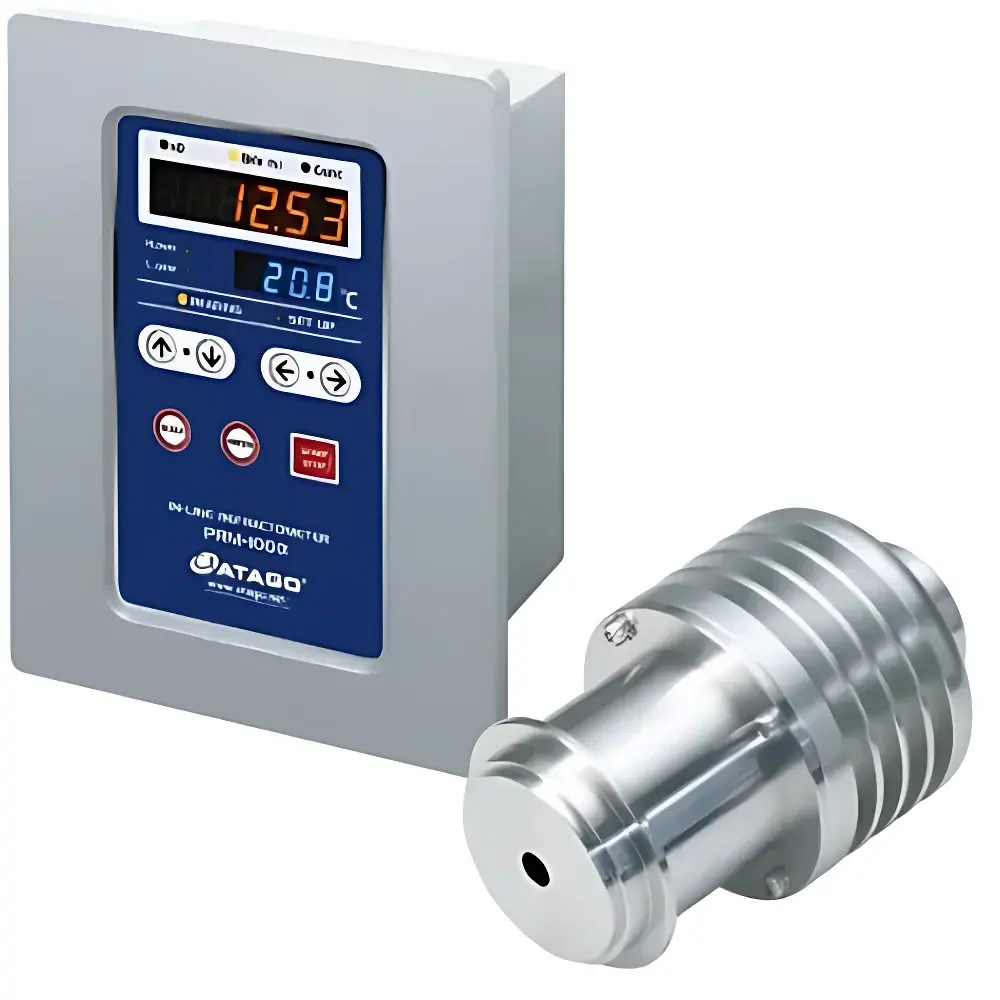
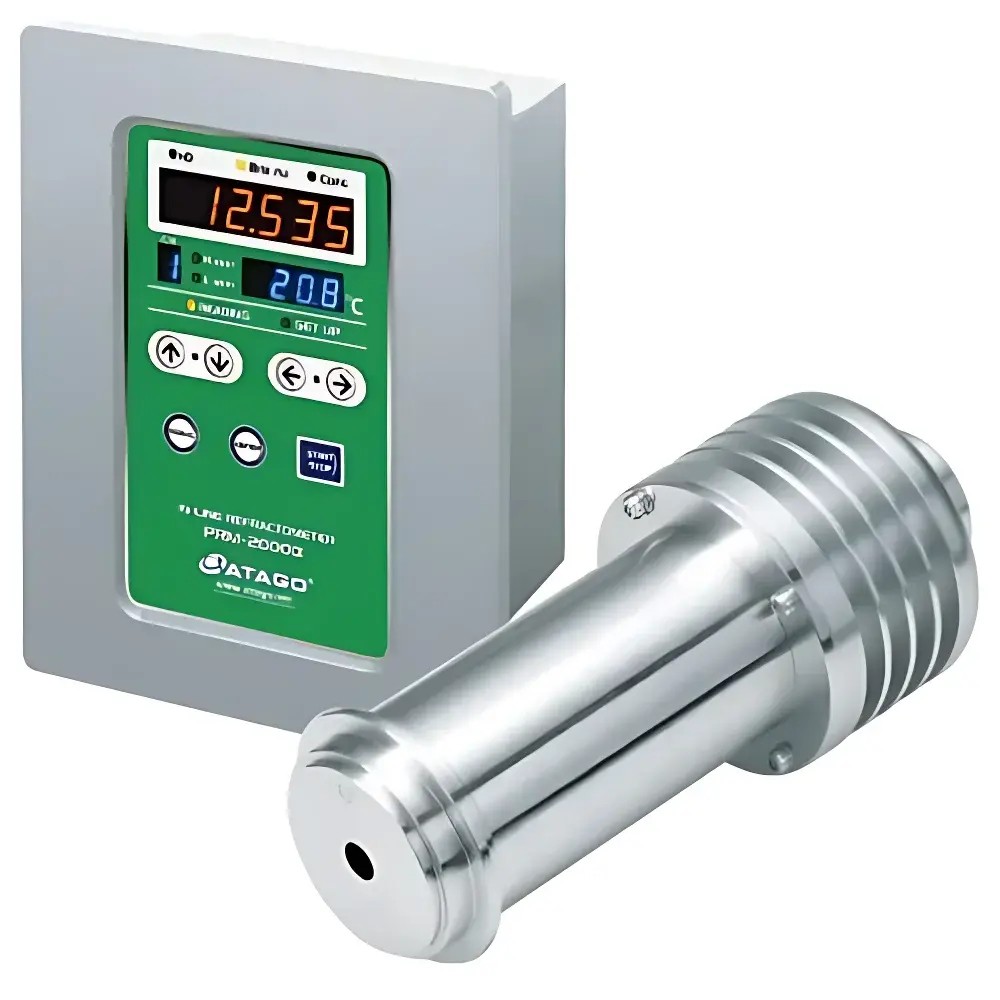
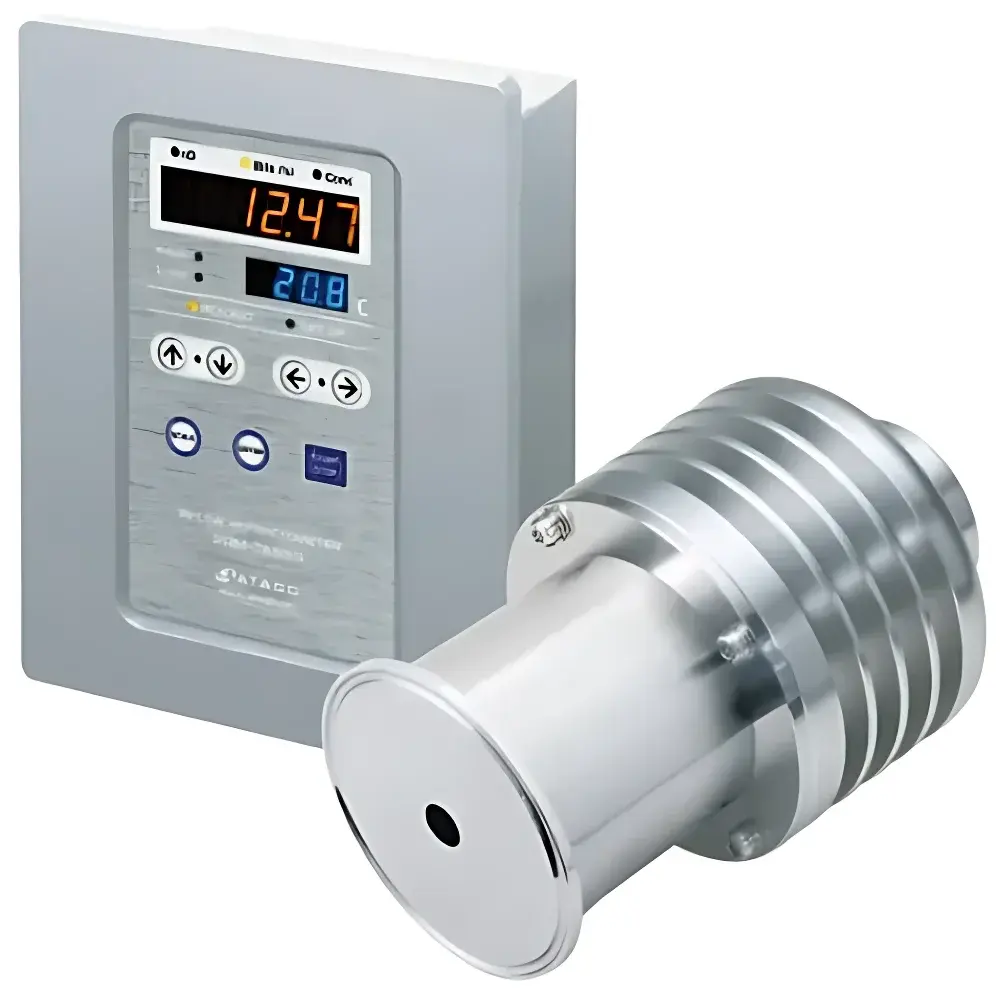
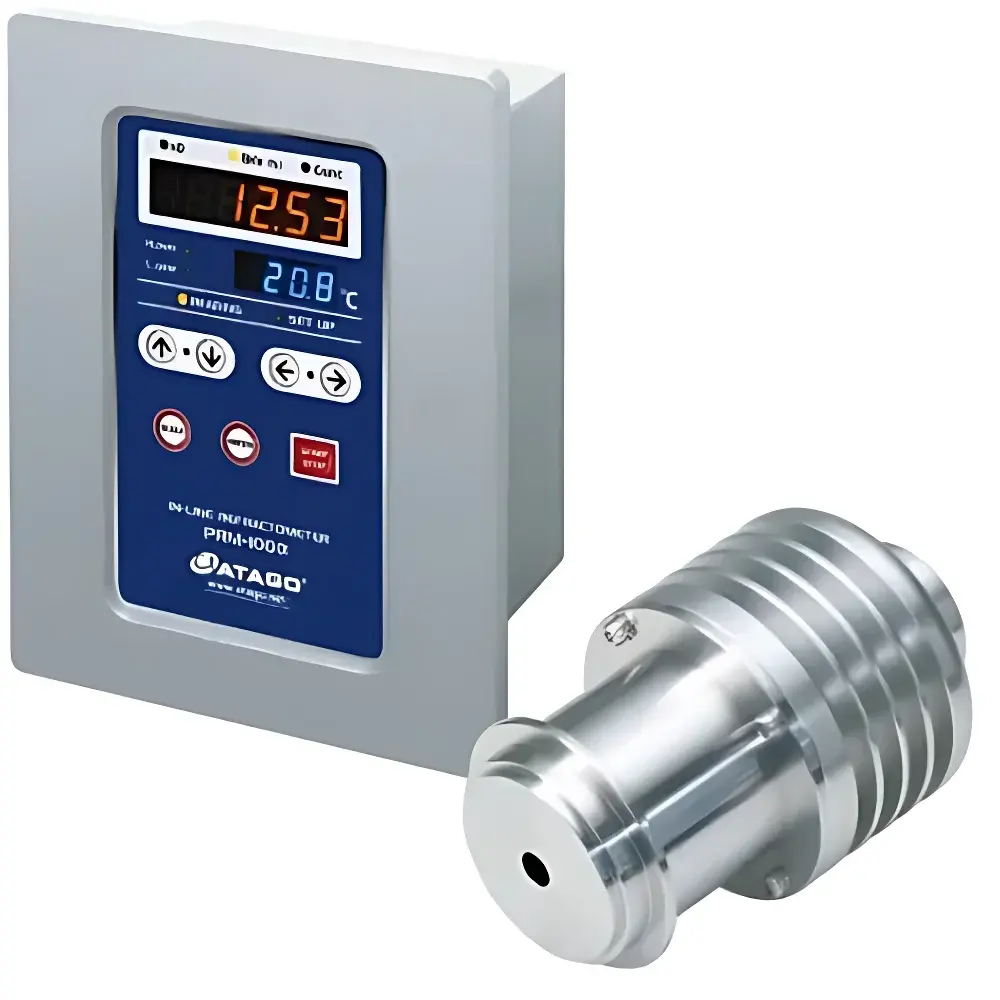
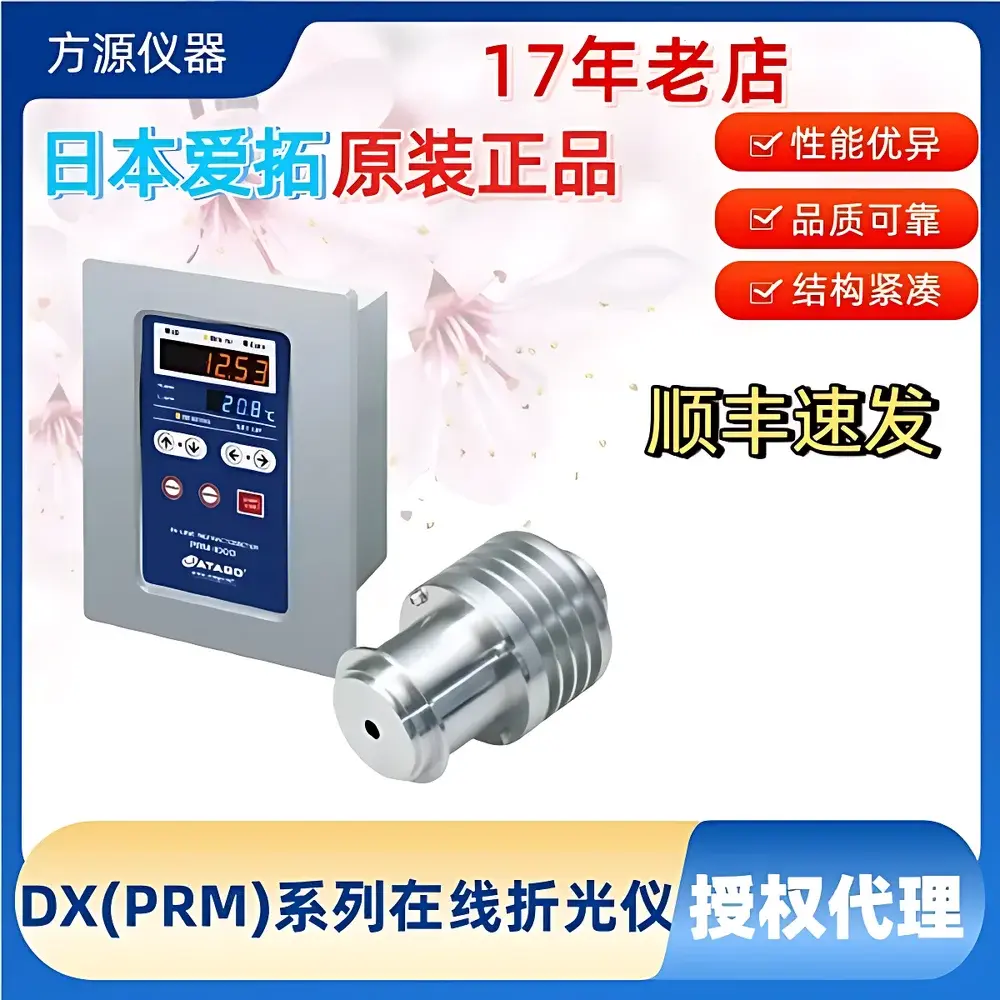
ATAGO PRM-DX Series In-Line Refractometer for Low-Concentration, High-Precision Applications
| Brand | ATAGO |
|---|---|
| Origin | Japan |
| Model | PRM-DX Series |
| Measurement Principle | Critical-angle refractometry |
| Refractive Index Range (nD) | 1.32000–1.55700 (PRM-100α DX & PRM-TANK100α DX) |
| Brix Range | 0.00–100.00% |
| Refractive Index Resolution | 0.00001 (high-resolution models) |
| Brix Resolution | 0.001% (selectable) |
| Refractive Index Accuracy | ±0.00001 to ±0.00010 (dependent on range) |
| Brix Accuracy | ±0.005% (for 2.001–20.000%) |
| Temperature Compensation | Automatic (PT1000 sensor integrated) |
| Display | 7-inch LED color touchscreen |
| Cable Length | Up to 200 m (sensor-to-display separation) |
| Output Signals | 4–20 mA, 0–5 V, RS-485, Modbus RTU |
| Enclosure Rating | IP65 (sensor), IP67 (display unit) |
| Material Options | 316L stainless steel, titanium alloy, or custom-wetted materials |
| Compliance | CE, RoHS, FDA-compliant wetted materials (upon request) |
Overview
The ATAGO PRM-DX Series is an industrial-grade in-line refractometer engineered for continuous, real-time measurement of refractive index (nD), Brix (% w/w sucrose equivalent), and user-defined concentration (Cons) in liquid process streams. Based on the critical-angle principle of total internal reflection, the PRM-DX employs a high-stability sapphire prism interface and temperature-compensated optical detection to deliver traceable, repeatable measurements under dynamic flow conditions. Designed specifically for low-concentration applications—such as beverage dilution, pharmaceutical buffer preparation, ion exchange effluent monitoring, and fermentation broth analysis—the series includes dual-range variants: the PRM-100α DX and PRM-TANK100α DX for broad-range applications (1.32000–1.55700 nD), and the PRM-2000α DX and PRM-TANK2000α DX optimized for ultra-high resolution in narrow low-refractive-index windows (1.32000–1.36000 nD). All models integrate automatic temperature compensation using a built-in PT1000 sensor, ensuring metrological integrity across ambient and process temperatures from 0 to 80 °C.
Key Features
- High-resolution optical detection with sapphire prism interface for long-term stability and chemical resistance
- Selectable Brix resolution down to 0.001% and refractive index resolution to 0.00001, calibrated per ISO 21527-1 and ASTM D1218 standards
- Modular architecture: sensor head and display unit separable by up to 200 m via shielded industrial cable (optional fiber-optic extension)
- 7-inch full-color LED touchscreen interface with intuitive menu navigation, multilingual support (EN/DE/FR/ES/JP/CN), and configurable data logging
- Integrated alarm system with programmable upper/lower limits; visual (LED flash), audible (buzzer), and relay outputs (SPDT) plus analog (4–20 mA) and digital (RS-485/Modbus RTU) signaling
- Smooth-surface prism coating technology minimizes sample adhesion and biofilm accumulation—validated for CIP/SIP compatibility in regulated bioprocessing environments
- Wetted material options include 316L stainless steel, titanium alloy (Grade 2/7), and fluoropolymer-sealed variants for aggressive media (e.g., caustic cleaning solutions, organic solvents)
- Optional ultrasonic cleaning module (US-α series) with scalable transducer configurations (1S–5S) for automated in-situ prism maintenance
Sample Compatibility & Compliance
The PRM-DX series accommodates homogeneous aqueous solutions, syrups, dairy-based emulsions, fermentation broths, and low-viscosity chemical process streams (dynamic viscosity < 500 mPa·s). It is not intended for opaque suspensions, highly viscous gels, or particulate-laden fluids without inline filtration. Sensor housings meet ASME BPE-2022 surface finish requirements (Ra ≤ 0.4 µm) for pharmaceutical applications. All wetted materials comply with USP Class VI and FDA 21 CFR 177.2400 for food-contact safety. Optional validation packages support IQ/OQ documentation aligned with GMP Annex 15 and EU GMP Part I. Data integrity features—including audit trail, electronic signature, and secure user access levels—enable compliance with FDA 21 CFR Part 11 when configured with ATAGO’s optional PRM-Link software suite.
Software & Data Management
The embedded firmware supports real-time data streaming to PLCs, SCADA systems, and MES platforms via standard industrial protocols. Optional PRM-Link PC software provides extended functionality: calibration curve management (including multi-point non-linear Brix-to-concentration mapping), trend visualization with time-stamped event markers, CSV export with ISO 8601 timestamps, and configurable alarm history reporting. All stored measurements include metadata: nD, Brix, temperature, sensor status flags, and calibration verification timestamps. Data retention is configurable up to 30 days onboard (SD card slot optional); remote backup via Ethernet or USB is supported. Firmware updates are performed via signed binary files to ensure cryptographic integrity.
Applications
- Continuous monitoring of sugar concentration in soft drink concentrate dilution lines (Brix ±0.005% repeatability at 5–15% range)
- Real-time control of ethanol content during beer and wine fermentation (via correlation to refractive index shift)
- Ion exchange column breakthrough detection through conductivity-refractometry cross-validation
- In-process verification of buffer composition in biopharmaceutical purification skids
- Concentration control in plant extract processing (e.g., herbal tinctures, botanical infusions)
- Quality assurance of cleaning-in-place (CIP) rinse water conductivity and residual detergent concentration
- Monitoring of glycol-based heat transfer fluid concentration in HVAC and chiller systems
FAQ
What is the maximum allowable process pressure for PRM-DX sensor heads?
Standard models are rated for continuous operation up to 1.0 MPa (145 psi); high-pressure variants (PRM-DX-HPP) support up to 4.0 MPa upon request.
Can the PRM-DX be calibrated with NIST-traceable sucrose standards?
Yes—calibration follows ISO 21527-1 procedures using certified reference materials; factory calibration certificates include uncertainty budgets per GUM guidelines.
Is temperature compensation linear across the full operating range?
No—compensation uses a 3rd-order polynomial algorithm derived from empirical nD/T curves for common process liquids, validated between 5 °C and 70 °C.
How frequently does the ultrasonic cleaning module require maintenance?
US-α transducers operate continuously during measurement cycles; no scheduled maintenance is required, but periodic inspection of transducer coupling integrity is recommended every 6 months.
Does the PRM-DX support integration with Siemens S7 or Rockwell ControlLogix PLCs?
Yes—native Modbus RTU over RS-485 is standard; optional EtherNet/IP and PROFINET gateways are available as field-installable modules.




