
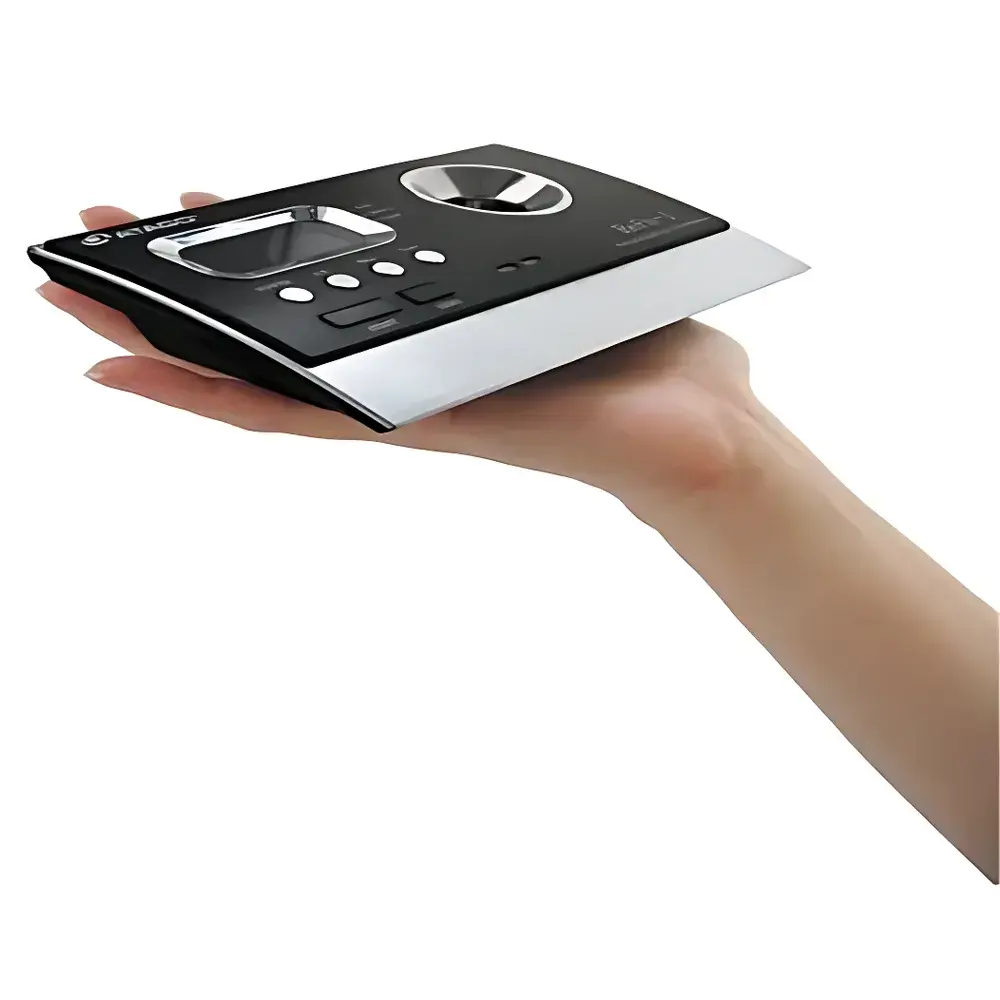
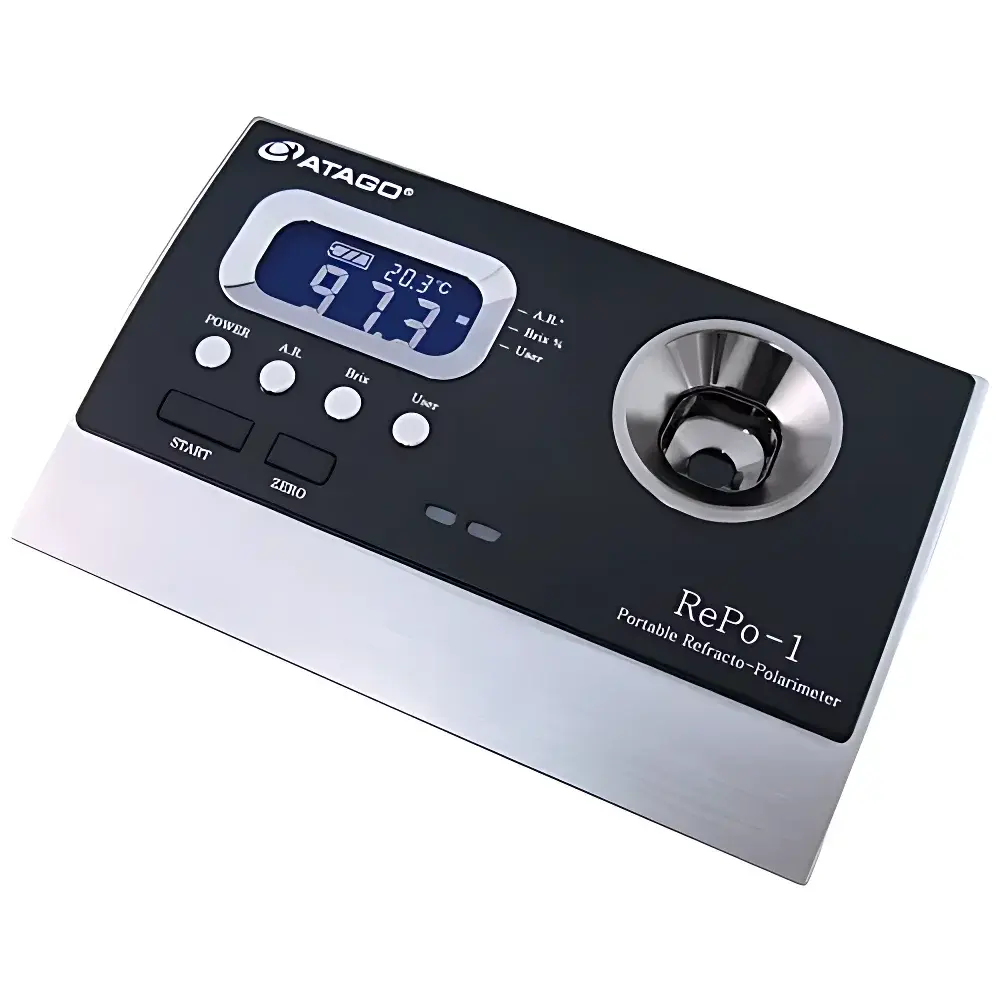
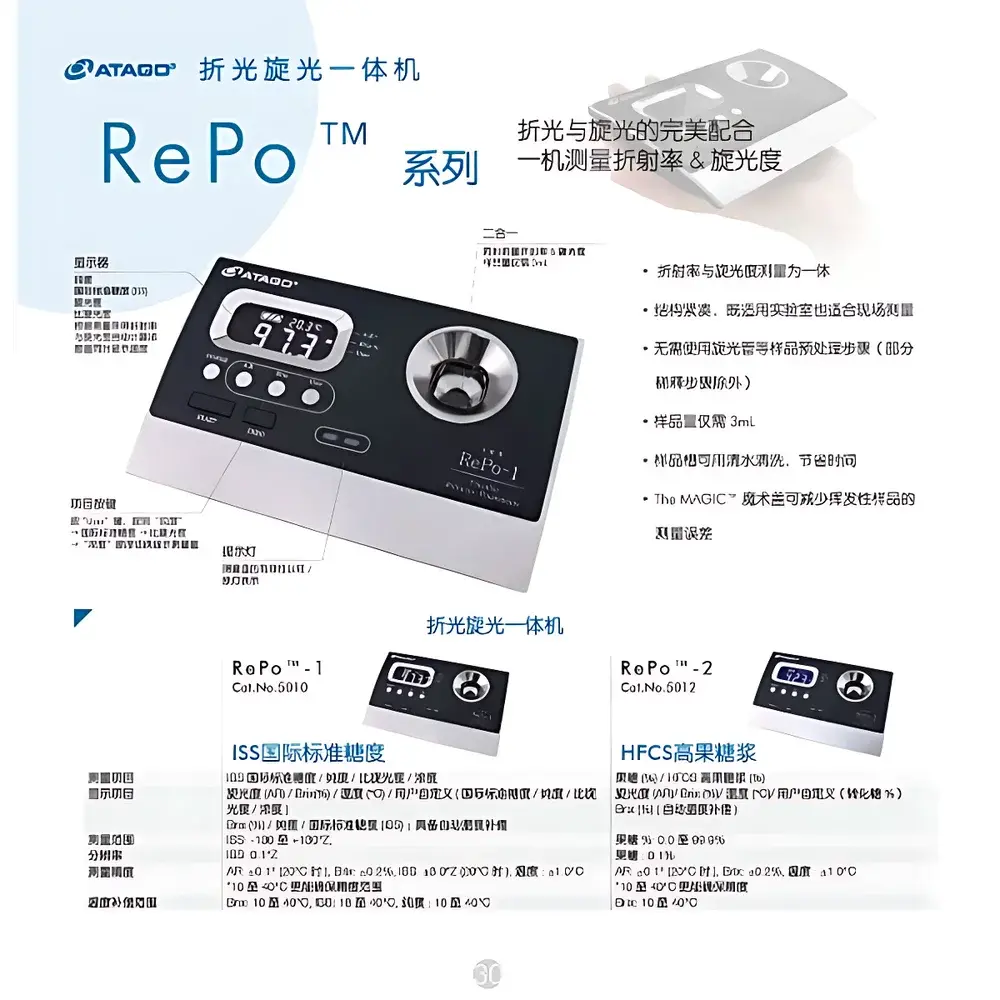
ATAGO RePo-1 Integrated Refractometer and Polarimeter
| Brand | ATAGO |
|---|---|
| Origin | Japan |
| Model | RePo-1 |
| Measurement Principle | Simultaneous dual-mode optical measurement via sodium D-line (589 nm) polarimetry and critical-angle refractometry |
| Measurement Types | Optical Rotation (°Z), Brix (%), International Sugar Scale (ISS, °Z), Purity (%), Specific Rotation (°·mL·g⁻¹·dm⁻¹), Concentration (%) |
| Temperature Control | Built-in Peltier-assisted thermal stabilization (15–40 °C) |
| Light Source | High-stability LED (589 nm equivalent) |
| Sample Volume | 3 mL |
| Measurement Time | ≤12 s per cycle |
| Display Resolution | Rotation: 0.01°Z |
| Brix | 0.1% |
| ISS | 0.1°Z |
| Temp | 0.1 °C |
| Accuracy | Optical Rotation: ±0.1°Z (at 20 °C) |
| Brix | ±0.2% |
| ISS | ±3°Z (at 20 °C) |
| Temperature | ±1.0 °C |
| Environmental Rating | IP67 |
| Dimensions | 10.1 × 16.0 × 3.8 cm |
| Weight | 325 g (host only) |
| Power Supply | 4 × AAA alkaline batteries |
| Compliance | ASTM D1006 (refractometric sugar analysis), ISO 5725 (accuracy & precision), USP <788> (optical rotation for pharmaceuticals), GLP-ready audit trail via optional PC interface |
Overview
The ATAGO RePo-1 Integrated Refractometer and Polarimeter is a compact, field-deployable optical instrument engineered for concurrent measurement of optical rotation and refractive index in liquid samples. It operates on two complementary physical principles: polarimetry—based on the rotation of plane-polarized light at the sodium D-line wavelength (589 nm)—and critical-angle refractometry—derived from Snell’s law and calibrated against aqueous sucrose standards. Unlike sequential or modular systems, the RePo-1 performs both measurements in a single sample load, eliminating inter-test variability and operator-induced alignment errors. Its design conforms to internationally recognized metrological frameworks for sugar analysis, including the International Sugar Scale (ISS) defined by the International Commission for Uniform Methods of Sugar Analysis (ICUMSA). The instrument is calibrated traceably to NIST-traceable sucrose reference materials and supports temperature-compensated reporting across 15–40 °C, making it suitable for ambient-condition field use without external thermostatic control.
Key Features
- Simultaneous dual-parameter acquisition: Optical rotation (°Z), Brix (%), ISS (°Z), purity, specific rotation, and concentration—all derived from one 3 mL sample injection.
- Integrated Peltier-based temperature stabilization with real-time monitoring (±0.1 °C resolution) and automatic compensation per ICUMSA Method GS4/3-14 for Brix and ISS.
- LED light source emitting at 589 nm equivalent—stable over battery life, free from mercury vapor hazards, and compliant with RoHS and IEC 62471 photobiological safety standards.
- IP67-rated enclosure ensures operational reliability in humid, dusty, or splash-prone environments typical of sugar mills, honey extraction sites, and QC labs.
- On-device limit alarm system: Configurable upper/lower thresholds trigger visual LED alerts—critical for rapid pass/fail screening during raw material intake or batch release.
- Battery-powered operation (4 × AAA) enables >2,000 measurements per set; no AC adapter required for mobile deployment.
Sample Compatibility & Compliance
The RePo-1 accepts aqueous solutions, syrups, honey, fruit juices, pharmaceutical intermediates, and essential oil distillates—provided they are optically clear and non-scattering at 589 nm. Turbid or particulate-laden samples require prior filtration (0.45 µm) to avoid signal attenuation. The instrument complies with ASTM D1006 for refractometric sugar determination and supports method validation under ISO/IEC 17025:2017. For pharmaceutical applications, it meets USP requirements for specific rotation measurement when used with certified reference standards and documented calibration procedures. Data integrity is maintained through built-in timestamping and non-volatile memory storage (up to 1,000 results), satisfying basic GLP documentation needs. Optional USB-to-PC connectivity enables export of CSV-formatted datasets compatible with LIMS integration and 21 CFR Part 11-compliant electronic records when paired with validated software.
Software & Data Management
The RePo-1 operates autonomously without embedded firmware updates or proprietary drivers. All configuration—including unit selection (°Z, %, °·mL·g⁻¹·dm⁻¹), alarm thresholds, temperature compensation profiles, and user-defined calculation formulas—is performed via intuitive front-panel navigation. Measurement data are stored locally with date/time stamps and cannot be edited or deleted—ensuring raw-data integrity. For advanced traceability, optional PC software (ATAGO DataLink v3.x) provides secure data export, statistical summary generation (mean, SD, CV%), trend charting, and PDF report templating aligned with ISO 9001 internal audit requirements. Audit trails include operator ID, calibration event logs, and environmental condition metadata—supporting GMP-aligned quality review processes.
Applications
- Sugar & Sweetener Production: Real-time monitoring of juice clarification, syrup concentration, and final product ISS/Brix ratios in cane and beet sugar refineries—enabling immediate process correction per ICUMSA GS2/3-12 specifications.
- Honey Authentication: Discrimination of adulterated honey via combined Brix–rotation deviation analysis; detection of invert sugar addition using the characteristic sign reversal in specific rotation relative to floral origin references.
- Flavor & Fragrance QA: Verification of chiral purity in natural isolates (e.g., limonene, menthol) and synthetic analogues by comparing measured specific rotation against pharmacopoeial monographs.
- Pharmaceutical Raw Materials: Identity confirmation and assay support for optically active APIs (e.g., levofloxacin, escitalopram) per USP monograph requirements.
- Academic Research: Teaching laboratory tool for demonstrating optical activity–concentration relationships and temperature-dependent refractive index behavior in carbohydrate chemistry.
FAQ
What is the difference between ISS and conventional Brix measurement?
ISS (International Sugar Scale) is a standardized angular scale defined by ICUMSA for reporting optical rotation of sucrose solutions, expressed in degrees Z (°Z). Unlike Brix—which estimates total soluble solids by refractive index—ISS directly quantifies sucrose-specific optical activity and is unaffected by interfering sugars like glucose or fructose.
Can the RePo-1 measure samples below 15 °C?
No. The temperature compensation algorithms and optical calibration are validated only within 15–40 °C. Measurements outside this range will display a warning and disable result output to prevent extrapolation error.
Is calibration verification traceable to national standards?
Yes. Each unit ships with a Certificate of Calibration referencing NIST SRM 84d (sucrose solution) and NIST SRM 1921b (sodium D-line wavelength standard), with uncertainty budgets stated per ISO/IEC 17025 Annex A.
Does the instrument support Good Manufacturing Practice (GMP) documentation?
The RePo-1 meets foundational GMP data integrity requirements (ALCOA+ principles) through immutable local storage, time-stamped records, and configurable user access levels via optional PC software. Full 21 CFR Part 11 compliance requires validated third-party software and procedural controls.
How often must the instrument be recalibrated?
ATAGO recommends annual recalibration using certified sucrose standards and temperature reference blocks. Field verification with zero-solution (distilled water) and 10 % sucrose standard is advised before each shift in regulated environments.





