
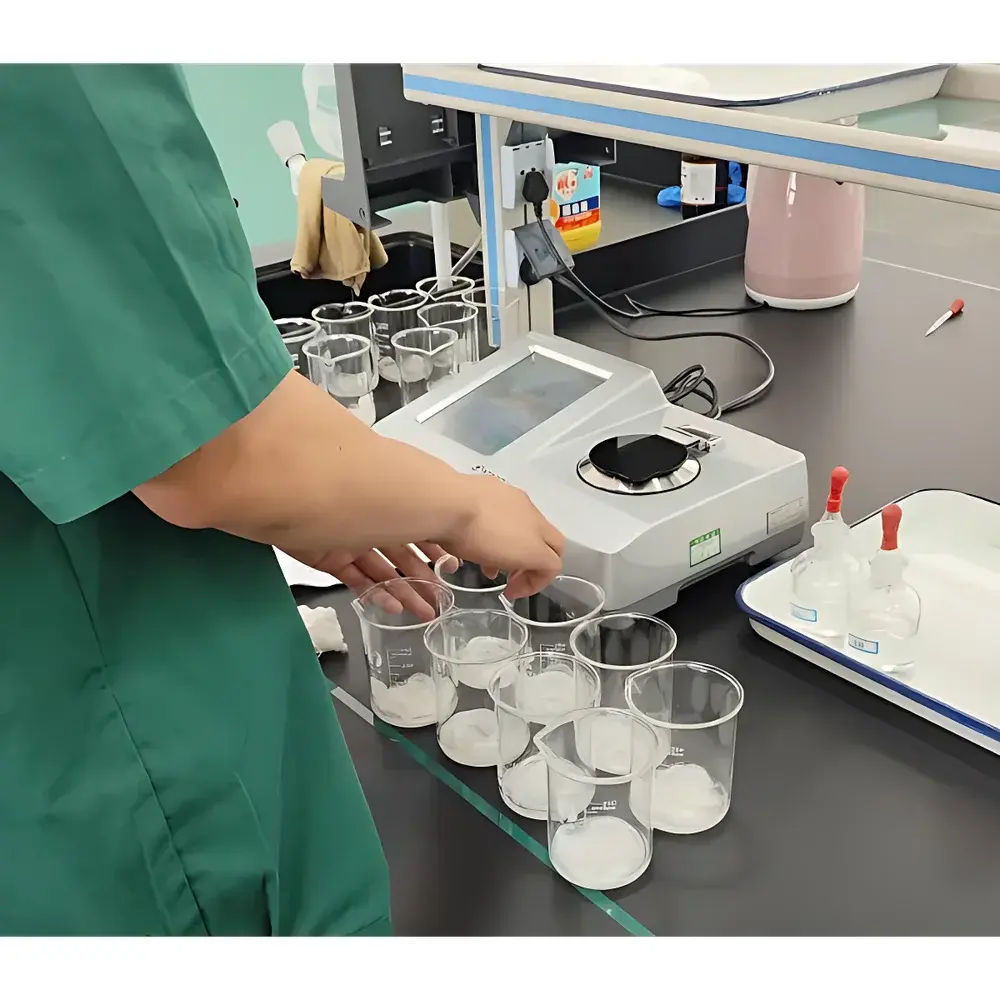
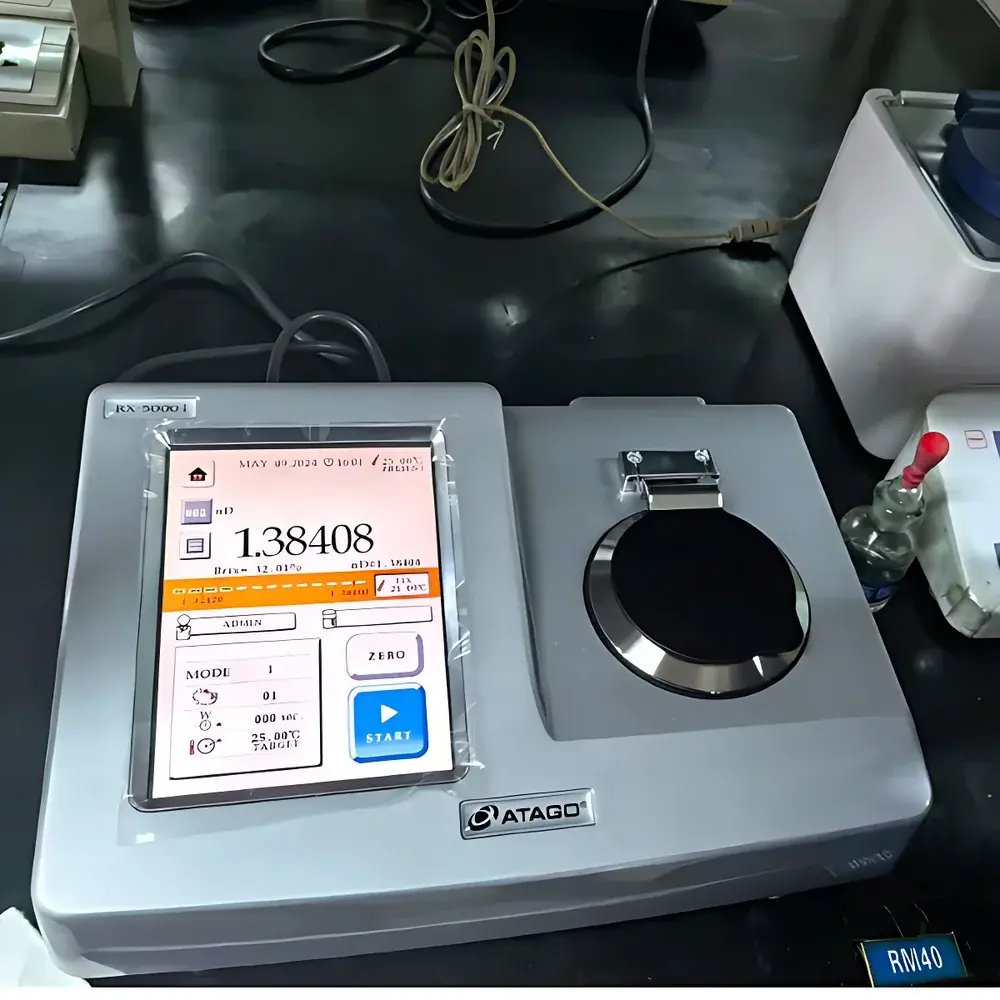
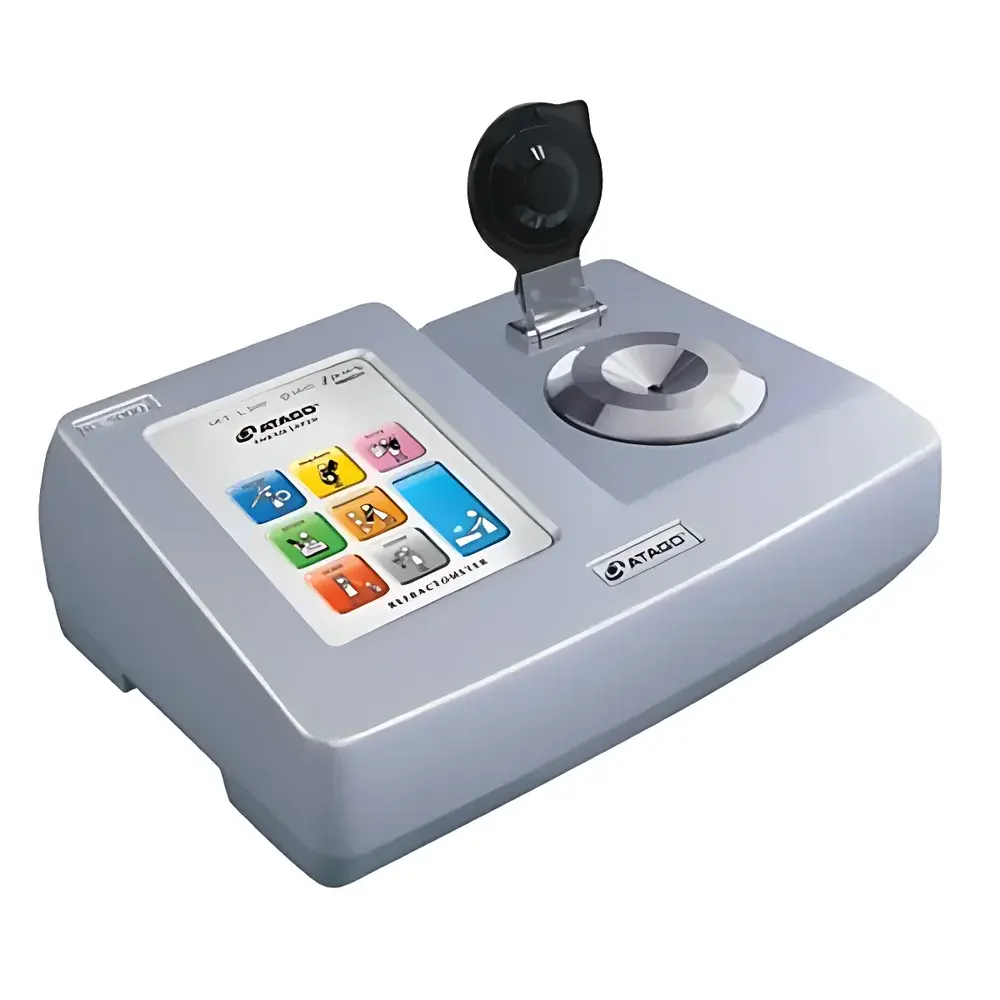
ATAGO RX-5000i Automatic Desktop Refractometer for Nylon 66 Salt Solution Concentration Measurement
| Brand | ATAGO |
|---|---|
| Origin | Japan |
| Product Type | Benchtop Refractometer |
| Temperature Control | Peltier-controlled (±0.1 °C) |
| Digital Display | Yes |
| Refractive Index Range | 1.324200–1.580000 |
| Brix Range | 0.00–100.00% (ATC) |
| RI Accuracy | ±0.000040 |
| Brix Accuracy | ±0.03% |
| Prism Material | Synthetic Sapphire |
| Prism Housing | SUS316L Stainless Steel |
| Interface | Touchscreen LCD |
| Pre-installed Scales | 24 |
| Custom Scale Capacity | 100 |
| Compliance | ASTM D1218, ISO 21747, JIS K0061 |
Overview
The ATAGO RX-5000i is a high-precision, Peltier-temperature-controlled benchtop refractometer engineered specifically for quantitative concentration analysis of nylon 66 salt (hexamethylenediamine adipate) aqueous solutions in polymer synthesis and quality control laboratories. It operates on the fundamental optical principle of critical angle refraction: when a collimated light beam passes from a high-refractive-index prism into a liquid sample, the angle at which total internal reflection occurs correlates directly with the sample’s refractive index (RI), which—under controlled temperature and composition—is linearly related to solute concentration via empirical calibration. For nylon 66 salt solutions, RI increases predictably with molecular weight and ionic concentration due to polarizability enhancement and density elevation; this enables traceable, non-destructive quantification without reagents or chromatographic separation. The instrument is optimized for process-critical environments in polyamide resin production, where real-time monitoring of salt hydrolysis, condensation reaction progress, and feedstock purity demands sub-0.000040 RI repeatability and thermal stability within ±0.1 °C.
Key Features
- Peltier-based thermostatic system maintaining sample temperature at user-defined setpoints (10–60 °C) with ±0.1 °C stability—essential for eliminating thermal drift in RI measurements of thermosensitive nylon salt solutions.
- Synthetic sapphire prism (Mohs hardness 9) and SUS316L stainless steel sample chamber—chemically inert against concentrated diamine/adipic acid mixtures, hydrolyzed intermediates, and acidic/basic process streams.
- Automatic RI-to-concentration conversion using dual-scale calibration: factory-loaded Brix scale (0.00–100.00%) and user-configurable custom scales for nylon 66 salt mass fraction (% w/w), molarity (mol/L), or density-equivalent units.
- High-resolution touchscreen interface with intuitive workflow navigation, audit-trail-enabled measurement logging, and USB data export compliant with GLP documentation requirements.
- Integrated ATC (Automatic Temperature Compensation) algorithm referencing NIST-traceable water RI values at 30 °C (1.33196), enabling direct cross-laboratory comparability per ISO 21747 Annex A.
Sample Compatibility & Compliance
The RX-5000i accommodates viscous, mildly turbid, and chemically aggressive samples typical in nylon intermediate processing—including undiluted nylon 66 salt brines (up to 45% w/w), partially hydrolyzed oligomer suspensions, and post-neutralization reaction mixtures. Its sapphire prism resists etching by adipic acid residues and amine vapors, while the sealed SUS316L chamber prevents corrosion during extended exposure. The instrument meets mechanical and optical performance criteria defined in ASTM D1218 (Standard Test Method for Refractive Index of Hydrocarbon Liquids) and ISO 21747:2020 (Refractometers — Specifications and methods of test), and supports compliance with FDA 21 CFR Part 11 through optional password-protected user accounts, electronic signature logging, and immutable measurement history export.
Software & Data Management
Firmware v3.2+ includes embedded calibration management tools supporting multi-point linear and polynomial regression for nylon 66 salt standard curves (e.g., 5–40% w/w range). All measurements store timestamp, operator ID, temperature, RI, converted concentration, and pass/fail status relative to configurable specification limits. Data exports as CSV or PDF reports with embedded instrument serial number, calibration certificate ID, and traceable reference standards (e.g., certified water at 30 °C per GB/T 6682 Grade II). Optional PC software (ATAGO LabLink Pro) enables centralized database synchronization, statistical process control (SPC) charting, and automated report generation aligned with ISO/IEC 17025 laboratory accreditation requirements.
Applications
- Real-time monitoring of nylon 66 salt solution concentration during crystallization, dissolution, and purification stages in polyamide manufacturing.
- Verification of feedstock purity prior to polycondensation—detecting residual adipic acid or hexamethylenediamine deviations impacting polymer molecular weight distribution.
- QC release testing of commercial nylon 66 salt batches against internal specifications or customer technical data sheets (TDS).
- Research-scale formulation development for high-performance engineering resins, including copolymer blends with nylon 610 or nylon 12.
- Method validation studies supporting ICH Q2(R2) guidelines for analytical procedure verification in regulated polymer synthesis environments.
FAQ
What temperature is recommended for nylon 66 salt concentration measurement?
30 °C is the standardized reference temperature per GB/T 6682 and industry practice; the RX-5000i maintains this precisely via Peltier control.
Can the RX-5000i measure undiluted nylon 66 salt solutions?
Yes—the 1.324200–1.580000 RI range covers concentrated brines up to saturation (~48% w/w at 30 °C), provided samples are filtered to remove particulates.
How is calibration traceability ensured for nylon-specific scales?
Users calibrate using NIST-traceable secondary water standards and in-house prepared nylon 66 salt reference solutions certified via gravimetric dilution and HPLC cross-validation.
Is cleaning protocol specified for sapphire prism after corrosive sample contact?
Rinse immediately with deionized water, followed by gentle wipe with lint-free lens tissue; avoid organic solvents or abrasive cleaners to preserve prism surface integrity.
Does the instrument support integration with LIMS or MES systems?
Via RS-232 or USB-C serial emulation mode, enabling ASCII-based command/response communication for automated data ingestion into enterprise quality management platforms.




