
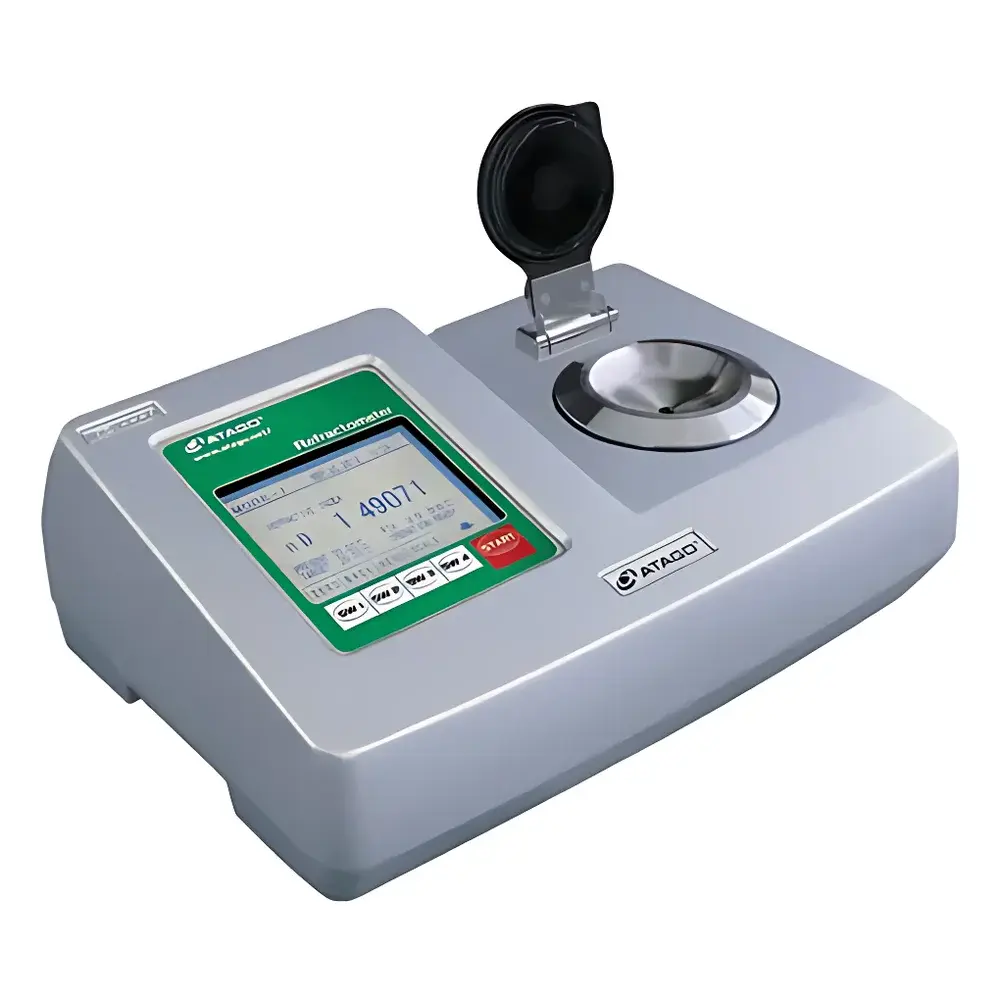
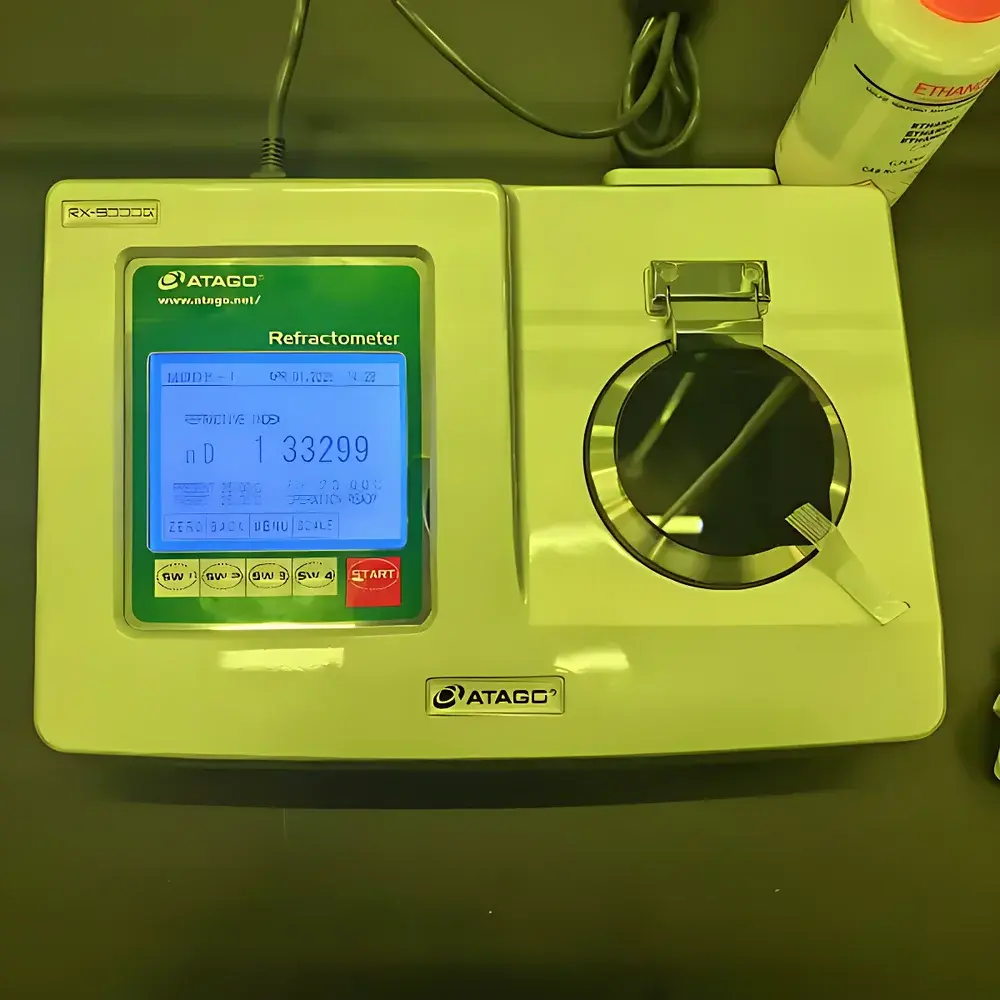
ATAGO RX-9000α Desktop Digital Refractometer with Peltier Temperature Control
| Brand | ATAGO |
|---|---|
| Origin | Japan |
| Model | RX-9000α |
| Product Type | Benchtop Refractometer |
| Temperature Control | Peltier-based thermostatic control (5–70 °C) |
| Digital Display | Yes |
| Refractive Index Range | 1.29980–1.71500 nD |
| Brix Range | 0.00–100.00% |
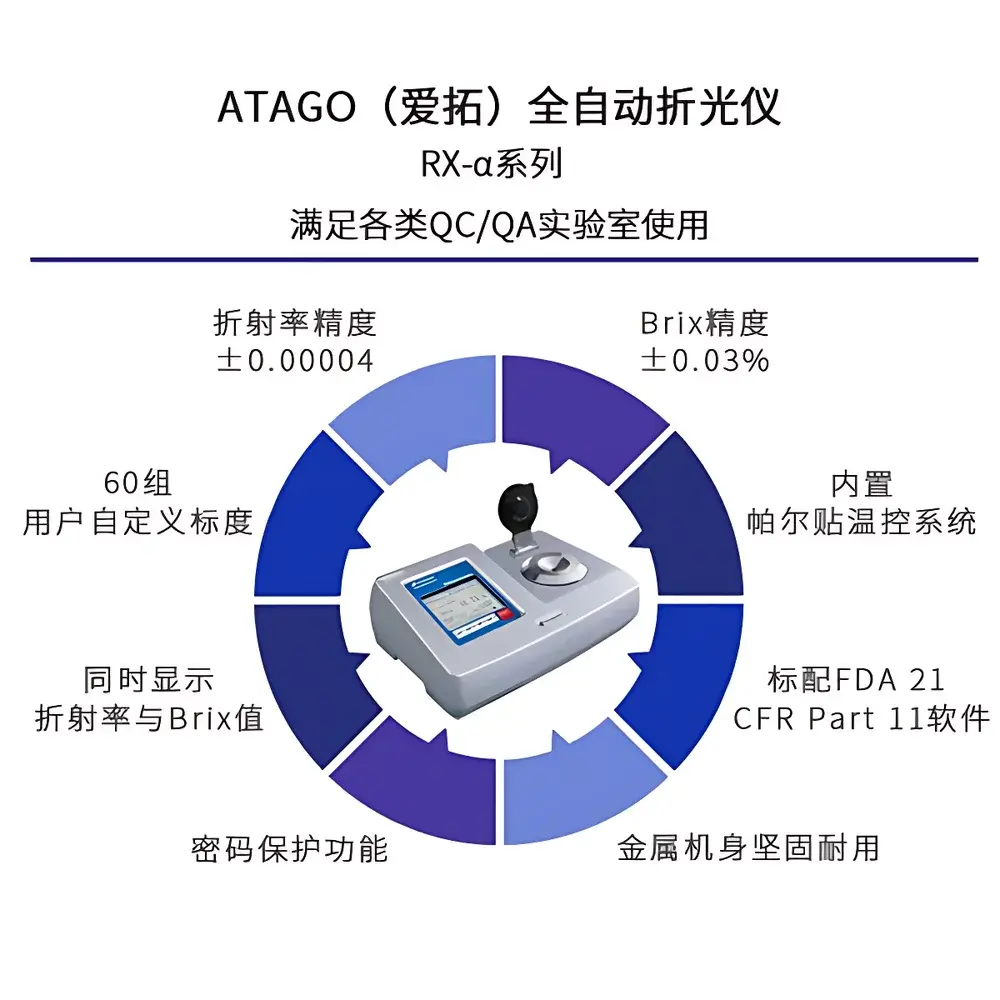
| Refractive Index Accuracy | ±0.00004 (nD 1.33299–1.42009, at 10.00–30.00 °C) / ±0.00010 (nD >1.42009) |
| Brix Accuracy | ±0.03% (0.00–50.00%, 10.00–30.00 °C) / ±0.05% (50.01–95.00%, 10.00–30.00 °C) / ±0.10% (all other conditions, MODE-1 sucrose calibration) |
| Resolution | nD: 0.00001 |
| Brix | 0.01% |
| Temperature | 0.01 °C |
| Dimensions & Weight | 370 × 260 × 140 mm, 6.9 kg (main unit only) |
| Power Supply | AC 100–240 V, 50/60 Hz, 65 VA |
Overview
The ATAGO RX-9000α is a high-precision benchtop digital refractometer engineered for laboratories requiring rigorous optical measurement of refractive index (nD) and Brix concentration across an exceptionally wide range—spanning from low-refractive aqueous solutions to high-index organic solvents, essential oils, resins, and thermally stable lipid systems. It operates on the principle of critical angle measurement via total internal reflection at the prism-sample interface, with automated detection of the shadow line boundary using a high-resolution CCD linear image sensor. Its integrated Peltier thermoelectric module enables precise, programmable temperature control (5–70 °C), ensuring compliance with standardized measurement conditions per ISO 21745, AOAC 932.12, and USP . Designed for metrological traceability and long-term stability, the RX-9000α serves as a primary reference instrument in QC/QA labs where repeatability (RSD <0.00002 nD) and inter-laboratory comparability are critical.
Key Features
- Extended refractive index range (1.29980–1.71500 nD) — uniquely suited for high-nD materials including aromatic hydrocarbons, silicone oils, and concentrated polymer solutions
- Peltier-driven temperature regulation with ±0.1 °C stability and 0.01 °C resolution, eliminating external water baths and enabling rapid thermal equilibration
- High-resolution CCD detection system delivering 0.00001 nD resolution and automatic baseline correction for prism surface contamination or minor condensation
- Dual-mode calibration: standard sucrose (Brix) calibration per ICUMSA Method GS3/8-4, plus user-defined nD-based calibration for non-sugar matrices (e.g., glycols, ethanol/water blends, pharmaceutical excipients)
- Robust stainless-steel sample stage with ergonomic prism cover and integrated LED illumination for consistent optical path geometry
- Compliance-ready firmware supporting audit trail logging, user access levels, and electronic signature capability aligned with FDA 21 CFR Part 11 requirements
Sample Compatibility & Compliance
The RX-9000α accommodates viscous, volatile, and thermally sensitive samples—including hot-melt adhesives, fragrance concentrates, anhydrous solvents, and molten waxes—without degradation of optical performance. Its sealed prism assembly (sapphire contact surface) resists chemical erosion from aggressive organics (e.g., chlorinated solvents, ketones) and high-Brix syrups. The instrument meets IEC 61010-1 safety standards and carries CE marking for laboratory use in the EU. Measurement protocols align with ASTM D1218 (hydrocarbon refractive index), ISO 21527-1 (yeast viability via Brix correlation), and JP XVII General Test 2.30 (refractometric assay of injectables). For GLP/GMP environments, optional 21 CFR Part 11-compliant software modules provide full data integrity controls, including time-stamped event logs and immutable raw-data archives.
Software & Data Management
The RX-9000α interfaces via USB or RS-232 with ATAGO’s proprietary WinCT-Refracto software (Windows 10/11 compatible), enabling automated report generation in PDF or CSV formats compliant with LIMS integration. Software features include multi-point temperature sweep analysis, real-time deviation tracking against master calibration curves, and statistical process control (SPC) charting (X̄/R charts, Cpk calculation). All measurement metadata—including ambient humidity, operator ID, calibration certificate number, and Peltier power consumption—is embedded in each exported dataset. Raw sensor output (12-bit grayscale intensity profiles) is preserved for retrospective reprocessing, supporting method validation and root-cause investigation during regulatory audits.
Applications
- Food & Beverage: Brix quantification in fruit concentrates, honey adulteration screening, and thermal stability assessment of caramelized syrups
- Pharmaceuticals: Excipient purity verification (e.g., propylene glycol, glycerin), API solubility profiling, and lyophilization endpoint confirmation
- Chemical Manufacturing: Refractive index mapping of polymerization reactions, solvent recovery efficiency monitoring, and batch-to-batch consistency checks for surfactant micellar systems
- Essential Oils & Flavors: Authentication of citrus oil origin via nD fingerprinting; quantification of terpene content in distillates
- Electronics & Advanced Materials: Refractive index matching of photoresist formulations and optical adhesive curing kinetics
FAQ
What temperature accuracy is maintained during extended measurements?
The Peltier system maintains ±0.1 °C stability over 2-hour continuous operation at any setpoint between 5 °C and 70 °C, verified by NIST-traceable PT100 sensor feedback.
Can the RX-9000α measure samples below 5 °C?
No—the minimum operational temperature is 5 °C due to condensation risk and Peltier efficiency limits; sub-zero measurements require external cryostat integration (not supported out-of-the-box).
Is Brix calibration valid for non-sucrose solutions?
Brix values are strictly defined for sucrose/water systems per ICUMSA; for other solutes (e.g., fructose, NaCl), users must apply matrix-specific nD correlation models or perform empirical calibration.
How often does the instrument require recalibration?
Annual factory recalibration is recommended; field verification using certified refractive index standards (e.g., NIST SRM 1791a) is advised before each analytical campaign.
Does the RX-9000α support custom units or user-defined formulas?
Yes—WinCT-Refracto allows definition of custom concentration units (e.g., % w/w glycerol, mg/mL caffeine) linked to nD via polynomial or exponential regression equations.





