
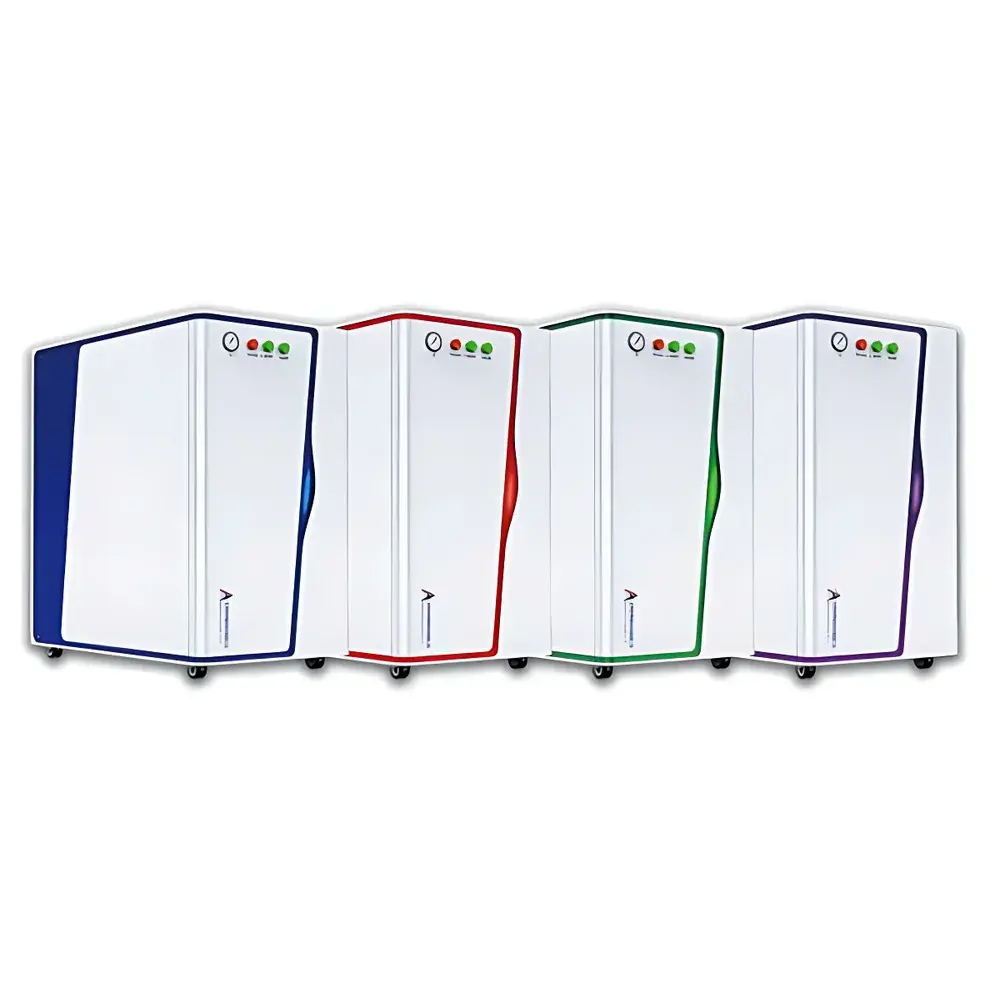
ATARICO AGS-60 Nitrogen Generator
| Brand | ATARICO |
|---|---|
| Origin | Beijing, China |
| Manufacturer Type | Direct Manufacturer |
| Product Category | Domestic |
| Model | AGS-60 |
| Nitrogen Generation Principle | Pressure Swing Adsorption (PSA) using Zeolite Molecular Sieve |
| Output Flow Rate | 70–80 L/min |
| Output Pressure | 0.1–0.75 MPa (14.5–108 psi) |
| Nitrogen Purity | 97–99.9% |
| Dew Point | −40 °C to −45 °C |
| Air Purification Capacity | 1200 m³/h |
| Filtration | Composite VOC + Formaldehyde + Benzene + Hydrocarbon Adsorption Cartridge |
| Onboard Purity Monitor | Integrated Real-time Electrochemical Sensor |
| Power Supply | 230 V, 50/60 Hz |
| Power Consumption | 3.3 kW |
| Noise Level | 58 dB(A) |
| Dimensions (W×D×H) | 1200 × 600 × 1300 mm |
| Weight | 310 kg |
| Operating Ambient | 5–35 °C, ≤80% RH, up to 3500 m altitude |
| Particulate Retention | <0.01 µm |
| Hydrocarbon Removal | Integrated Hydrocarbon Trap (NDMA-compliant) |
Overview
The ATARICO AGS-60 Nitrogen Generator is an integrated laboratory-grade gas supply system engineered for high-reliability nitrogen delivery to mass spectrometry platforms—including single-quadrupole, triple-quadrupole, time-of-flight (TOF), tandem (MS/MS), and high-resolution liquid chromatography–mass spectrometry (LC-MS) instruments. It employs pressure swing adsorption (PSA) technology with high-selectivity zeolite molecular sieves to separate nitrogen from compressed ambient air. Unlike membrane-based systems, the AGS-60 achieves 25–40% higher nitrogen separation efficiency at equivalent flow rates—reducing energy consumption and supporting institutional sustainability goals aligned with ISO 50001 and carbon neutrality frameworks. Critically, the system integrates dual-functionality: continuous on-site nitrogen generation *and* active laboratory air purification. This dual-role architecture addresses two interdependent operational requirements in modern analytical labs—gas purity assurance and occupational health compliance—without requiring separate standalone units.
Key Features
- Real-time electrochemical nitrogen purity monitoring with data logging capability, enabling full traceability per GLP/GMP documentation standards;
- Dedicated hydrocarbon trap upstream of the nitrogen outlet, specifically designed to remove volatile organic compounds (VOCs), benzene homologues, formaldehyde, and nitrosamine precursors (e.g., NDMA), ensuring compatibility with ultra-trace analysis and ICH Q5C-compliant biopharmaceutical workflows;
- Integrated air recirculation module delivering 1200 m³/h airflow through a multi-stage composite filter (pre-filter + activated carbon + impregnated zeolite), certified to ASTM D5197 and ISO 16000-23 for formaldehyde and VOC reduction;
- Optimized PSA cycle control algorithm with adaptive pressure regulation, maintaining stable output across variable inlet air conditions (5–35 °C, ≤80% RH, up to 3500 m elevation);
- Modular mechanical design with quick-connect fittings (6 mm push-to-connect nitrogen outlet, 10 mm condensate drain), facilitating service access and minimizing downtime during maintenance;
- Customizable front-panel aesthetics and enclosure finish options to align with institutional lab design guidelines or ergonomic workflow integration.
Sample Compatibility & Compliance
The AGS-60 delivers nitrogen meeting ASTM D852–22 specifications for instrumental gas purity (Class 2, Grade B) and satisfies the inlet gas requirements of major LC-MS OEMs including Waters, Thermo Fisher Scientific, Agilent, and Shimadzu. Its −40 to −45 °C dew point ensures no condensation in heated transfer lines or electrospray ionization (ESI) sources, while sub-0.01 µm particulate retention prevents downstream filter clogging in sensitive vacuum manifolds. The system complies with IEC 61000-6-3 (EMC emissions), IEC 61000-6-2 (immunity), and UL 61010-1 safety standards. Optional audit trail configuration supports FDA 21 CFR Part 11 compliance for electronic records and signatures when paired with validated software modules.
Software & Data Management
The AGS-60 features embedded firmware with RS-485 and optional Ethernet connectivity, enabling remote status monitoring and alarm notification via SNMP or Modbus TCP protocols. Logged parameters—including real-time purity (%N₂), pressure (MPa), flow (L/min), dew point (°C), and cumulative runtime—can be exported as CSV files compatible with LIMS integration. All sensor calibrations are stored with timestamped metadata, fulfilling ALCOA+ principles (Attributable, Legible, Contemporaneous, Original, Accurate, Complete, Consistent, Enduring, Available). No proprietary cloud platform is required; local data storage resides on internal flash memory with password-protected administrative access.
Applications
- Continuous nitrogen supply for ESI and APCI ion sources in LC-MS, GC-MS, and HRAM instrumentation;
- Blank gas for carrier and purge applications in residual solvent analysis (ICH Q3C) and extractables/leachables studies;
- Ambient air remediation in fume hood-perimeter zones where chlorinated solvents, acetonitrile, methanol, and tetrahydrofuran vapors accumulate;
- Support for ISO/IEC 17025-accredited testing laboratories requiring documented gas source validation and environmental exposure controls;
- On-site nitrogen for mobile or field-deployable analytical platforms operating beyond centralized gas infrastructure.
FAQ
Does the AGS-60 require external compressed air?
Yes—it requires a clean, oil-free, desiccated compressed air feed at 0.7–1.0 MPa, compliant with ISO 8573-1 Class 2:2:2 for particulates, water, and oil.
Can the nitrogen purity be adjusted dynamically during operation?
No—purity is governed by fixed PSA cycle timing and adsorption bed configuration. However, users may select preset modes (e.g., “High-Purity” at 99.5% @ 40 L/min or “High-Flow” at 97% @ 80 L/min) via the front-panel interface.
Is the air purification function independent of nitrogen generation?
Yes—the recirculation fan and composite filter operate continuously regardless of nitrogen demand, providing uninterrupted indoor air quality management.
What maintenance intervals are recommended?
Molecular sieve beds: 36 months or 15,000 hours; hydrocarbon trap: 12 months or 5,000 hours; pre-filter: quarterly; dew point sensor calibration: annually.
Does the system support third-party SCADA integration?
Yes—via Modbus RTU over RS-485 or Modbus TCP over Ethernet, with register mapping documentation provided upon request.



