
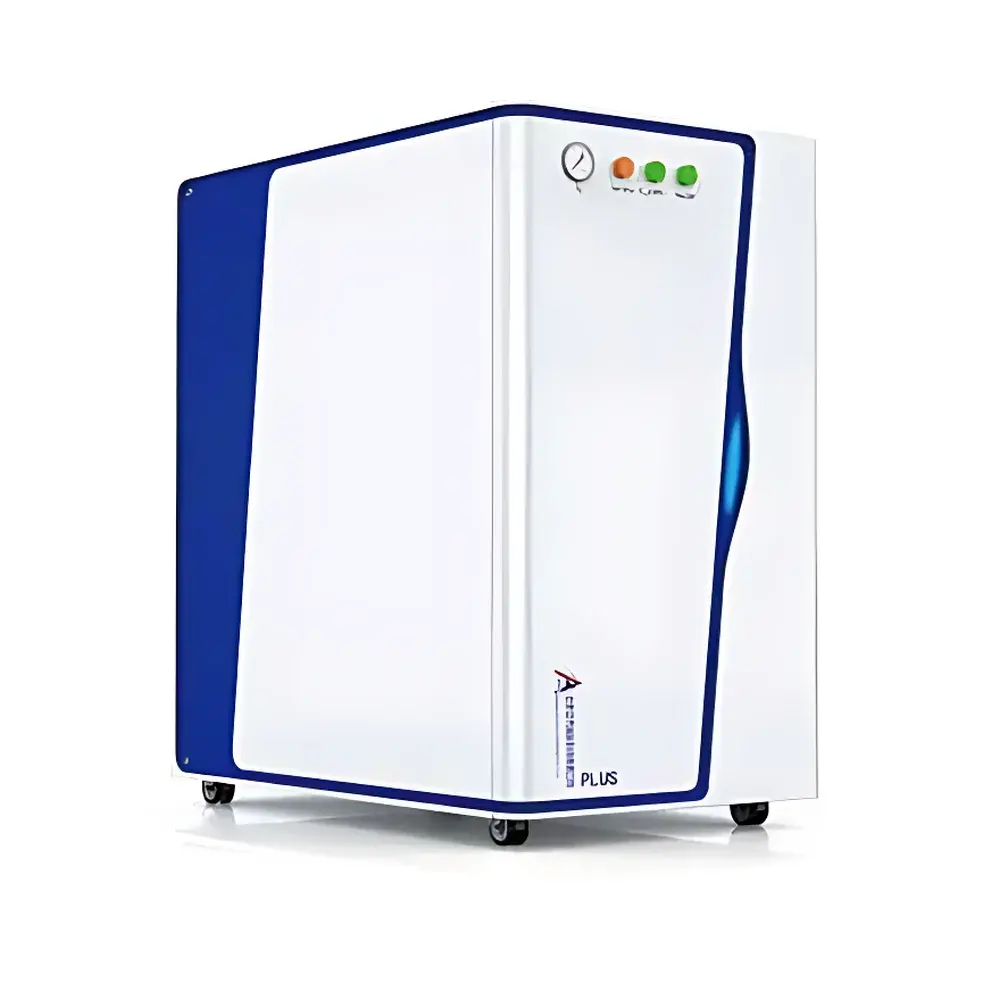
ATARICO Angos PLUS Series AGS-P302 Nitrogen Generator
| Brand | ATARICO |
|---|---|
| Origin | Beijing, China |
| Manufacturer Type | Direct Manufacturer |
| Product Category | Domestic (China-Made) |
| Model | AGS-P302 |
| Nitrogen Generation Principle | Pressure Swing Adsorption (PSA) using Zeolite Molecular Sieve |
| Output Flow Rate | 20 L/min at 450 kPa (65 psi) |
| Output Pressure Range | 0.1–0.75 MPa (14.5–108.8 psi) |
| Nitrogen Purity | 97%–99.9% (adjustable, inversely proportional to flow rate) |
| Dew Point | −40 °C to −45 °C |
| Air Inlet Requirement | 26 L/min at 100 psi (690 kPa) |
| Ambient Operating Temperature | 5–35 °C (41–95 °F) |
| Relative Humidity | ≤80% RH (non-condensing) |
| Max. Altitude | 2500 m above sea level |
| Particulate Filtration | <0.01 µm |
| Liquid Carryover | None |
| Noise Level | 55 dB(A) |
| Electrical Supply | 230 V, 50/60 Hz, Single-Phase |
| Power Consumption | 1.95 kW |
| Nitrogen Outlet | 6 mm push-to-connect fitting |
| Drain Outlet | 10 mm push-to-connect fitting |
| Dimensions (W×D×H) | 950 × 640 × 1090 mm |
| Net Weight | 210 kg |
Overview
The ATARICO Angos PLUS Series AGS-P302 Nitrogen Generator is an on-site, continuous-flow gas generation system engineered for laboratory and light industrial applications requiring stable, high-purity nitrogen supply. It employs a dual-tower Pressure Swing Adsorption (PSA) process utilizing high-efficiency zeolite molecular sieve media to selectively adsorb oxygen, moisture, and CO₂ from compressed ambient air—yielding nitrogen with purity adjustable between 97% and 99.9%. Unlike cryogenic or membrane-based alternatives, PSA technology delivers consistent performance across variable demand cycles while maintaining low operational overhead. The AGS-P302 is designed for integration into analytical instrumentation workflows—including LC-MS, GC carrier gas supply, glove box purging, sample preparation inerting, and solvent evaporation systems—where reliability, trace moisture control, and regulatory-compliant documentation are critical.
Key Features
- Stable output of up to 20 L/min at 450 kPa (65 psi), with pressure regulation across 0.1–0.75 MPa to accommodate diverse instrument inlet requirements.
- Adjustable nitrogen purity (97–99.9%) via integrated flow/purity optimization logic; higher purity settings correspond to reduced flow rates per system thermodynamics.
- Dual-tower PSA architecture with automatic valve sequencing ensures uninterrupted nitrogen delivery during regeneration cycles—eliminating downtime or pressure drop spikes.
- Integrated pre-filtration train (coalescing + activated carbon + ultrafine particulate filter) removes oil aerosols, hydrocarbons, and particles <0.01 µm, meeting ISO 8573-1 Class 2:2:2 air quality standards for instrument-grade feed air.
- Dew point consistently maintained between −40 °C and −45 °C, satisfying stringent moisture specifications for mass spectrometry and chromatographic applications.
- Low-noise operation (55 dB[A]) achieved through acoustic enclosure design and vibration-damped mounting—suitable for shared laboratory environments.
- Single-phase 230 V, 50/60 Hz power input with 1.95 kW rated consumption; no external cooling water or exhaust venting required.
Sample Compatibility & Compliance
The AGS-P302 is compatible with all standard nitrogen-dependent laboratory instruments operating within its pressure and flow envelope—including but not limited to Agilent, Thermo Fisher, Waters, and Shimadzu platforms. Its output meets ASTM D6349-20 specifications for instrument-grade nitrogen used in chromatography and spectroscopy. The unit complies with IEC 61000-6-3 (EMC emission limits) and IEC 61000-6-2 (immunity), and its electrical safety conforms to GB 4793.1–2019 (equivalent to IEC 61010-1). While not certified for medical or pharmaceutical manufacturing use out-of-the-box, the system supports GLP/GMP-aligned operation when deployed with documented calibration procedures, maintenance logs, and user-defined SOPs. Optional audit-trail-enabled software modules can be configured to meet FDA 21 CFR Part 11 data integrity requirements.
Software & Data Management
The AGS-P302 features an embedded microcontroller with real-time monitoring of critical parameters—including inlet air pressure, tower differential pressure, outlet purity (via internal electrochemical O₂ sensor), dew point, temperature, and runtime hours. All operational data are logged locally with 30-day buffer memory and exportable via USB interface in CSV format. An optional Ethernet/Wi-Fi module enables remote status access and alarm notification (SMTP/SNMP) through a browser-based interface. No proprietary cloud platform is required; raw data files are fully interoperable with LabVantage, STARLIMS, and custom LIMS integrations. Firmware updates are performed offline via signed binary packages to ensure cybersecurity compliance.
Applications
- LC-MS and GC-MS carrier and collision gas supply—replacing high-pressure cylinders with continuous, contamination-free nitrogen.
- Inert atmosphere maintenance for glove boxes, synthesis reactors, and battery material handling environments.
- Nitrogen blow-down and solvent evaporation in sample prep labs (e.g., EPA Method 525.3, ISO 11843).
- Blanketing of reagent storage vessels and HPLC mobile phase reservoirs to prevent oxidation.
- Calibration gas dilution systems requiring stable, low-moisture nitrogen as balance gas.
- Supporting ISO/IEC 17025-accredited testing laboratories seeking traceable, auditable gas sourcing.
FAQ
What is the minimum inlet air quality required for optimal AGS-P302 performance?
Compressed air must be oil-free, dried to ≤−20 °C dew point prior to entry, and filtered to ISO 8573-1 Class 2:2:2. A dedicated refrigerated dryer and coalescing filter upstream are strongly recommended.
Can the AGS-P302 be used for GC carrier gas in regulated pharmaceutical QC labs?
Yes—provided the system is qualified per IQ/OQ protocols, calibrated against NIST-traceable O₂ and dew point analyzers, and operated under documented change control and preventive maintenance schedules.
Does the unit include automatic drainage or require manual condensate removal?
It incorporates an auto-drain solenoid valve synchronized with PSA cycle timing; no manual intervention is needed under normal operating conditions.
Is the nitrogen purity verified in real time?
An integrated electrochemical oxygen sensor provides continuous O₂ concentration measurement (0–1000 ppm range, ±5% accuracy), enabling live purity estimation and alarm triggering if thresholds are exceeded.
What service intervals are recommended for molecular sieve replacement?
Under typical lab usage (8 hrs/day, 5 days/week), zeolite beds maintain specification performance for ≥36 months; replacement is condition-based and confirmed via O₂ breakthrough testing during annual PM.
Related Products



