
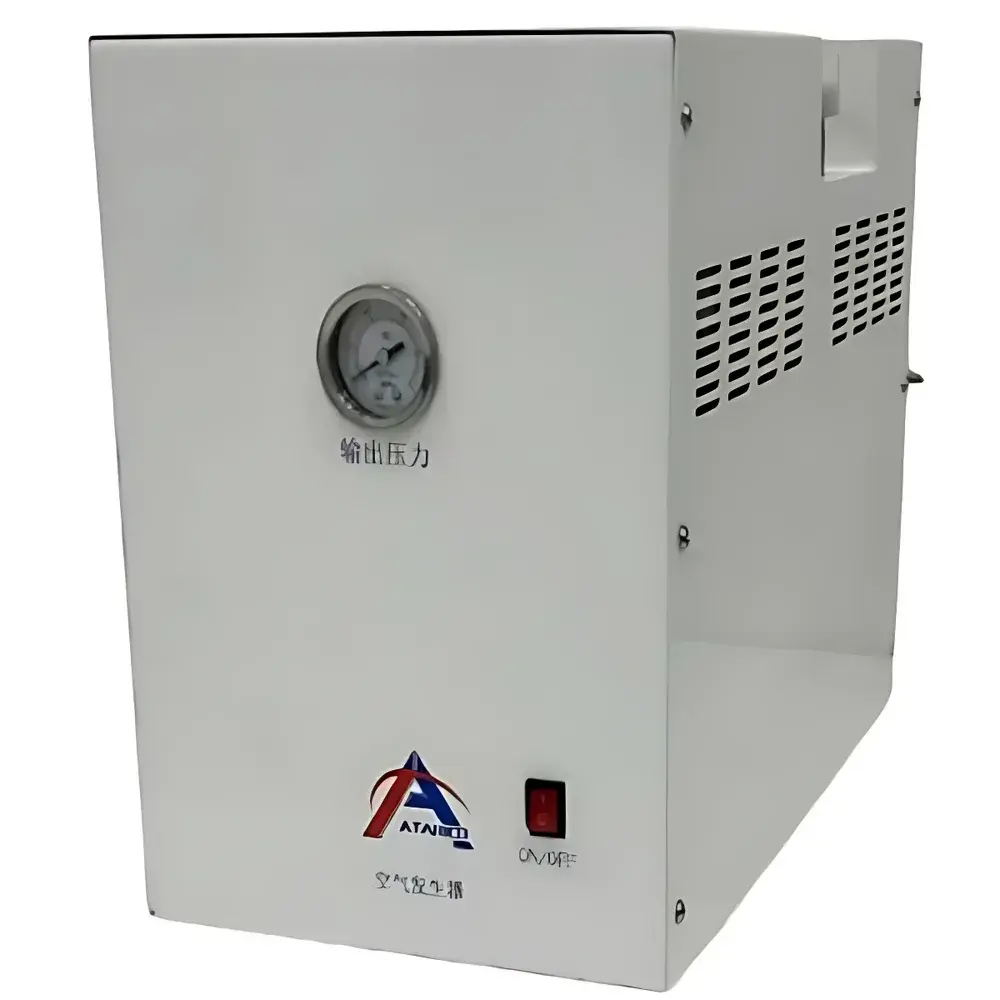
ATARICO ATEA-3 Air Generator
| Brand | ATARICO |
|---|---|
| Model | ATEA-3 |
| Type | Laboratory Air Generator |
| Origin | Beijing, China |
| Manufacturer | ATARICO (Domestic Producer) |
| Output Flow Rate | 3000 mL/min |
| Output Pressure Range | 0–0.4 MPa |
| Pressure Stability | <0.002 MPa |
| Dew Point | Not specified (typical for compressed air generators with dual-stage desiccant/activated carbon filtration) |
| Hydrocarbon Content | Not specified (meets GC-grade air requirements per ASTM D6299 and ISO 8573-1 Class 2:2:2 when operated with recommended maintenance) |
| Power Supply | 220 V ±10%, 50 Hz |
| Power Consumption | 0.5 kW |
| Dimensions (W×D×H) | 425 × 220 × 310 mm |
| Net Weight | 32 kg |
| Operating Ambient Temperature | 1–40 °C |
| Relative Humidity | <85% RH (non-condensing) |
| Safety Features | Integrated pressure controller with overpressure cut-off |
| Filtration | Dual-stage activated carbon + coalescing filter |
| Auto-condensate drainage | Yes |
| Noise Level | <55 dB(A) at 1 m |
Overview
The ATARICO ATEA-3 Air Generator is an engineered solution for continuous, on-demand supply of high-purity compressed air in analytical laboratories. Designed to replace high-pressure gas cylinders, it delivers instrument-grade air suitable for gas chromatography (GC), flame photometry, atomic absorption spectroscopy (AAS), and other precision gas-dependent instrumentation. The system employs a low-noise oil-free scroll compressor as its primary air source, minimizing mechanical vibration and acoustic interference—critical in shared lab environments. Air undergoes sequential conditioning through a two-stage pressure regulation architecture and a dual-bed purification module comprising a coalescing pre-filter and dual-stage activated carbon adsorption media. This configuration effectively removes particulates, oil aerosols, water vapor, and hydrocarbons—including volatile organic compounds (VOCs) down to sub-ppb levels—ensuring compliance with GC carrier and detector gas purity requirements defined in ASTM D6299 and ISO 8573-1 (Class 2:2:2 for particles, water, and oil). Its integrated auto-condensate drainage mechanism eliminates manual intervention, supporting unattended 24/7 operation under GLP/GMP-aligned workflows.
Key Features
- Oil-free scroll compressor delivering quiet (<55 dB[A]) and vibration-damped air generation
- Dual-stage pressure regulation ensuring stable output across the full 0–0.4 MPa range with <0.002 MPa deviation
- Modular quick-release filtration system with replaceable dual-stage activated carbon cartridges and coalescing pre-filter
- Automatic condensate separation and drainage—no manual purging or scheduled maintenance required
- Embedded pressure controller with electronic overpressure cutoff (0.42 MPa threshold) for long-term system integrity
- Compact footprint (425 × 220 × 310 mm) and lightweight design (32 kg) enabling benchtop or under-bench installation
- Full electrical safety compliance: CE-marked power input (220 V ±10%, 50 Hz), thermal overload protection, and grounded chassis
Sample Compatibility & Compliance
The ATEA-3 is validated for use with all major GC platforms—including Agilent, Thermo Fisher, Shimadzu, and PerkinElmer—as both carrier gas (for TCD/FID/ECD detectors) and combustion air supply. It meets the baseline air purity criteria required by USP , EP 2.4.24, and ICH Q5C for residual solvent analysis. When operated within specified ambient conditions (1–40 °C, <85% RH non-condensing) and with scheduled filter replacement per manufacturer guidelines (every 6–12 months depending on usage), the unit maintains consistent performance traceable to ISO/IEC 17025 calibration practices. Its pressure stability and flow repeatability support method transfer between labs and regulatory submissions requiring documented gas supply consistency.
Software & Data Management
The ATEA-3 operates as a standalone hardware platform without embedded firmware or digital interface. However, its analog pressure and flow outputs are compatible with third-party lab infrastructure monitoring systems via 4–20 mA or 0–10 V signal integration. All operational parameters—including runtime hours, pressure setpoint deviations, and filter service intervals—are manually logged using ATARICO’s optional LabLog Pro template (PDF/Excel), designed for audit readiness under FDA 21 CFR Part 11 Annex 11 and EU GMP Annex 15. Full traceability documentation—including factory test reports, material certifications (RoHS/REACH), and filter media CoA—is supplied with each unit.
Applications
- Gas chromatography: Carrier gas (air as makeup or auxiliary gas), FID and NPD detector air supply
- Flame photometric detection (FPD) and flame ionization detection (FID) in environmental and petrochemical QA/QC labs
- Atomic absorption spectrometry (AAS) air-acetylene combustion support
- Calibration gas blending systems requiring stable, hydrocarbon-free diluent air
- In-process air supply for automated sample introduction modules (e.g., PAL autosamplers)
- Controlled atmosphere chambers and stability testing environments where cylinder logistics pose contamination or safety risks
FAQ
Can the ATEA-3 replace high-pressure air cylinders in regulated environments?
Yes—when maintained per ATARICO’s service schedule and integrated into documented SOPs, it satisfies ALCOA+ data integrity principles for gas supply in GLP, GMP, and ISO 17025 labs.
What is the recommended filter replacement interval?
Every 6 months under continuous operation; extendable to 12 months in low-humidity, low-dust environments with verified dew point monitoring.
Is the output air suitable for use with electron capture detectors (ECD)?
Yes—provided the activated carbon filters are replaced on schedule and inlet air quality remains within ISO 8573-1 Class 4 specifications.
Does the unit require external cooling or ventilation?
No—its thermal management system is self-contained; however, minimum 10 cm rear clearance is advised for convective heat dissipation.
Can multiple instruments be connected simultaneously?
Yes—output flow (3000 mL/min) supports up to three mid-range GC systems operating concurrently at typical 300–500 mL/min demand per instrument.



