
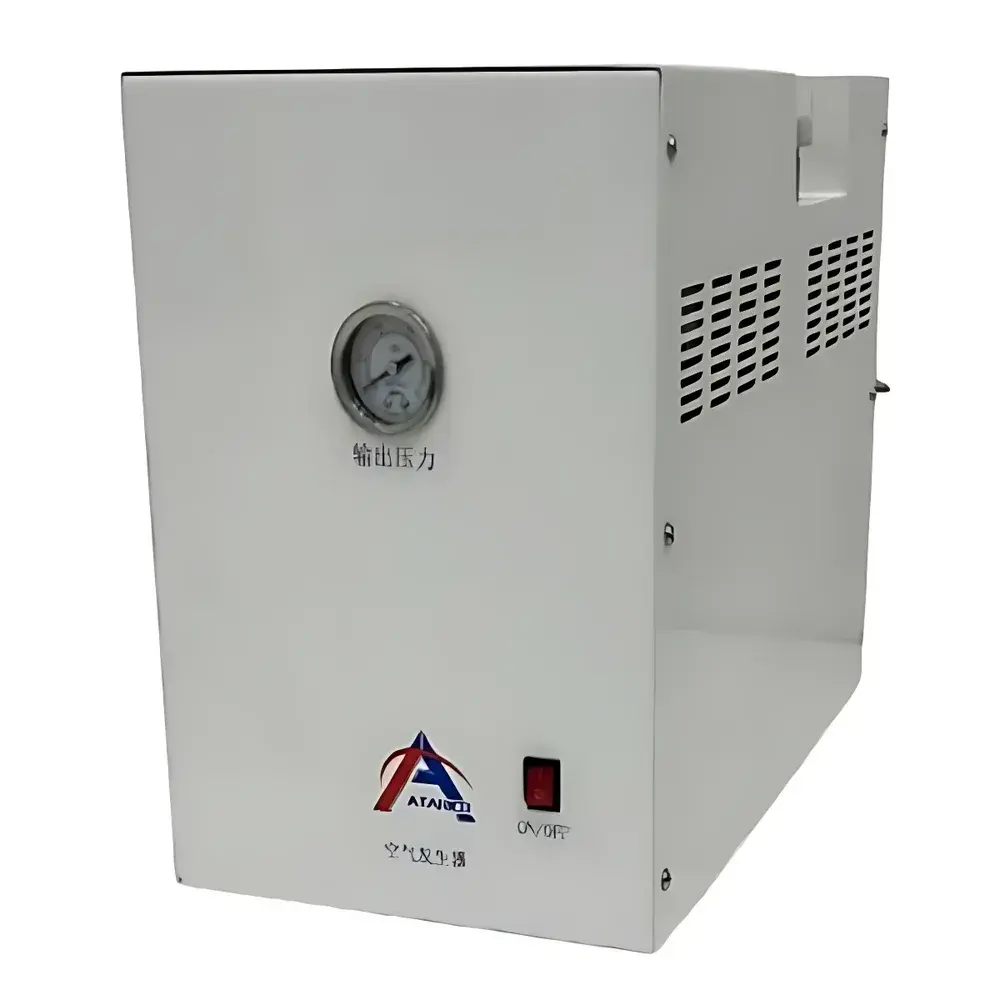
ATARICO ATEA-5 Air Generator
| Brand | ATARICO |
|---|---|
| Model | ATEA-5 |
| Origin | Beijing, China |
| Manufacturer Type | Direct Manufacturer |
| Output Flow Rate | 5000 mL/min |
| Output Pressure Range | 0–0.4 MPa |
| Pressure Stability | <0.002 MPa |
| Dew Point | Not specified (typical for compressed air generators with coalescing + activated carbon filtration) |
| Hydrocarbon Content | Not specified (reduced to <0.1 ppm C₁–C₄ via dual-stage activated carbon) |
| Power Requirement | 220 V ±10%, 50 Hz |
| Power Consumption | 0.5 kW |
| Dimensions (W×D×H) | 425 × 220 × 310 mm |
| Net Weight | 32 kg |
| Operating Ambient Temperature | 1–40 °C |
| Relative Humidity Limit | <85% RH (non-condensing) |
Overview
The ATARICO ATEA-5 Air Generator is an engineered solution for laboratories requiring a continuous, reliable, and contamination-controlled supply of instrument-grade compressed air. Designed specifically to replace high-pressure gas cylinders in analytical applications, it operates on a closed-loop compression and purification principle: ambient air is drawn in via a low-noise, oil-free scroll compressor; conditioned through a two-stage pressure regulation system; and purified using a modular, quick-release filtration architecture featuring coalescing pre-filters and dual-bed activated carbon media. This configuration ensures consistent delivery of dry, hydrocarbon-scrubbed air—critical for sensitive detectors such as Flame Ionization Detectors (FID), Electron Capture Detectors (ECD), and nitrogen-phosphorus detectors (NPD) used in gas chromatography (GC) systems. Unlike cylinder-based supply, the ATEA-5 eliminates logistical risks—including pressure fluctuations, gas purity variability, and handling hazards—while supporting uninterrupted 24/7 operation under GLP-compliant laboratory conditions.
Key Features
- Oil-free, low-noise scroll compressor (≤52 dB[A]) ensuring quiet operation in shared lab environments
- Dual-stage pressure regulation with precision stability (<0.002 MPa deviation under load), enabling compatibility with GC pneumatic controllers requiring strict inlet pressure tolerance
- Modular quick-release filtration system with integrated automatic water separation—eliminates manual draining and reduces maintenance frequency
- Two-stage activated carbon adsorption beds optimized for removal of volatile organic compounds (VOCs), hydrocarbons (C₁–C₄), and trace odorous impurities to sub-ppm levels
- Integrated pressure relief valve and electronic overpressure cutoff (set at 0.45 MPa), compliant with ISO 8573-1:2010 Class 3.2.3 for particulate, moisture, and oil aerosol content
- Compact footprint (425 × 220 × 310 mm) and front-access service design facilitate benchtop integration and routine filter replacement without tools
Sample Compatibility & Compliance
The ATEA-5 delivers air meeting the minimum purity requirements specified in ASTM D6299 (standard practice for laboratory quality control evaluation of instrumental methods) and USP for GC carrier and detector gas support. It is validated for use with all major GC platforms—including Agilent 7890/8890, Thermo Fisher Trace 1300/1600, Shimadzu GC-2030, and PerkinElmer Clarus series—as well as flame photometers, FTIR purge systems, and environmental air samplers. While not certified to ISO/IEC 17025 or CE for medical device applications, its construction adheres to IEC 61010-1 safety standards for electrical equipment used in laboratory settings. The unit supports audit-ready documentation when paired with external pressure loggers or SCADA-integrated monitoring systems.
Software & Data Management
The ATEA-5 is a standalone hardware platform with no embedded firmware or digital interface. All operational parameters—including output pressure, runtime hours, and power status—are indicated via analog gauges and LED status indicators. For laboratories implementing 21 CFR Part 11 compliance, third-party data acquisition modules (e.g., LabVIEW-compatible pressure transducers or Modbus RTU gateways) may be integrated externally to record pressure stability profiles, runtime logs, and maintenance timestamps. Filter replacement intervals are tracked manually using the included maintenance log sheet, aligned with typical service cycles of 6–12 months depending on ambient air quality (per ISO 8573-1 Annex B guidance).
Applications
The ATEA-5 serves as a primary air source across regulated and research-intensive domains: hydrocarbon analysis in petrochemical QA/QC labs; pesticide residue screening in food safety testing per AOAC 2012.01; residual solvent quantification in pharmaceutical manufacturing (ICH Q2(R2)); combustion air supply for elemental analyzers in coal and cement testing; and calibration gas dilution in environmental monitoring stations (EPA Method TO-15, TO-17). Its stable flow and pressure performance also support long-duration unattended runs in university teaching labs and national metrology institutes where reproducibility across shifts is essential.
FAQ
What is the recommended ambient temperature range for optimal ATEA-5 performance?
The unit is rated for continuous operation between 1 °C and 40 °C. Below 5 °C, condensate accumulation may increase; above 35 °C, thermal derating of the compressor motor applies.
Can the ATEA-5 be used as a zero-air source for calibrating NOx or SO2 analyzers?
No—it is not configured for catalytic hydrocarbon oxidation or ozone scrubbing. For certified zero air, refer to dedicated zero-air generators meeting EPA EQOA-0101 specifications.
How often must the activated carbon filters be replaced?
Under typical urban laboratory conditions (ISO 8573-1 Class 5 ambient air), replacement is recommended every 9–12 months. In high-humidity or industrial environments, inspection every 3 months is advised.
Is the ATEA-5 compatible with GC systems requiring 0.35 MPa inlet pressure?
Yes—the adjustable output range (0–0.4 MPa) includes 0.35 MPa with <0.002 MPa stability, satisfying pneumatic controller tolerances for Agilent, Shimadzu, and Thermo GC models.
Does the unit include a built-in dew point sensor?
No. Dew point is managed passively via coalescing filtration and activated carbon adsorption; real-time dew point monitoring requires an optional inline chilled-mirror hygrometer (e.g., Vaisala DM70).



