
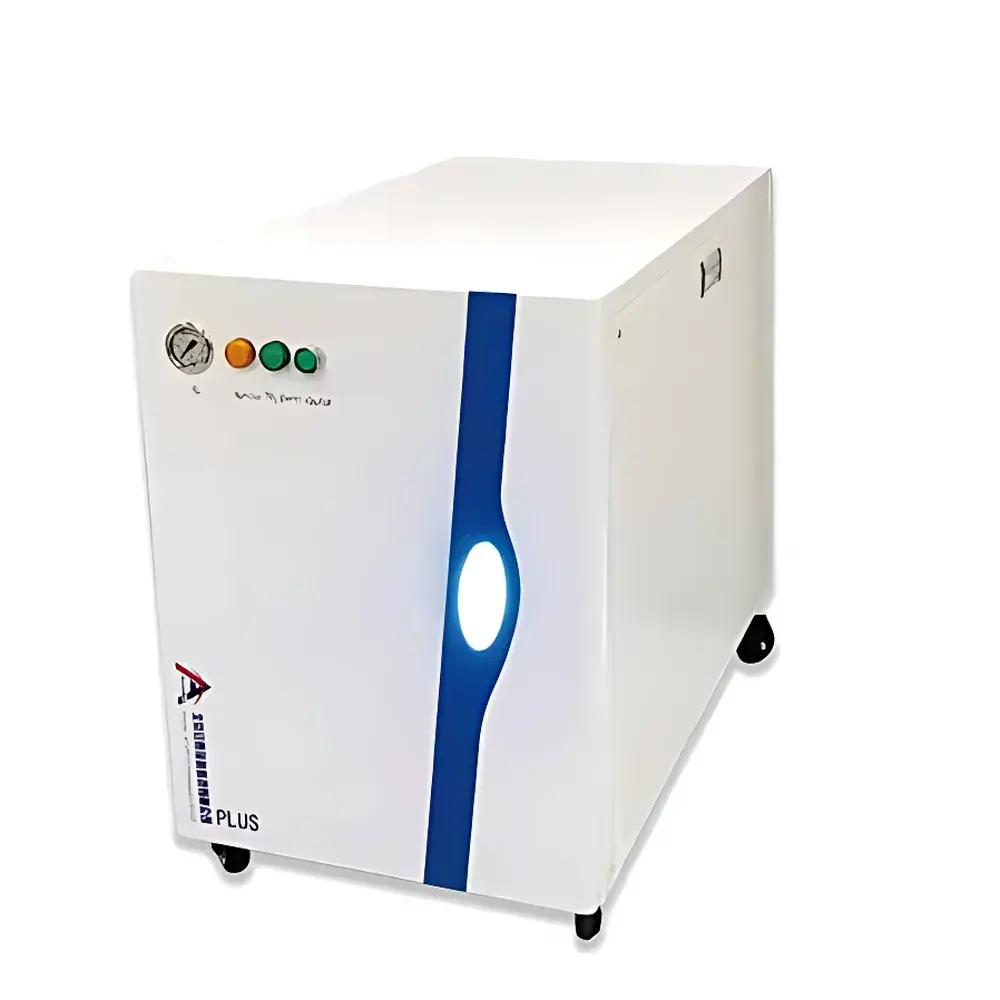
ATARICO ATEN-P301 Advanced PSA Nitrogen Generator with Integrated Dry Air Supply
| Brand | ATARICO |
|---|---|
| Origin | Beijing, China |
| Manufacturer Type | Direct Manufacturer |
| Model | ATEN-P301 |
| Nitrogen Generation Principle | Pressure Swing Adsorption (PSA) using Zeolite Molecular Sieve |
| Nitrogen Flow Rate | 25 L/min at 101 psi (7 bar) |
| Output Pressure Range | 0.1–0.7 MPa (14.5–101.5 psi) |
| Nitrogen Purity | 95–99.5% (v/v) |
| Dew Point | −40 °C to −45 °C |
| Air Flow Output | 125 L/min at 101 psi |
| Operating Temperature | 5–35 °C (41–95 °F) |
| Relative Humidity | ≤80% RH |
| Max. Altitude | 1500 m |
| Particulate Filtration | <0.01 µm |
| Oil & Liquid Carryover | None |
| Noise Level | 52 dB(A) |
| Power Supply | 230 V, 50/60 Hz |
| Power Consumption | 1.85 kW |
| Dimensions (L×W×H) | 1060 × 650 × 750 mm |
| Weight | 180 kg |
Overview
The ATARICO ATEN-P301 is an engineered nitrogen generator designed specifically for high-demand LC-MS and GC-MS laboratories requiring continuous, reliable supplies of both high-purity nitrogen and instrument-grade dry air. It employs dual-stream Pressure Swing Adsorption (PSA) technology—utilizing optimized zeolite molecular sieve beds—to separate nitrogen from compressed ambient air with high selectivity and reproducibility. Unlike membrane-based systems, the ATEN-P301 achieves superior adsorption efficiency (25–40% higher at equivalent flow rates), resulting in lower specific energy consumption (kWh/Nm³), extended sieve lifetime, and reduced long-term operational cost. Its integrated dual-gas architecture eliminates the need for separate nitrogen and air generators—reducing footprint, interconnection complexity, and point-of-use pressure drop. The system operates continuously under 24/7 duty cycles and is validated for uninterrupted service over 10,000+ hours per year, making it suitable for GLP/GMP-compliant analytical environments where gas continuity directly impacts data integrity and instrument uptime.
Key Features
- Multi-chamber PSA design isolates compressor thermal mass from adsorption beds, minimizing temperature-induced fluctuations in purity and flow stability.
- Intelligent PLC-based control system with multi-point temperature monitoring, real-time pressure regulation, and automatic cycle optimization based on demand profile.
- Dual independent gas outputs: one dedicated nitrogen stream (25 L/min @ 101 psi) and one regulated dry air stream (125 L/min @ 101 psi), both filtered to <0.01 µm and oil-free.
- Integrated condensate management with auto-drain valves and desiccant-assisted drying stage ensures consistent −40 °C to −45 °C dew point across operating load range.
- Robust mechanical architecture featuring industrial-grade vibration-dampened mounting, low-noise scroll compressor (52 dB(A)), and omnidirectional castor wheels for lab repositioning.
- Comprehensive safety suite including overtemperature cutoff, phase-loss protection, ground-fault circuit interruption (GFCI), and pressure relief valves compliant with ISO 8573-1:2010 Class 2 solid particle / Class 2 water / Class 1 oil standards.
Sample Compatibility & Compliance
The ATEN-P301 delivers nitrogen and dry air meeting critical specifications for electrospray ionization (ESI), atmospheric pressure chemical ionization (APCI), and heated electrospray ionization (HESI) sources in LC-MS platforms—including Thermo Fisher Orbitrap, Waters Xevo, and Agilent Q-TOF systems. Nitrogen purity (95–99.5%) and dew point (−40 °C to −45 °C) satisfy ASTM D6622-20 and ISO 8573-1 Class 2 requirements for analytical gas supply. All internal wetted materials comply with USP Class VI biocompatibility standards; no silicone or plasticizers leach into gas streams. The unit supports audit-ready operation under FDA 21 CFR Part 11 when paired with optional data logging modules, and its maintenance intervals and calibration records align with ISO/IEC 17025 laboratory accreditation criteria.
Software & Data Management
While the base ATEN-P301 operates via intuitive front-panel HMI with LED status indicators and tactile start/stop controls, optional Ethernet-enabled firmware enables remote monitoring via Modbus TCP or OPC UA protocols. Logged parameters—including inlet pressure, bed temperature differentials, purity estimates (via O₂ sensor feedback loop), runtime hours, and fault codes—are exportable as CSV or integrated into LIMS via RESTful API. All event logs include timestamped operator actions and system-initiated responses, supporting full traceability for GLP audits. Firmware updates are performed via secure HTTPS interface with digital signature verification.
Applications
- LC-MS mobile phase nebulization and collision gas in triple quadrupole and high-resolution mass spectrometers.
- GC-MS carrier and make-up gas for flame ionization (FID) and electron capture (ECD) detectors.
- Dry air supply for pneumatic sample introduction, autosampler purge, and detector cooling circuits.
- Blank solvent evaporation in preparative HPLC and parallel synthesis workstations.
- Controlled-atmosphere glove boxes requiring inert overlay gas with concurrent dry air for operator access ports.
FAQ
What is the expected service life of the molecular sieve beds?
Under standard operating conditions (25 °C, 50–80% RH, 101 psi feed pressure), the zeolite beds maintain ≥95% purity performance for ≥20,000 hours (≈2.3 years continuous use); replacement is recommended after 36 months or upon verified purity drift >0.5% (v/v).
Can the ATEN-P301 be integrated with existing lab gas distribution panels?
Yes—the unit features standardized 6 mm push-to-connect nitrogen and 10 mm quick-disconnect drain fittings, compatible with Swagelok SS-400 and Parker A-LOK tubing systems; custom manifolds available upon request.
Does the system require external cooling or ventilation?
No active cooling is needed; the cabinet includes passive convection grilles and thermal mass buffering—only 300 mm rear clearance is required for ambient airflow.
Is validation documentation provided for IQ/OQ/PQ protocols?
Yes—Factory Acceptance Test (FAT) reports, as-built P&IDs, material certifications (3.1 EN 10204), and a customizable URS-aligned validation support package are included with each unit.
How does power consumption compare to membrane-based alternatives?
At rated flow, the ATEN-P301 consumes 1.85 kW versus typical 2.4–2.9 kW for equivalent membrane units—translating to ~23% lower annual electricity cost and measurable contribution toward ISO 50001 energy management goals.



