
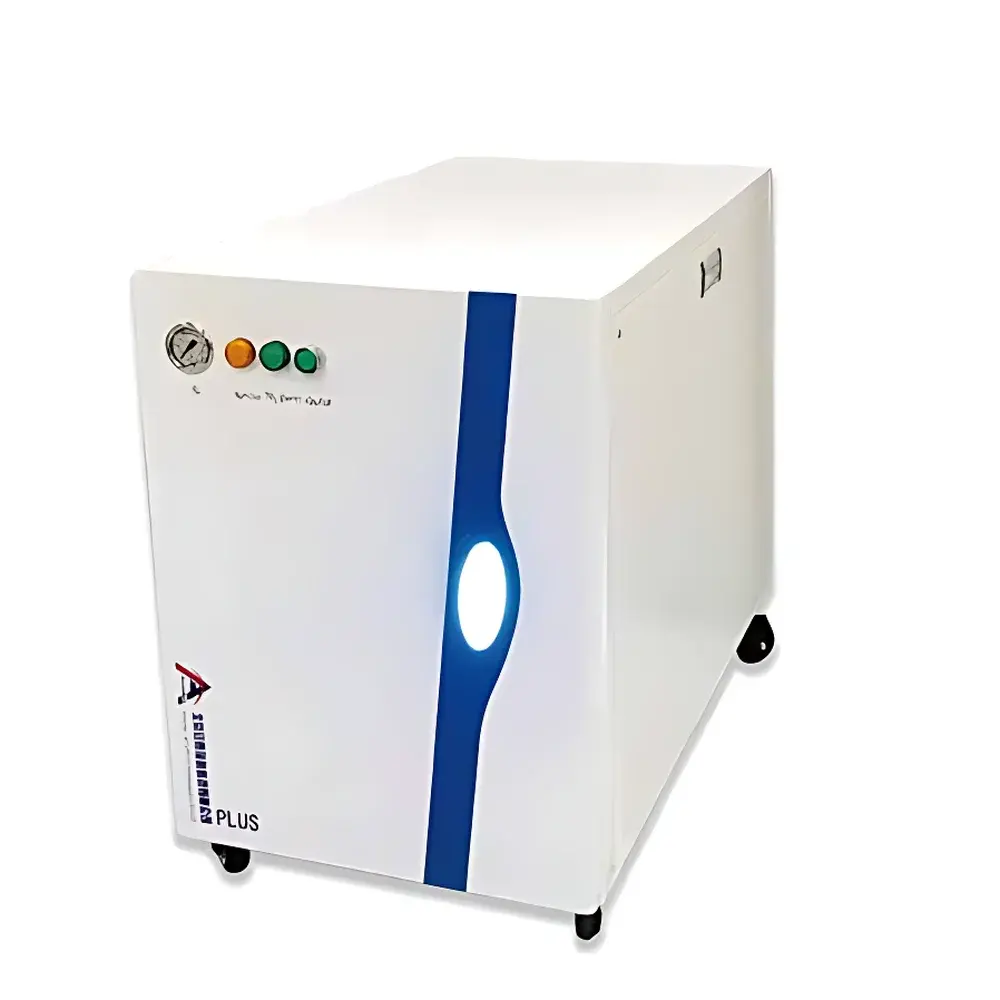
ATARICO ATEN-P302 Dual-Stream Nitrogen & Dry Air Generator for LC-MS
| Brand | ATARICO |
|---|---|
| Origin | Beijing, China |
| Manufacturer Type | OEM Manufacturer |
| Model | ATEN-P302 |
| Nitrogen Generation Principle | Pressure Swing Adsorption (PSA) with Zeolite Molecular Sieve |
| Nitrogen Flow Rate | 15 L/min at 65 psi (4.5 bar) |
| Nitrogen Output Pressure Range | 0.1–0.7 MPa (14.5–101.5 psi) |
| Nitrogen Purity | 95–99.5% (v/v) |
| Nitrogen Dew Point | −40 °C to −45 °C |
| Dry Air Flow Rate | 24 L/min at 65 psi |
| Dry Air Dew Point | ≤ −40 °C |
| Operating Ambient Temperature | 5–35 °C (41–95 °F) |
| Relative Humidity | ≤ 80% RH (non-condensing) |
| Max. Altitude | 1500 m |
| Particulate Filtration | < 0.01 µm |
| Oil & Liquid Carryover | None |
| Sound Pressure Level | 52 dB(A) |
| Electrical Supply | 230 V, 50/60 Hz |
| Power Consumption | 1.85 kW |
| Dimensions (L×W×H) | 1060 × 650 × 750 mm |
| Weight | 180 kg |
Overview
The ATARICO ATEN-P302 is a dual-stream, on-site gas generation system engineered specifically for liquid chromatography–mass spectrometry (LC-MS) laboratories requiring simultaneous, high-reliability supplies of both high-purity nitrogen and instrument-grade dry air. Unlike conventional single-output nitrogen generators, the ATEN-P302 integrates two independent pressure swing adsorption (PSA) gas separation modules—one optimized for nitrogen production and the other for compressed air drying and purification—within a unified, compact chassis. Its core nitrogen generation relies on advanced zeolite molecular sieve beds operating under precisely controlled cyclic pressurization and depressurization, enabling consistent separation of O₂, CO₂, H₂O, and trace hydrocarbons from compressed ambient air. The integrated dry air module employs coalescing and desiccant filtration stages to deliver oil-free, particle-free, low-dew-point air essential for electrospray ionization (ESI) and atmospheric pressure chemical ionization (APCI) sources. Designed for continuous 24/7 operation in regulated analytical environments, the ATEN-P302 meets the stringent gas stability, purity, and uptime requirements of modern LC-MS workflows without dependency on high-pressure cylinders or membrane-based systems.
Key Features
- Simultaneous dual-gas output: Independent nitrogen and dry air streams, each with dedicated flow regulation, pressure control, and real-time monitoring
- High-efficiency PSA architecture: Zeolite molecular sieve beds with adaptive cycle timing—25–40% higher adsorption efficiency compared to equivalent-capacity membrane systems
- Thermally isolated multi-chamber design: Compressor compartment physically separated from adsorption beds and electronics to minimize thermal drift, vibration transmission, and acoustic coupling
- Intelligent PLC-based control: Multi-point temperature sensing, auto-compensating pressure sequencing, and built-in leakage detection with fault logging and alarm relay outputs
- Energy-optimized operation: Dynamic load-matching algorithm reduces average power draw by up to 18% versus fixed-cycle PSA units; compliant with ISO 50001 energy management principles
- Low-maintenance engineering: No consumable membranes or catalysts; molecular sieves rated for ≥20,000 hours of continuous service; filter elements accessible via front-panel quick-release housings
Sample Compatibility & Compliance
The ATEN-P302 delivers nitrogen and dry air meeting critical specifications for LC-MS source gases per ICH Q2(R2), USP , and ASTM D6167–21 standards. Nitrogen purity (95–99.5%) and dew point (−40 to −45 °C) support both ESI and APCI applications across Agilent, Thermo Fisher, Waters, and Shimadzu platforms. Dry air output satisfies ISO 8573-1 Class 1.2.1 (particle, water, oil) requirements for instrument air supply lines. All electrical components comply with CE marking directives (EMC 2014/30/EU, LVD 2014/35/EU), and firmware supports audit-trail-enabled operation compatible with FDA 21 CFR Part 11–compliant data integrity frameworks when integrated with validated LIMS or CDS environments.
Software & Data Management
The ATEN-P302 includes an embedded web server interface accessible via Ethernet or Wi-Fi, enabling remote status monitoring, parameter adjustment, and event log export (CSV/JSON). Real-time metrics include nitrogen purity (via internal electrochemical O₂ sensor), inlet/outlet pressures, bed temperature gradients, compressor runtime, and filter life estimation. All operational events—including start/stop cycles, pressure faults, and maintenance alerts—are timestamped and stored with configurable retention (up to 12 months). Optional OPC UA integration allows seamless connection to SCADA systems or enterprise MES platforms for predictive maintenance scheduling and energy consumption analytics.
Applications
- LC-MS mobile phase nebulization and desolvation (ESI/APCI sources)
- Gas chromatography–mass spectrometry (GC-MS) make-up gas and collision gas
- Automated sample preparation systems requiring inert purge or blanking gas
- Controlled-atmosphere glove boxes and inert storage cabinets
- QA/QC laboratories operating under GLP or ISO/IEC 17025 accreditation where cylinder dependency introduces traceability and supply-chain risk
FAQ
Does the ATEN-P302 require external cooling or ventilation?
No—its thermally partitioned architecture and low-noise centrifugal fan ensure stable operation within standard laboratory ambient conditions (5–35 °C, ≤80% RH) without auxiliary HVAC support.
Can nitrogen purity be adjusted in real time during operation?
Yes—purity is inversely proportional to flow rate; users may select preset purity modes (95%, 99%, or 99.5%) via the touchscreen interface, with corresponding automatic flow and cycle adjustments.
What maintenance intervals are recommended?
Pre-filters: every 6 months; coalescing filters: annually; desiccant air dryer cartridge: every 2 years; molecular sieve beds: replacement only after ≥20,000 hours or if purity falls below specification despite recalibration.
Is the unit compatible with third-party mass spectrometer control software?
Yes—via Modbus TCP or optional RS-485 interface, enabling bidirectional communication with vendor-specific instrument control suites for synchronized start/stop and alarm forwarding.
How does the ATEN-P302 handle altitude variations above 1500 m?
Above 1500 m, inlet air density decreases; the unit’s adaptive pressure compensation algorithm maintains specified outlet flow and purity down to 2500 m—performance derating data available upon request.
Related Products



