
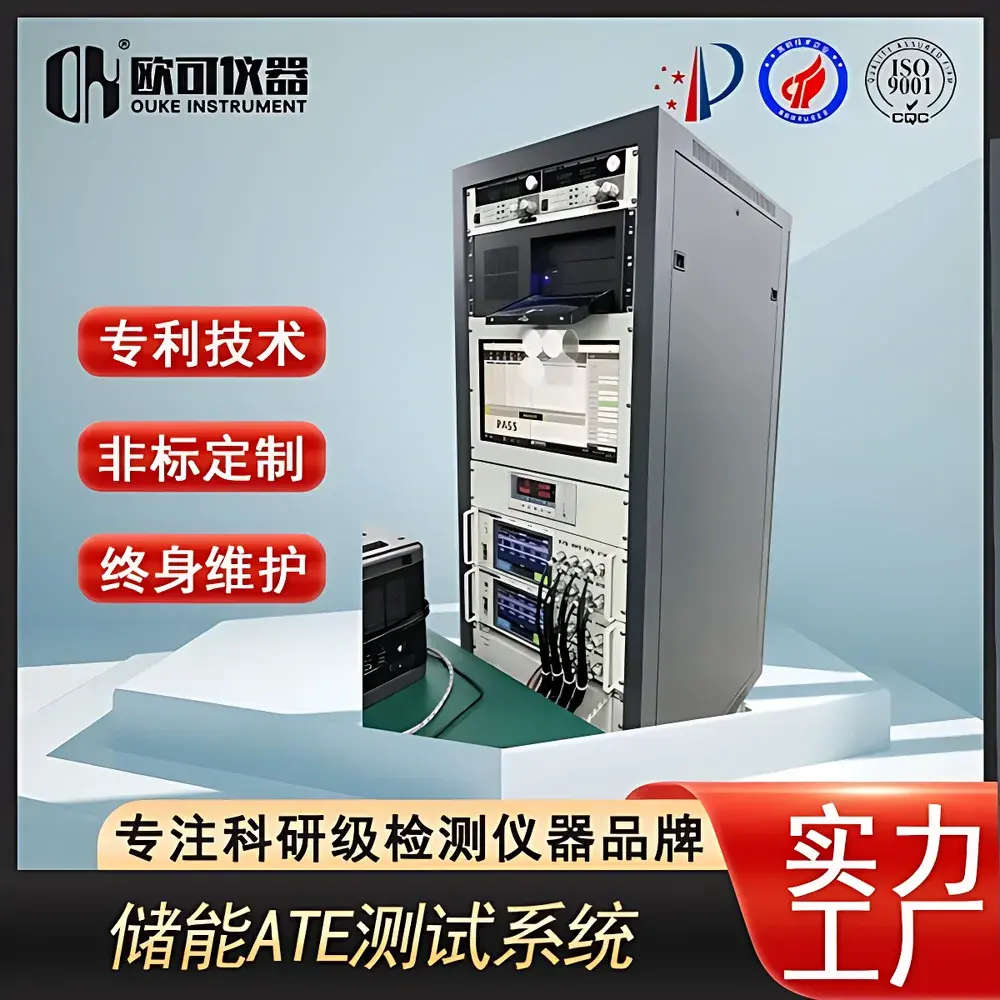
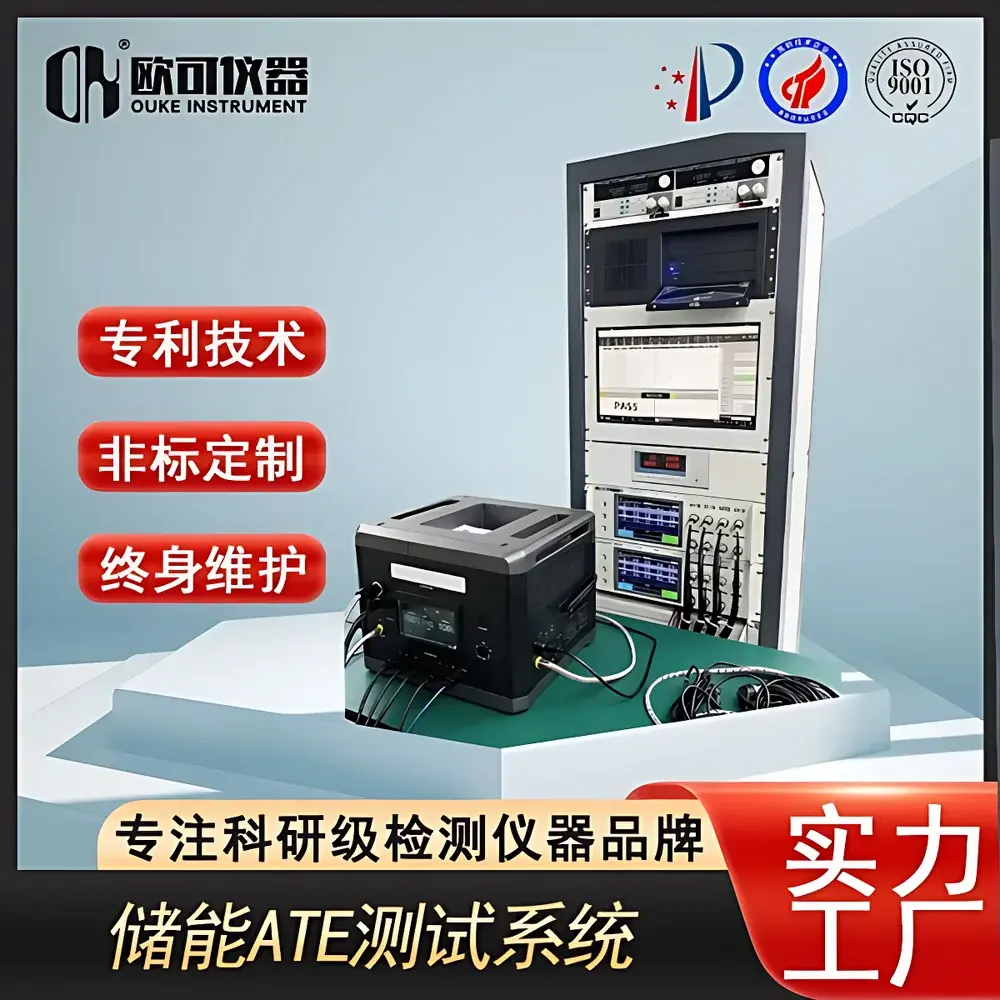
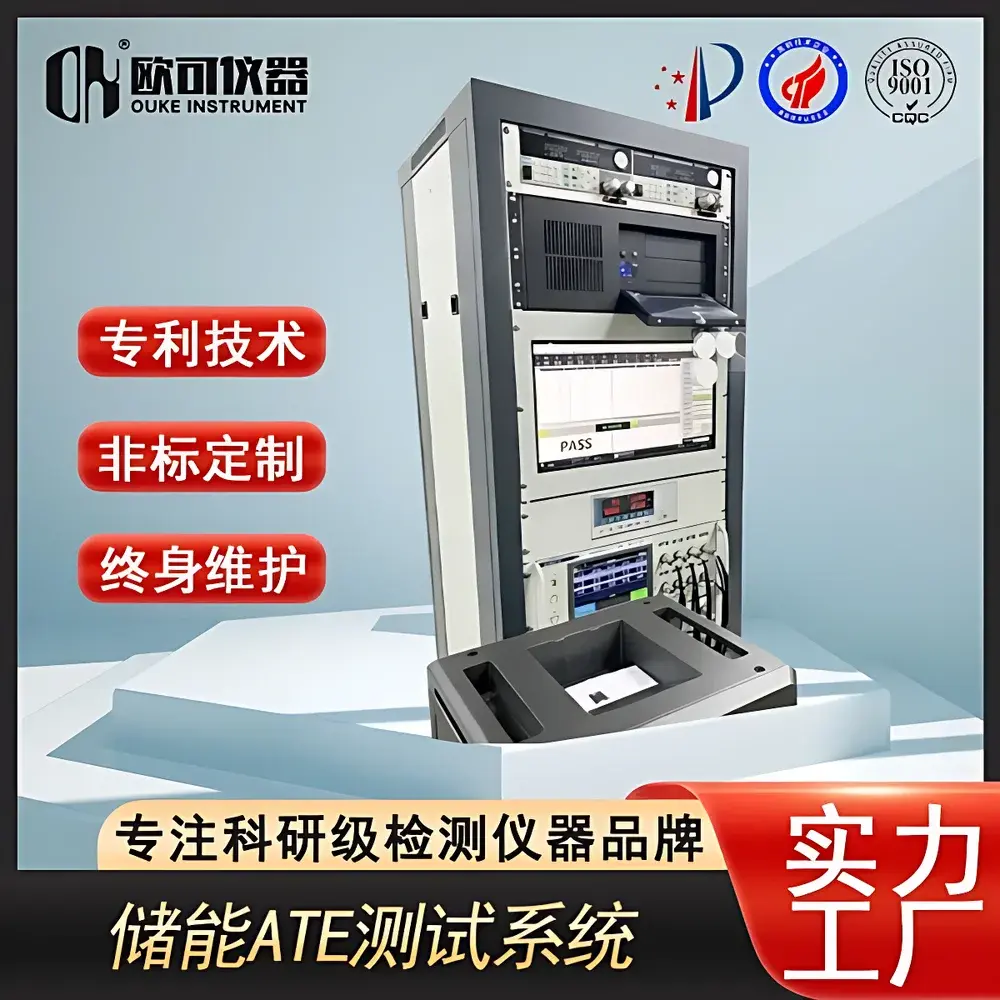
OK-ATE-1 Energy Storage Automated Test Equipment System
| Brand | OK Instruments |
|---|---|
| Origin | Guangdong, China |
| Manufacturer Type | OEM/ODM Producer |
| Country of Origin | China |
| Model | OK-ATE-1 |
| Price | USD 3,100 (FOB Guangdong) |
| Voltage Range | DC 0–1000 V (battery side), AC 220/380 V ±20% (grid side) |
| Accuracy | ±0.02% FS, Resolution: 1 mV |
| Current Range | DC charge/discharge 0–200 A, AC output 0–100 A |
| Accuracy | ±0.05% FS, Resolution: 10 mA |
| Power Rating | 0–200 kW |
| Accuracy | ±0.1% FS |
| Sampling Rate | 10–2000 Hz |
| Communication Interfaces | Standard CAN, RS485, Ethernet, USB |
| Compliance | GB/T 3048.1–2018, GB/T 20438–2017, GB/T 37408–2019, IEC 62116, IEC 61000 |
| Enclosure Rating | IP30 (standard), optional IP54 |
| EMC | GB/T 17626 series |
Overview
The OK-ATE-1 Energy Storage Automated Test Equipment System is an integrated, production-grade test platform engineered for end-of-line (EOL) functional and performance validation of electrochemical energy storage systems—including battery packs (Pack), modules (Module), battery management systems (BMS), hybrid energy storage units (e.g., PV + ESS + PCS), and residential/commercial energy storage inverters. Built upon automated test equipment (ATE) architecture, the system replaces fragmented manual verification with synchronized, programmable, and traceable test sequences across electrical, functional, safety, and communication domains. Its core measurement methodology combines precision power electronics-based bidirectional DC/AC stimulus generation, high-fidelity signal simulation (voltage, current, temperature, SOC), hardware-in-the-loop (HIL) BMS emulation, and real-time grid-interactive waveform synthesis (including harmonic injection, voltage sag/swell, frequency ramping). Designed explicitly for lithium iron phosphate (LFP), sodium-ion, and flow battery applications in utility-scale, commercial, and residential energy storage markets, the OK-ATE-1 ensures conformance to stringent safety-critical manufacturing requirements while enabling scalable throughput in high-volume production environments.
Key Features
- Modular, multi-channel architecture supporting parallel testing of up to 4 battery packs or BMS units per rack—reducing cycle time without compromising measurement integrity.
- Bidirectional regenerative power stage with 200 kW maximum capacity, enabling energy回馈 to the grid during discharge phases and reducing operational electricity costs by >65% versus resistive load banks.
- Dual-domain HIL capability: Simulates up to 128 cell-level voltage channels, 32 thermistor inputs, and current shunt signals to validate BMS acquisition accuracy, protection logic (overvoltage, undervoltage, overtemperature, short-circuit), relay switching behavior, passive/active balancing response, and insulation monitoring algorithms.
- Grid emulator functionality compliant with IEEE 1547-2018 and IEC 62116, supporting islanding detection, seamless grid-connect/disconnect transitions, reactive power control (Q(V), Q(f)), and anti-islanding robustness validation under dynamic load conditions.
- Photovoltaic (PV) source emulator with MPPT tracking simulation across 0–1000 V / 0–200 A range, enabling full-cycle photovoltaic-storage-coordination testing including charging efficiency, clipping loss analysis, and EMS-driven dispatch logic verification.
- Industrial-grade synchronization engine ensuring sub-millisecond timestamp alignment across all analog/digital I/O, CAN bus traffic, and Ethernet-based device communications—critical for root-cause analysis of timing-dependent faults.
Sample Compatibility & Compliance
The OK-ATE-1 accommodates a broad spectrum of energy storage configurations: residential all-in-one ESS units (≤10 kWh), commercial battery racks (up to 500 kWh), PCS-integrated systems, and modular BMS units with CAN/CAN FD, RS485, or Ethernet interfaces. It supports both low-voltage (≤100 V) and high-voltage (up to 1000 V DC) topologies, including series-parallel arrangements typical of LFP and emerging sodium-ion chemistries. All safety-critical test functions—including insulation resistance measurement (50–5000 MΩ range), dielectric withstand (AC 3 kV @ 1 min), and grounding continuity verification—adhere to GB/T 3048.1–2018 (electrical wire and cable test methods), GB/T 20438–2017 (functional safety of E/E systems), and IEC 62116 (anti-islanding testing for grid-connected inverters). Electromagnetic compatibility meets GB/T 17626 series standards for industrial environments (Level 3 surge, Level 4 ESD, Level 3 fast transient burst). Optional IP54-rated enclosures are available for semi-outdoor deployment in controlled warehouse settings.
Software & Data Management
The OK-ATE-1 operates under a unified software suite comprising three tightly coupled modules: Test Sequence Editor (TSE), Real-Time Execution Engine (REE), and Data Intelligence Platform (DIP). TSE enables graphical or Python-scripted creation of complex test protocols—including HPPC, dynamic load cycling, SOC-dependent protection validation, and custom fault injection scenarios. REE executes sequences with deterministic timing, monitors interlocks (e.g., emergency stop, door interlock, HV enable status), logs all state transitions, and triggers configurable alarms with severity-level escalation. DIP performs automated Pass/Fail evaluation against user-defined limits, generates ISO/IEC 17025-compliant PDF reports with digital signatures, exports structured data (CSV, Excel, SQLite), and provides native OPC UA and REST API endpoints for MES/SCADA integration. Audit trails comply with FDA 21 CFR Part 11 requirements, recording operator identity, timestamp, parameter changes, and result modifications—with immutable log retention for ≥12 months. Statistical process control (SPC) dashboards support Cp/Cpk calculation, trend analysis of capacity decay or IR drift, and binning logic for parametric sorting.
Applications
- End-of-line functional verification of battery packs prior to shipment—validating voltage/current/temperature acquisition fidelity, protection trip thresholds, relay contact resistance, and communication protocol compliance (SAE J1939, CANopen, Modbus RTU).
- Production-line BMS validation under simulated field conditions—including thermal stress (via optional environmental chamber interface), grid instability events (voltage sags, frequency deviations), and PV intermittency patterns.
- Performance benchmarking of PCS units across grid-support functions: reactive power injection, synthetic inertia emulation, primary frequency response, and harmonic distortion profiling (THD ≤1.5% at rated load).
- Process qualification and yield improvement—leveraging high-resolution temporal data to correlate assembly variations (e.g., busbar weld quality, cell matching tolerance) with functional outliers detected during EOL testing.
- Supporting IEC 62933-2-2 certification workflows for energy storage system safety and performance, including functional safety assessment (ISO 26262 ASIL-B alignment) and cybersecurity readiness evaluation (UL 2849 Annex G).
FAQ
What standards does the OK-ATE-1 support for grid-interconnection testing?
It fully implements IEC 62116 (anti-islanding), IEEE 1547-2018 (interconnection), and GB/T 37408-2019 (Chinese grid code), including ride-through capability validation under voltage/frequency disturbances.
Can the system perform accelerated life testing or cycle aging validation?
While optimized for EOL functional verification, it supports programmable long-duration cycling profiles (up to 10,000 cycles) with automated data logging, though dedicated cyclers are recommended for R&D-grade longevity studies.
Is third-party calibration documentation provided with delivery?
Yes—NIST-traceable calibration certificates for all voltage, current, and power sensors are included, with recalibration intervals defined per ISO/IEC 17025 and aligned to annual maintenance schedules.
How is cybersecurity addressed in the software architecture?
The system employs role-based access control (RBAC), TLS 1.2+ encrypted communications, secure boot firmware signing, and segregated network segmentation (test LAN vs. enterprise DMZ) to meet IEC 62443-3-3 SL2 requirements.
Does OK Instruments offer MES integration support beyond standard protocols?
Yes—custom driver development, Siemens SIMATIC IT UDI adapters, Rockwell FactoryTalk integration kits, and cloud-based data lake ingestion (AWS IoT Core, Azure IoT Hub) are available as optional engineering services.




